
The Machinery of Unrest
The Machinery of Unrest – 2026
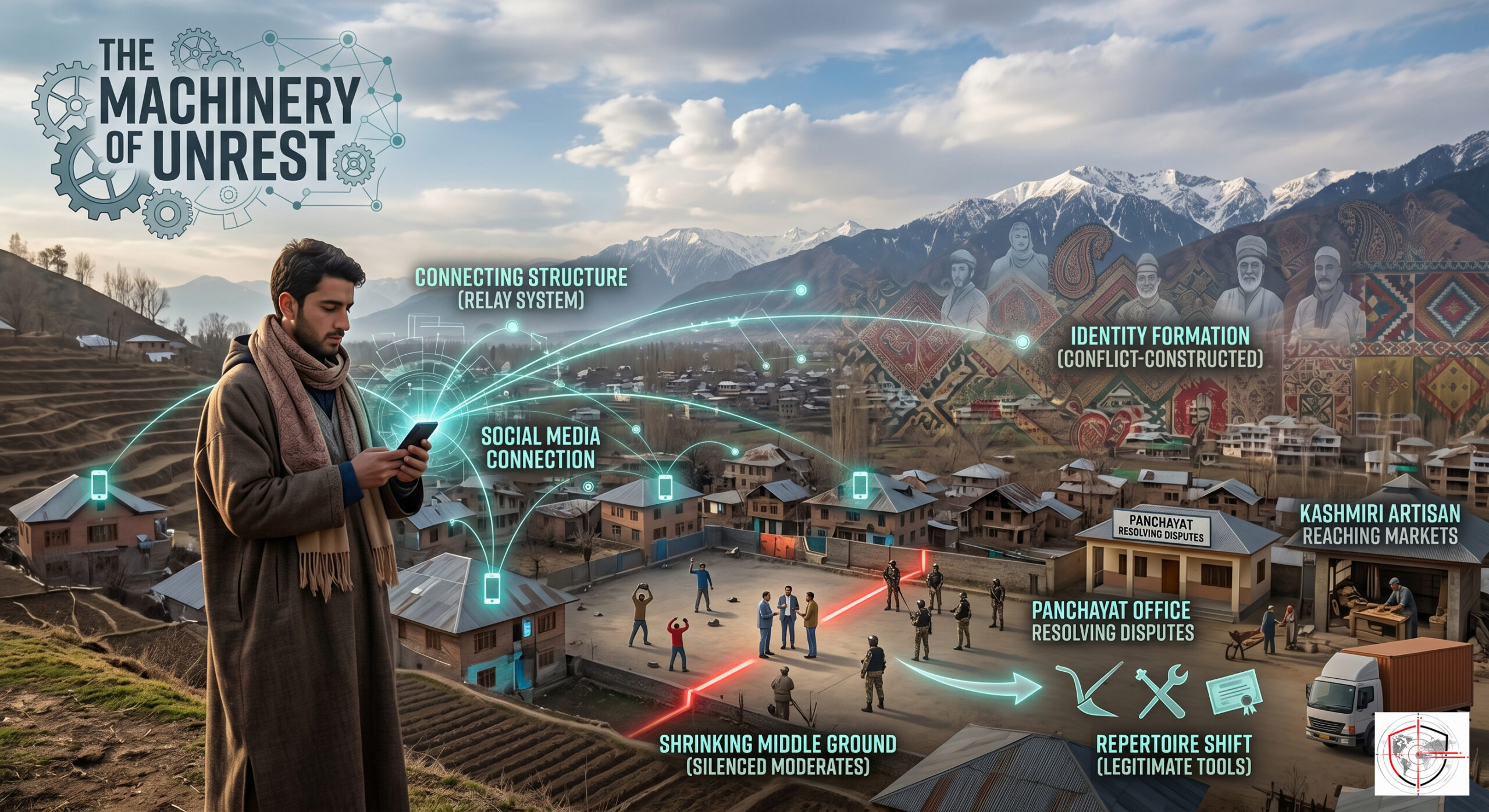
Kashmir’s conflict is not a mystery. It is a mechanism. And mechanisms, once understood, can be interrupted.
In the summer of 2010, a rumour moved through South Kashmir faster than any administration could contain it. A young man had been killed. The details were disputed. The facts, as facts often are in Kashmir’s charged political atmosphere, were secondary to the velocity of their circulation. Within hours, streets that had been quiet the previous morning were dense with stone-pelters. Within days, the unrest had spread across the valley in a pattern so consistent district by district, town by town that it could not be read as spontaneous. Over a hundred people died before the cycle exhausted itself.
Politicians called it orchestrated. Security analysts called it spontaneous. Both missed the more important question: not who started it, but how it spread, why it spread in that specific pattern, and what that pattern reveals about the political structure underneath the surface.
I have been watching Kashmir’s cycles of contention long enough to recognise that the argument about causes, azaadi versus Article 370 versus economic marginalisation versus foreign hand has consumed thirty years of analysis without producing much clarity. The causes are real. But causes do not act on their own. They require machinery. And it is the machinery, the specific mechanisms through which grievance becomes mass mobilisation, that determines whether a society moves toward resolution or deeper into its own wound.
Kashmir has four such mechanisms. They are not unique to this conflict. They appear, in different combinations, wherever populations and states contend over the terms of their relationship. Understanding them is not an academic exercise. It is the precondition for any governance strategy that aims at something more durable than enforced quiet.
Kashmir’s conflict is not a mystery. It is a mechanism. And mechanisms, once understood, can be interrupted.
How grievance becomes collective action
The first mechanism is the most important and the most consistently misunderstood.
Individual grievance is universal. Every society produces citizens who feel wronged by the state over land, over employment, over dignity, over the thousand daily frictions of administration that fall unevenly on the less powerful. What separates a grievance that remains private from one that becomes public and collective is not its intensity. It is the presence of a connecting structure: an actor, an organisation, a network, or increasingly a platform that links isolated individuals to each other and gives their shared feeling a name, a target, and a form of expression.
In Kashmir’s first insurgency, that connecting structure was an armed organisation with cross-border logistics and an ideological vocabulary. It took unconnected village frustrations, young men who had failed examinations, families who had lost land disputes, communities who felt the administration was administered against them and wired them into a coordinated political claim. The result looked like a mass uprising. It was, in its architecture, a relay system.
What changed between 2008 and 2016 was not the underlying frustration but the reality. Social media replaced the organisation as the primary connecting mechanism. The death of a militant commander in Tral in July 2016 produced funerals attended by tens of thousands within hours, not because the population had radicalised overnight, but because the speed of connection had changed structurally. The machinery accelerated. The output looked familiar. The mechanism was different.
The governance implication is specific. When the dominant connecting structure between citizen and political claim is a militant network or an algorithm designed for outrage, legitimate political participation cannot compete. The answer is not to suppress connection; every attempt at communication blackouts in Kashmir has produced costs that outweigh whatever temporary calm they secured. The answer is to build alternative connecting structures: panchayats that actually resolve disputes, grievance bodies that respond within weeks rather than years, and local courts that function without requiring a retired civil servant to navigate them. When these work, the militant broker and the viral post lose their functional monopoly on translating grievance into action.
How identity is made inside conflict
The second mechanism is more difficult to accept, because it challenges a comfortable assumption on all sides.
Political identities are not fixed. They are formed through conflict itself. The particular shape of “Kashmiri” political identity, valley-centric, framed around a specific reading of post-Partition history, defined in opposition to a specific adversary, is not primordial. It is a political construction built, layer by layer, through successive cycles of contention. Before the conflict hardened, Kashmiri identity was composite and plural: Dogra, Kashmiri-speaking, Ladakhi, Gujjar, Pahari, Pandit, Shi’a, and Sunni. The conflict narrowed that plurality into a single, contested political category.
This matters because it means identity is not destiny. If conflict builds a particular identity formation, then the reduction of conflict and the expansion of alternative forms of participation can build different ones. The Kashmiri entrepreneur who has built a national supply chain, the Kashmiri student placed in a Delhi institution, the Kashmiri artisan whose work reaches international markets through digital platforms: each of these is participating in an identity formation that runs alongside the conflict-constructed one. Neither cancels the other. But the question of which receives institutional support and which is left to accident is a governance choice, not a cultural given.
The current policy environment has accelerated some of this alternative formation and obstructed other parts of it. The tourism economy has created genuine economic stakes in stability for hundreds of thousands of Kashmiris. The panchayat system, where it functions, has created civic identities, ward members, district councillors, and development committee participants that give people a relationship to the state that is not defined by hostility. These are not cosmetic changes. They are identity-level interventions. They need to be named as such and expanded deliberately.
How the middle ground disappears
The third mechanism is polarisation, and it is the most dangerous because it operates invisibly until the damage is done.
Each escalatory exchange between state and challenger narrows the space in which it is possible to hold a moderate position. Not because moderate people become rare in Kashmir, as in every contested society, the vast majority of people want the unglamorous things: employment, education, safety, functioning administration. But because the structural conditions for acting on moderate preferences shrink. When expressing a position that is neither full endorsement of the state’s framing nor full alignment with the challenger’s framing carries a social cost when the moderate is accused of collaboration from one side and of disloyalty from another, the rational choice is silence. And silenced moderates cannot build the civic coalitions that contested societies require.
The Pandit exodus of 1990 was both a product and an accelerant of this dynamic. It removed from the valley the population most associated, in the conflict’s dominant framing, with the Indian state, and it deepened categorical separation between communities that had shared geography, economy, and in many cases personal friendship for generations. Subsequent cycles of militancy and counter-insurgency each produced further polarisations. The political centre of gravity shifted. The middle ground shrank.
Rebuilding it requires not political speeches about unity but the patient, unglamorous work of creating shared institutional spaces, inter-district economic programmes, educational exchanges within J&K itself, professional associations that cross community lines, cultural platforms that document plurality rather than perform it. These produce the social ties that make moderation structurally viable rather than personally costly.
How people choose their tools
The fourth mechanism is the most immediately actionable.
People in political conflict do not choose their methods at random. They choose from what is available, what has worked before, and what the current environment makes possible. Stone-pelting dominated Kashmir’s street politics between 2008 and 2019 not because Kashmiri youth had a cultural preference for it, but because it was low-cost, high-visibility, difficult to attribute to any individual, and crucially because no comparable legitimate tool existed that could produce equivalent visibility for political grievance.
When the security environment changed after 2019, and the stone-pelting repertoire became structurally riskier, something interesting happened. Young Kashmiris did not simply become apolitical. Many shifted toward economic participation, toward professional ambition, toward the kind of individual mobility that a more open economy offered. This is not depoliticisation. It is a repertoire shift, the same underlying desire for agency and recognition, finding a different form of expression.
The policy task is to make the legitimate repertoire elections that produce visible outcomes, civic participation that delivers results, professional and economic mobility that is not contingent on political compliance, genuinely competitive with the transgressive alternative. Not more attractive by compulsion, but more attractive by function. When casting a vote produces a repaired road, when filing a complaint produces a resolved dispute, and when building a business produces a market, the transgressive alternative loses its practical argument.
The diagnosis
Kashmir’s political situation is not mysterious. It is mechanical in the precise sense that it operates through identifiable, recurring mechanisms that governance can either ignore or engage. Thirty years of analysis focused on causes have produced no resolution because causes alone do not explain trajectories. What explains how a conflict sustains itself, accelerates, or transforms is not the original grievance but the mechanisms through which that grievance circulates, the identities it hardens, the polarisations it produces, and the repertoires it makes available.
The administration that understands this will build connecting structures before grievance finds its own. It will invest in identity formations that include rather than exclude. It will protect and expand the middle ground before it disappears again. And it will make the legitimate tools of political participation functional enough that choosing them is rational rather than naive.
The machinery of unrest is not invisible. It is, for anyone willing to read the political landscape carefully, entirely legible. What Kashmir has needed for a very long time is not more force applied to its symptoms, but more intelligence applied to its structure. That intelligence is available. The question is whether anyone in a position to act on it will.
Go To Homepagehttp://theredlines.world
The Machinery of Unrest – 2026
The Machinery of Unrest – 2026
#Kashmir conflict analysis 2026 #Kashmir political unrest mechanisms #Kashmir governance and militancy #South Kashmir mass mobilization #Kashmir identity politics
#Kashmir polarization and civil society #Kashmir post-2019 political landscape #Kashmir grievance and state response #Kashmir conflict resolution strategy #Kashmir security and administration
About The Author