


When the Ear Goes Deaf: Intelligence, Trust, and the Slow Unraveling of Kashmir’s Security Architecture
Inside the Erosion of India’s Human Security Grid
SERIES OF AN ONGOING INVESTIGATION Part I
When the Ear Goes Deaf: Intelligence, Trust, and the Slow Unravelling of Kashmir’s Security Architecture – 2026
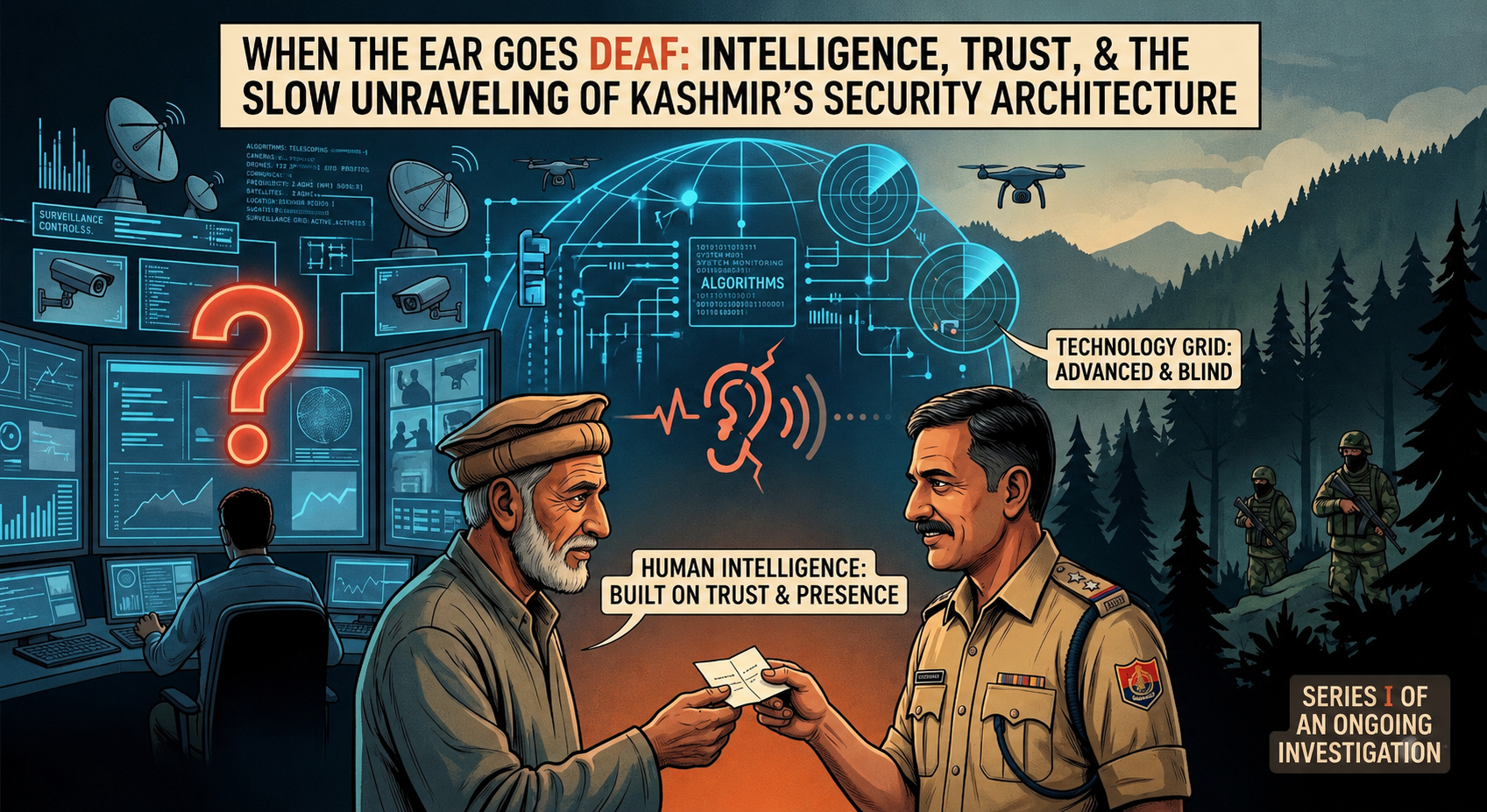
Jammu and Kashmir’s security grid has never been more technologically advanced or more humanly blind. The erosion of intelligence built on trust, presence, and local knowledge is not a failure of men. It is a failure of institutional choice. And the adversary is counting on it.
In early December 2024, a farmer from the outskirts of Srinagar handed a folded note to a police officer he had known for eleven years. The note contained four lines. By morning, the Lashkar-e-Taiba commander responsible for the Gagangir attack in Ganderbal, one of the most audacious strikes on civilian workers in recent memory, was dead, killed in an encounter in the dense forest belt of Dachigam and Harwan on Srinagar’s eastern fringe. A weapons cache that had kept his network operational for months was located and neutralized alongside him. No satellite intercepted that conversation between the farmer and the officer. No algorithm flagged the transaction. No drone hovered above the moment of decision. A man trusted another man, and that trust did the work of a hundred surveillance cameras. That single exchange is the most important lesson in Jammu and Kashmir’s counter-terror history, and it is a lesson the system is now in danger of forgetting. Because across the Pir Panjal, in the forested ridgelines between Rajouri and Poonch, a different kind of silence prevails. Small, disciplined foreign terrorist modules have spent months in the mountains without detection, not because India’s security forces are weak, but because the human network that once made them formidable has quietly gone deaf. This is the story of how that happened, why it matters, and what it will cost if it is not reversed.
To understand what has been lost, one must first understand what existed. The Jammu and Kashmir Police’s intelligence infrastructure, built painfully through the bloodiest years of the insurgency in the 1990s, was never a product of headquarters thinking. It was built in tea shops, at village chowks, in the quiet offices of district police stations where officers spent years learning the texture of a community.
The system had two distinct but complementary arms. The Special Operations Group, formed in 1993 as the insurgency was at its peak, was a dedicated counter-terror strike unit. Its officers were trained for kinetic action, including raids, encounters, and cordon-and-search operations. They moved fast, hit hard, and withdrew. The District Police operated on a different rhythm entirely. Their job was civil interface: maintaining law and order, keeping channels open, being the face of the state that ordinary citizens could approach without fear.
This division was not a bureaucratic formality. It was strategic genius. The separation meant that a villager in Shopian or a trader in Handwara could approach a district police officer without being seen as an informant to a combat unit. The distinction protected source security. It maintained the emotional boundary between armed state power and community service. Intelligence flowed in the gap between those two identities.
David Kilcullen, the Australian counter-insurgency theorist whose work shaped both American doctrine in Iraq and British practice in Afghanistan, makes precisely this point in The Accidental Guerrilla: Fighting Small Wars in the Midst of a Big One. Kilcullen argues that the fatal error of modern counter-insurgency is the militarisation of every state function, the conversion of every officer in uniform into an instrument of combat in the eyes of the population. When that happens, the population withdraws. Not out of sympathy for the insurgent, but out of self-preservation. Information dries up at the source, and the security apparatus is left chasing shadows with expensive equipment that cannot replicate what a trusted conversation once delivered in thirty seconds.
Jammu and Kashmir’s system worked because it had not made that error, at least not entirely. The District Police retained its human face. The SOG retained its operational edge. Between them, they built a nervous system that kept the security grid informed and responsive. That system has been significantly degraded. The how and why of that degradation is where the analysis must now turn.
The Merger That Broke the Balance
The administrative decision to merge the Special Operations Group and District Police into a unified structure was presented as modernization. The language that accompanied it was the standard vocabulary of bureaucratic reform: efficiency, coordination, elimination of redundancy, integrated operations. On paper, the logic was coherent. In practice, it was catastrophic.
The merger erased the distinction that had kept the intelligence ecosystem functioning. To the ordinary citizen, the villager who once knew which police officer to approach, the informant who relied on the personal relationship with a specific handler, the new structure presented an undifferentiated face of combat. Every officer became, in the public imagination, a member of a strike force. The approachable local constable and the armed counter-terror specialist now wore the same identity.
The consequences cascaded. Informants who had taken years to cultivate began to withdraw. The risk calculus had changed: approaching any officer now felt like approaching a combat unit. Source protection, the bedrock of any intelligence system, depends on social camouflage, on the ability of an informant to interact with a law enforcement officer without that interaction appearing threatening or consequential to hostile observers. When every officer becomes a soldier visibly, that camouflage disappears.
Field officers who lived through the transition describe the change in precise terms. Leads that once arrived within hours of an event now come after the fact, if at all. Villagers who once called to report new arrivals in forest areas or unfamiliar vehicles on peripheral roads have gone silent. The intelligence cycle, which in the best years of the JKP began with early warning and ended with preemptive neutralization, now frequently begins only after an incident has occurred. The force has shifted, unintentionally, from prediction to reaction.
Consider what this means operationally. Counter-terror work is a race against time. The value of intelligence is measured in hours, sometimes minutes. A tip that arrives twelve hours before a planned attack is priceless. The same information arriving twelve hours after is a post-mortem. When source networks thin, the timing shifts consistently in the wrong direction. A senior officer, speaking without attribution in Srinagar, put the matter in terms that deserve wider hearing:
“
“We can intercept a voice, but we cannot read intent. A machine can tell you that someone made a call. Only a person can tell you what that call meant, and whether the caller was afraid, loyal, or lying.”
“
There is a seductive logic to technological substitution. Drones cover terrain without risking lives. Intercepts capture conversations that no informant could attend. Facial recognition systems identify known operatives at checkpoints. Surveillance cameras document movement across wide areas with a permanence and completeness that no human patrol can match. The investment case for technology in counter-terror is overwhelming in budget meetings. In the field, the picture looks different.
The United States military learned this lesson at catastrophic cost across two decades in Afghanistan. Seth Jones, in In the Graveyard of Empires: America’s War in Afghanistan, documents how American forces invested billions in signals intelligence, unmanned aerial vehicles, and electronic monitoring infrastructure, yet consistently failed to build the human networks that would have told them what the technology could not. The Taliban’s endurance was not a product of superior weaponry. It was a product of superior local knowledge, maintained through a human intelligence ecosystem that the American military never successfully replicated or disrupted.
Jones traces what happened at the operational level: intercepted communications gave coordinates but not context. Drone footage showed movement but not motivation. Actionable intelligence, the kind that allows a commander to prevent an attack rather than respond to one, came almost exclusively from human sources. And human sources required something that technology budgets cannot purchase: trust, cultivated slowly, over time, through presence.
The parallel to Jammu and Kashmir is precise. The JKP’s technological infrastructure is now more sophisticated than at any point in its history. Cameras cover arterial routes. Intercepts monitor communications. Biometric databases track movement. And yet, in districts where the human network has thinned, the quality of actionable intelligence has fallen. Technology tells officers where people are. Human sources tell them why and what they are planning to do next.
This is not an argument against technology. Surveillance infrastructure is a necessary component of any modern counter-terror system. The error is substitution: treating technology as a replacement for human intelligence rather than a supplement to it. A drone can locate a terrorist’s position. Only a person can tell you that a specific family in a specific village has been providing the terrorist with food for six weeks.
“
Five Reforms the System Requires
-
Restore Separated Roles : SOG returns to dedicated counter-terror strike. District Police reclaims civil interface. The population must see a difference.
-
Rebuild HUMINT Cells: Dedicated small teams, trained for community liaison, re-established at every district level.
-
Protect Informants: Secure, anonymous channels for local intelligence. Protection is the best incentive.
-
Decentralized Authority: District commanders empowered for rapid decisions. Approval chains shortened.
-
Balance Tech With Trust: Surveillance as supplement, not substitute. Machines verify. Humans understand.
“
Pakistan’s Calculus and the Gift of Predictability
Across the Line of Control, the changes in Jammu and Kashmir’s intelligence architecture have not gone unnoticed. Pakistan’s Inter-Services Intelligence and its affiliated terror management structures organizations, whose patience is measured in years, not news cycles, have adapted their strategy accordingly.
Bruce Riedel, the former CIA analyst and Brookings Institution senior fellow whose work Deadly Embrace: Pakistan, America, and the Future of the Global Jihad remains essential reading for anyone studying the subcontinent’s security landscape, makes a point that applies directly to the present moment. Pakistan’s use of proxy conflict in Kashmir, he argues, is not premised on military victory. It is premised on cost imposition and narrative disruption. The goal is not to defeat India. The goal is to make India’s claim of normalcy in Kashmir permanently contestable.
This strategy has evolved in recent years with considerable sophistication. The era of mass infiltration, hundreds of militants crossing the Line of Control each year, seeking to replicate the 1990s insurgency through sheer numbers, has given way to a model of small, disciplined modules. Foreign terrorists, typically numbering between two and eight, cross the LoC through high-altitude passes or under river cover, move into forested areas in the Jammu division, and then do something that requires remarkable discipline: they wait.
Their instructions are not to attack immediately. Their mission is survival. Every month that a module remains undetected in the forests of Rajouri or the ridgelines of Pir Panjal is a strategic victory for Rawalpindi. It proves that the surveillance grid has gaps. It demonstrates that the human intelligence network cannot reliably locate and neutralize small, patient groups. When an incident eventually does occur, a sudden strike on a security force vehicle or a targeted killing, the effect is amplified precisely because it follows weeks of apparent normalcy. The attack says: we were always here. You simply could not find us.
This is psychological warfare conducted through endurance. And it exploits, with precision, the exact vulnerability that the degradation of HUMINT has created. If the human network were functioning at its earlier capacity, long-term survival of a module would be far more difficult. Villagers who notice new faces, unusual livestock disturbances, unfamiliar food purchase patterns, or strangers moving through areas at irregular hours are the sensors that no camera can replace. When they stop talking, the modules have darkness to hide in.
The political consequences of this strategy are equally deliberate. India’s government has invested heavily in a narrative of restored normalcy in Jammu and Kashmir. Tourism figures are cited. Infrastructure projects are announced. Reduced incident counts are used as evidence of strategic success. This narrative is not without foundation. Violence has decreased compared to the insurgency years, and the region has seen genuine developmental activity.
But the narrative has also created a trap. When the official position is that peace has been achieved, every breach of that peace carries disproportionate political cost. A single successful terror strike, even a small one, contradicts months of official messaging. Pakistan’s handlers understand this. They do not need mass violence to achieve their objectives. They need symbolic disruption, delivered with enough frequency to keep the question alive: Is Kashmir really at peace?
The experience of policing in Northern Ireland during and after the Troubles offers instructive parallels and, crucially, instructive lessons in what works.
At its peak in the 1970s, the Royal Ulster Constabulary faced a security environment in many ways analogous to Kashmir’s: a motivated armed opposition with cross-border sanctuary, a divided civilian population with deep-seated reasons to distrust the state, and an adversary that had embedded itself in community life. The British government’s initial response was heavily militarised: army deployments, aggressive search operations, and detention without trial under the Special Powers Act. The effect was predictable. Already alienated communities became more so. Intelligence dried up. Violence escalated.
The shift came gradually, in fits and starts, through the recognition that sustainable security in a contested society cannot rest on military dominance alone. It requires police legitimacy, and police legitimacy requires that significant portions of the civilian population, including those who are not natural supporters of the state, find it possible to cooperate with law enforcement without social cost. The reforms of the late 1990s, including the creation of the Police Service of Northern Ireland to replace the RUC, were in large part designed to rebuild that legitimacy.
The intelligence consequence was profound. As new officers, including, for the first time, recruits from Catholic and nationalist communities, built a presence in areas that had previously been hostile, the flow of information changed. Not immediately, and not completely. But incrementally, the human network rebuilt itself. The result was not just better intelligence but a qualitatively different kind of intelligence: contextual, locally grounded, and capable of distinguishing between genuine threats and ambient social tension.
Kilcullen’s analysis of these dynamics identifies the fundamental principle: in a counter-insurgency, the population is the prize, not the terrain. Whoever secures the loyalty or, at a minimum, the practical cooperation of the civilian population wins access to the information that determines operational success. Lose that cooperation, and all the technology in the world cannot compensate.
The Political Trap
Inside Jammu and Kashmir’s administrative and security structures, there is a problem that officers acknowledge privately but rarely articulate publicly: the security system has been partially subordinated to the political narrative rather than vice versa.
When the ruling establishment declares peace, security failures acquire an institutional cost that goes beyond the operational. A successful attack does not simply represent a tactical failure. It threatens the political case that the entire post-2019 restructuring of the region is working. This means that the incentive structures within the system now point in a dangerous direction.
Intelligence reports that highlight genuine gaps in HUMINT coverage, that document the growing silence of civilian informant networks, and that record the monthly survival of undetected foreign modules are uncomfortable. They contradict the narrative. And so, as multiple officers have independently described, such reports are softened, rewritten, or buried as they move upward through the chain of command. The system has acquired the habit of telling the political leadership what it wants to hear rather than what it needs to hear.
This is not a new pathology. It appears in intelligence failures across history, from the CIA’s pre-September 11 bureaucratic paralysis to the British intelligence community’s groupthink on Iraq’s weapons programmes. In each case, political pressure distorted the information that reached decision-makers, and the distortion had operational consequences.
In Jammu and Kashmir, the consequence is a growing gap between the official picture and the ground reality. The official briefings document reduced incident counts and improved infrastructure. Field officers in South Kashmir and the Jammu division speak of civilian cooperation at its lowest level in years, of informant networks that have thinned dramatically, of young officers who have never built a single genuine community relationship because the incentive structures of their career do not reward that work.
An intelligence officer serving in South Kashmir described the institutional atmosphere with quiet precision: “We have the tools to fight. We do not have the freedom to think.”
That single sentence contains the diagnosis of the problem. Freedom to think, the space for honest assessment, for field officers to report what they actually see, for commanders to act on uncomfortable intelligence, is the precondition of an effective system. When that freedom is constrained by narrative requirements, the system’s intelligence function degrades even as its enforcement capacity remains intact. A force can be simultaneously more powerful and more blind. Jammu and Kashmir’s security grid is, at this moment, moving in that direction.
Behind the institutional analysis lies a human cost that deserves its own accounting. The officers who built Jammu and Kashmir’s counter-insurgency capacity during the worst years of the 1990s and early 2000s operated in conditions of extraordinary danger with limited technology and considerable autonomy. They succeeded because they were trusted by their command to exercise judgment, and by local communities to be something other than instruments of coercion.
That double trust created professional identity and operational pride. The JKP’s reputation as the sharpest counter-terror force in India was not a boast. It was an accurate assessment, earned through decades of difficult work in the field. Officers who served through those years carry that identity, and many of them are now watching it erode.
The culture of over-control has produced specific, measurable effects on the force. Experienced officers retire early or seek administrative transfer rather than continue operating under conditions where every decision requires multiple approvals, where field reports are edited above their heads, and where a tactical failure in a career of operational success can become a media controversy that ends a career. The institutional knowledge they carry, the local relationships, the dialect competencies, the deep familiarity with specific terrain walks out the door with them.
The younger generation filling those positions has been trained in a different culture. Technology proficiency is valued. Community relationship-building is not. Many younger officers have never spent an afternoon in a village shop, have never built the slow personal connection that eventually produces an informant. They are skilled operators of systems they do not fully understand because they lack the human context that gives data meaning.
This generational shift is not irreversible. But it requires deliberate intervention, a conscious institutional decision that HUMINT competency will be trained, rewarded, and protected as a career-defining skill. That decision has not yet been made.
INTERNATIONAL CASE STUDY
Afghanistan: When Technology Replaced Trust
American forces in Afghanistan invested billions in signals intelligence, unmanned aerial vehicles, and electronic monitoring while consistently failing to build human networks. Intercepted communications gave coordinates but not context. Drone footage showed movement but not motivation. Actionable intelligence came almost exclusively from human sources. And human sources required something that technology budgets cannot purchase trust, cultivated slowly, over time, through presence. The Taliban’s endurance was not a product of superior weaponry. It was a product of superior local knowledge maintained through a HUMINT ecosystem that the American military never successfully replicated.
The Reforms That Are Needed
The path back is not a secret. Officers at every level of the JKP and associated agencies identify the same set of interventions. What has been missing is the institutional will to implement them, because implementation requires acknowledging that something has gone wrong and acknowledgment conflicts with the success narrative.
The first and most fundamental reform is the restoration of separated roles. The Special Operations Group must return to being what it was designed to be: a dedicated, specialized counter-terror strike unit. District Police must recover their civil interface function. The population must be able to distinguish, visually and experientially, between an officer who is there to arrest a terrorist and one who is there to listen to a complaint about a boundary dispute or a missing daughter. That distinction is not symbolic. It is the operational foundation of human intelligence.
The second reform concerns HUMINT infrastructure. Dedicated human intelligence cells, small, discreet, staffed by officers trained in community liaison rather than kinetic operations, must be re-established at the district level. These cells require different personnel profiles, different training, different performance metrics, and different career pathways from those currently dominant in the system. An officer whose career is measured by encounters handled cannot be expected to develop the patience and interpersonal skills that source cultivation demands. The two functions must be separated and resourced accordingly.
The third reform is informant protection. The degradation of the source network is not entirely attributable to the merger of units or to community distrust. Part of it reflects a genuine security failure: informants have been exposed, in some cases through intelligence leaks, in others through operational carelessness. Each exposure sends a signal to every other potential source. The message is simple: cooperation with the police is dangerous. Restoring source confidence requires demonstrable, institutionalized protection mechanisms, anonymous reporting channels, secure handler relationships, and a visible commitment to protecting those who take personal risk to support the security system.
The fourth reform is decentralization of authority. The most damaging consequence of the current system’s overcentralisation is temporal: by the time an intercept is verified, cleared through multiple command layers, and authorized for action, the operational window has closed. Counter-terror work is, at its fastest, a matter of hours. A system that requires days to translate intelligence into action will consistently miss. District commanders must be empowered to make rapid decisions within clear operational parameters. The approval chains that currently extend from field to regional to central command must be shortened, and the trust in middle leadership that makes shortened chains possible must be consciously rebuilt.
The fifth reform is attitudinal. No structural change will produce lasting results if the culture of selective reporting remains intact. Intelligence systems depend on the free flow of honest assessment. Commanders who suppress uncomfortable field reports are not protecting the political establishment. They are guaranteeing the next operational failure. Creating a professional culture in which honest assessment is rewarded rather than punished requires leadership from the top to make explicit statements that accurate intelligence, even when it contradicts official narratives, is what the system values above all other things.
The Larger Lesson
What is happening in Jammu and Kashmir is not unique to Jammu and Kashmir. It is a case study in a pathology that recurs wherever security systems subordinate professional function to political purpose. The United States spent twenty years in Afghanistan with an intelligence apparatus that cost more than the entire GDP of many countries. It produced spectacular signals intelligence, unprecedented drone strike accuracy, and comprehensive biometric databases. And it consistently failed to predict major Taliban offensives, consistently failed to identify when local partners had switched loyalties, and ultimately failed to prevent the rapid collapse of everything it had built. The reason, as Jones documents in exhaustive detail, is that the human network, the web of local relationships that gives technical intelligence its meaning and context, was never built with the same seriousness of purpose that was applied to the technology.
The British in Northern Ireland, after two decades of military-first policing, eventually understood what the first generation of community police officers had known intuitively: that the most effective anti-insurgency tool is a community that trusts the police enough to talk to them. The IRA was not defeated by better surveillance. It was defeated, in part, by the gradual withdrawal of the community protection it had depended on a withdrawal that happened as police legitimacy was slowly, painfully rebuilt.
India’s national security establishment has access to these lessons. The question is whether institutional pride and political momentum will allow their application to the specific, urgent situation in Jammu and Kashmir before the cost of inaction compounds further.
What Peace Actually Requires
The government’s claim of restored normalcy in Jammu and Kashmir is not entirely a fiction. Violence is lower than in the insurgency years. Infrastructure investment has increased. Many residents of the region have told journalists, researchers, and visiting officials that they value the relative calm, even if they have reservations about how it was achieved and how it is maintained.
But calm and peace are not the same thing. Calm is the absence of visible conflict. Peace is the presence of confidence in institutions, in the future, in the value of cooperation. When civilians withhold information not because they support insurgents but because they fear the consequences of being seen to cooperate with the state, the calm is borrowed. It is financed at high interest, and the repayment terms are set by the adversary.
Pakistan’s strategists, as Riedel’s analysis makes clear, have always understood that time is their primary resource in Kashmir. Political leadership in India has changed. Security strategies change. What endures is the demographic reality of a region where the legitimacy of governance remains contested, where the dividend of democratic participation has not yet been fully delivered, and where the human networks that could anchor long-term stability remain fragile.
The response to that challenge is not more cameras and fewer conversations. It is not tighter cordons and thinner informant networks. It is the patient, unglamorous work of restoring the human contact that made the JKP formidable, restoring it not as a counterinsurgency tactic but as a genuine expression of what it means to police a democracy.
That means returning to presence. Officers are spending time in communities, not just patrolling them. It means returning to listening, not the digital interception of communications, but the slower, more difficult practice of actually hearing what people say when they feel safe enough to say it. It means accepting that intelligence is not a product of technology. It is a product of trust.
Somewhere in the villages of Rajouri, in the market lanes of Shopian, in the mountain communities of Gurez and Keran, the whisper that once defined Jammu and Kashmir’s security success is still there. It has not disappeared. It has simply gone quiet, for reasons that are institutional rather than permanent, because the officer who used to listen has been replaced by one who cannot afford to, because the channel that once carried the whisper has been disrupted by administrative choices that can be reversed.
The farmer in South Armagh handed over a note that dismantled a weapons cache. He did so because he knew the officer, trusted the officer, and believed that the officer would protect him. That transaction, one of the most consequential intelligence acts in the history of the Northern Ireland conflict, was not the product of surveillance technology. It was the product of eleven years of presence and one Tuesday afternoon of trust.
Jammu and Kashmir’s security architecture was built on thousands of such transactions. It was the most effective HUMINT system India has ever fielded. It can be rebuilt. The intelligence it produced early, specific, actionable, and drawn from the deepest layers of community knowledge is irreplaceable by any surveillance tool that currently exists or is likely to exist.
The security grid in Jammu and Kashmir remains powerful. Its equipment is superior. Its manpower is substantial. Its institutional memory, though thinning, has not been entirely lost. But power without perception is a force that swings blind. The next phase of stability in this region will not be decided by the number of cameras on arterial roads or the range of drone surveillance over the Pir Panjal. It will be decided by whether a police officer in a district posting can rebuild the relationship with a village elder that allows a whispered warning to travel to the right ear at the right moment.
That single relationship is worth more than any technology budget can buy. Its restoration is the most strategic investment India can make in Jammu and Kashmir. And its absence is the most honest measure of how far the system has drifted from what made it great… END-OF-COLUMN
SERIES NOTE
Next in Series——————————————->>>>>>>>>
(This is the first in a continuing series examining the decline of human intelligence infrastructure in Jammu and Kashmir, the strategic consequences for India’s national security, and the reforms that the situation demands. Part II will examine how Pakistan’s handlers have restructured infiltration doctrine in response to India’s shift toward technology-dependent surveillance and why the new model is more dangerous than the mass-infiltration era it replaced.)
Copyright © 2026 Yassir Ahmed Mir. All rights reserved. No part of this article may be reproduced or distributed without written permission from the author. For permissions or syndication, contact: yassirahmed001@gmail.com
Author Bio: Yassir Ahmed writes on national security, foreign policy, intelligence networks, and geopolitical strategy across South Asia and West Asia.
Disclaimer: This article draws on verified public sources and research available at the time of writing. The views expressed are solely those of the author and do not represent any government or institution.
Author Note: Yassir Ahmed is an Indian journalist covering national security, defence, and Asian–Middle Eastern affairs.
Contact: yassirahmed001@gmail.com
Go To Home Page
http://theredlines.world
The Merger That Broke the Balance
Five Reforms the System Requires
Pakistan’s Calculus and the Gift of Predictability
The Political Trap
INTERNATIONAL CASE STUDY
What Peace Actually Requires
The Larger Lesson
The Reforms That Are Needed
About The Author