
The Ankara Playbook
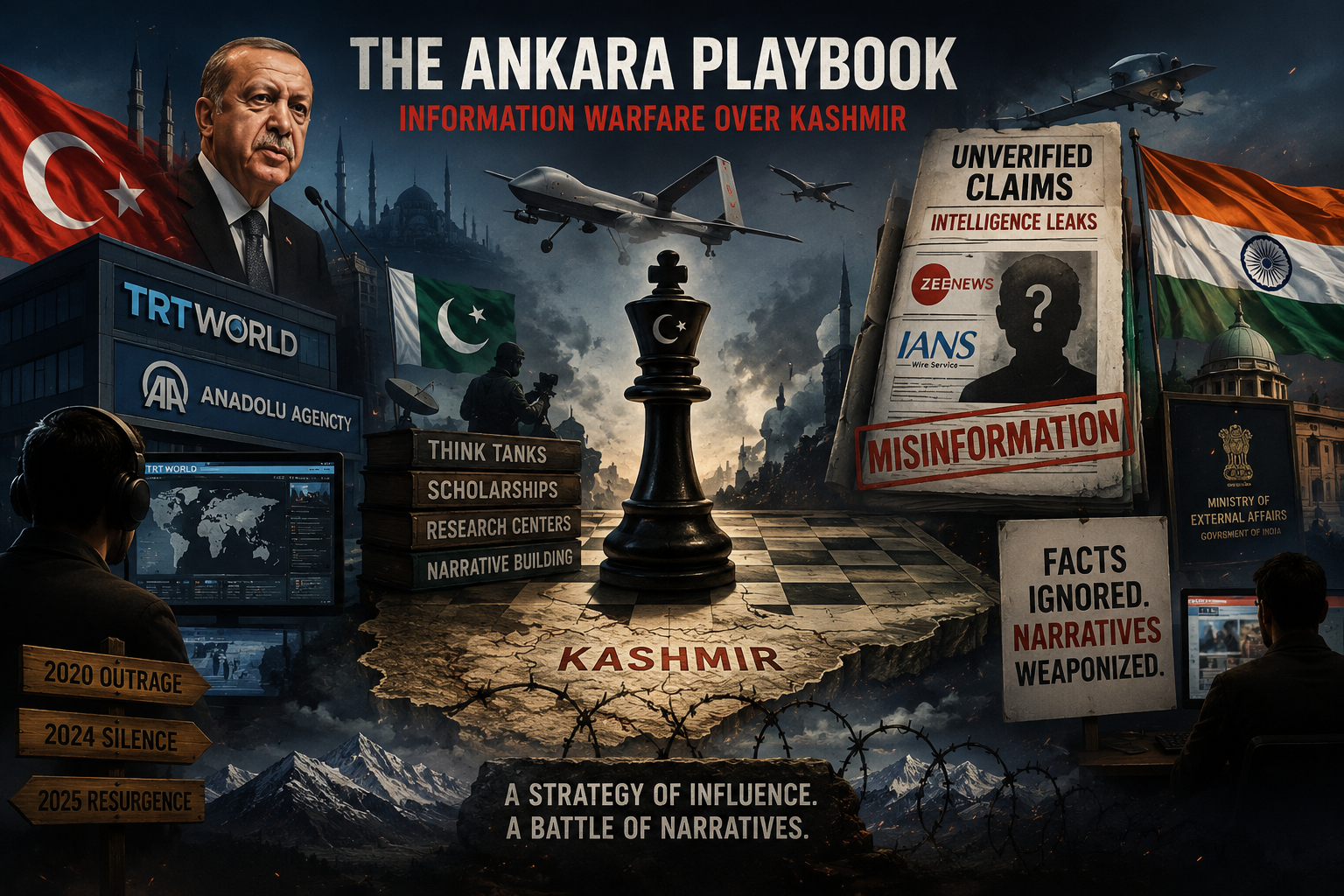
The Ankara Playbook – 2026
Turkey has built a real media and scholarship architecture aimed, in part, at Kashmir. Some of what is alleged about it is documented fact. Some of it is a single anonymous report wearing the costume of intelligence. The distinction matters and India’s own conduct has handed Ankara more ammunition than any “secret army” ever could.
By Yassir Ahmed
Srinagar, June 2026
In February 2021, a Greek website nobody in Kashmir had heard of before published a claim that a Kashmiri journalist working for Turkey’s state broadcaster had links to Pakistan’s Inter-Services Intelligence. Within forty-eight hours, the Indian news agency IANS had the story. Within seventy-two, Zee News had it on air. Within a week, the fact-checking desks at Newslaundry and Alt News had established, through the kind of pedestrian diligence that ought to have happened before publication rather than after, that the story had conflated two entirely different people Baba Umar, the working journalist at TRT World, and Umar Baba, an unrelated researcher based in South Korea who had once given an interview to an American activist. Zee News quietly swapped the name in its own copy. No correction was issued. No apology followed. For a week, a named, identifiable Kashmiri journalist had been told, in one of the country’s largest English news cycles, that he was an asset of a hostile foreign intelligence service. Baba Umar would later call it what it was: a piece that endangered his life and his family’s.
This is where any honest account of Turkey’s information war over Kashmir has to begin not with the drones that flew over the Kashmir valley in May 2025, not with President Recep Tayyip Erdoğan’s microphone at the United Nations General Assembly, but with the specific, documented moment when India’s own information ecosystem proved itself capable of manufacturing precisely the kind of fabricated intelligence dossier that Ankara is separately, and far more seriously, accused of running. Both things are true. Neither excuses the other. And conflating them treating every unverified claim about Turkish recruitment as confirmed the moment it appears in a national daily is how a real strategic problem gets buried under manufactured ones.
The Rivalry That Dated
The architecture is real enough on its own terms. In April 2020, Saudi Arabia blocked the Arabic-language websites of Anadolu Agency and TRT, days after an Istanbul prosecutor indicted twenty Saudi nationals over the murder of Jamal Khashoggi. Turkey retaliated within the week, blocking the Saudi Press Agency, the UAE’s WAM, and more than a dozen other Gulf outlets. This was the media expression of a deeper fracture the 2017 Saudi-led blockade of Qatar, whose thirteen demands had explicitly required Doha to shut down Al Jazeera and its affiliated platforms. Turkey backed Qatar through that crisis. The blockade collapsed in January 2021 without a single demand met, at a cost to Saudi Arabia and the UAE that analysts estimated near every benefit they had hoped to extract.
What most Indian commentary on this subject has not caught up to is that the rivalry it describes is already out of date. Erdoğan reset relations with the UAE from 2021, with Saudi Arabia from 2022, and by 2024 Ankara and the Gulf Cooperation Council were in free-trade talks. The old binary Turkey-Qatar against Saudi-UAE, with state media as the artillery has been substantially dismantled by economic interdependence. Anyone building a Kashmir argument on a frozen 2020 map of the region is arguing from a map that no longer exists.
The Fluctuating Microphone
Erdoğan’s commitment to the Kashmir cause is genuine and well documented, but it has never been static, and its movements track Ankara’s interests with a precision that ought to embarrass anyone who treats it as a matter of principle. In February 2020, addressing Pakistan’s parliament for a record fourth time, he compared Kashmir to Gallipoli “it was Çanakkale yesterday, Kashmir today” and pledged Turkish solidarity. New Delhi summoned the Turkish ambassador within seventy-two hours and called the remarks “completely unacceptable.” Erdoğan raised Kashmir at the UN General Assembly every year from 2019 through 2023. In 2024, he dropped it entirely a silence that coincided precisely with Turkey’s bid for BRICS membership, an organisation India helped found. In September 2025, weeks after Operation Sindoor, Kashmir was back in his UNGA remarks. The pattern is not the conduct of a man defending a principle against all costs. It is the conduct of a state using a grievance as a renewable diplomatic instrument, deployed and withdrawn according to what else is on the table.
“The pattern is not the conduct of a man defending
a principle against all costs. It is the conduct of a
state using a grievance as a renewable diplomatic instrument.”
What was on the table in May 2025 was Pakistan’s air defence. Following the Pahalgam attack of April 22 and India’s retaliatory Operation Sindoor, Indian military briefings described drone incursions at numerous locations along the western front, with Colonel Sofiya Qureshi stating that initial investigation pointed to Turkish-manufactured systems. Other reporting named Bayraktar-series platforms and alleged the presence of Turkish technical advisers; claims that two Turkish operators were killed circulated in Indian outlets without independent confirmation, and the precise drone models involved remain, as of this writing, a matter on which reports disagree a caveat that matters more than the headlines that ignored it. What is not in dispute is the Indian government’s response: the security clearance of Celebi Airport Services, a Turkish ground-handling firm operating at major Indian airports, was revoked on May 15, 2025, a decision the Delhi High Court subsequently upheld on the government’s argument that the company held access to sensitive zones. A consumer boycott followed with real economic teeth Turkish tourist arrivals from India fell roughly twenty-four percent in May and thirty-seven percent in June, e-commerce platforms delisted Turkish brands, and IndiGo wound down its leasing and maintenance arrangements with Turkish firms. This is the part of the story that has actually worked: targeted, legally defensible, judicially upheld measures against specific commercial relationships, rather than a blanket assault on Turkish media that would have invited exactly the press-freedom criticism Ankara would have been delighted to receive.
The Report That Became a Fact
The most sensational claim in circulation that Turkish intelligence and Pakistan’s ISI jointly run a coordinated scheme to staff TRT World and Anadolu Agency with recruited Kashmiri “mercenary journalists” traces to exactly one document. It is titled “Turkey-Pakistan: Secret Army of Mercenary Journalists,” attributed to an entity calling itself Mediterranean-Asian Investigative Journalists, and it surfaces online primarily through its posting on the website of a small Athens-based think tank, which explicitly disclaims that the piece reflects its own institutional view. The report cites no named sources. It claims specific staffing figures fifty Pakistanis and more than a dozen Kashmiris among roughly three hundred employees that no independent investigation has corroborated. It names individual working journalists as intelligence assets on the strength of anonymous attribution alone. And it has nonetheless been cited in Indian national dailies as though it were a settled finding rather than a single, unverifiable document of contested provenance.
This is worth dwelling on, because the method is the same method that destroyed Baba Umar’s name in 2021: an anonymous claim, amplified by outlets with an interest in the story being true, naming a real person without evidence a court or a serious newsroom would accept. The genuinely credible reporting on Turkish state media’s intelligence entanglements comes from a different source entirely Nordic Monitor, run from Stockholm by exiled Turkish journalists, which builds its findings on named former intelligence officials and leaked internal documents, and which Ankara has tried hard enough to silence that it sought one editor’s extradition from Sweden, a request Sweden’s Supreme Court rejected in October 2025. Nordic Monitor’s documented work concerns Kurdish dissidents, exiled Turkish journalists, and European targets. It has not produced a comparable named-source investigation into South Asian recruitment. That silence is itself a data point, and Indian commentary that skips past it in favour of the anonymous Athens report is choosing the weaker source because it is the more convenient one.
A second, more security-grounded narrative concerns a Kashmiri named Mukhtar Baba, now based in Turkey, whom Indian intelligence assessments have linked to the Lashkar-backed Resistance Front and accused of running an online intimidation network against journalists in the valley. The threats this narrative describes are independently confirmed a blog linked to a TRF commander issued names and warnings against more than forty Kashmiri journalists in November 2022, prompting resignations and police visits to journalists’ homes. The specific claim that Baba personally directs this network from Ankara rests on anonymous intelligence sourcing that has not been independently verified. Both things the threats are real, the individual attribution is unproven can and should be held at once.
The Scholarship and the Hypocrisy
Türkiye Bursları, Ankara’s flagship international scholarship programme, is real, generously funded, and openly advertised in Kashmiri outlets such as Kashmir Life every application season. It offers full tuition, a monthly stipend, and a compulsory year of Turkish language instruction to thousands of students from more than a hundred and sixty countries annually. It is soft power in the textbook sense alumni networks, linguistic affinity, goodwill and no published, evidence-based study has shown a deliberate pipeline running from Kashmiri scholarship recipients into Turkish state media employment. That pipeline is plausible in the abstract. It is not established in the record, and an investigative piece that asserts it as fact would be committing the same sin as the Athens report.
What is established, and what India’s own commentary has strangely failed to weaponise, is Ankara’s underlying hypocrisy. TRT World has run sympathetic coverage of Kashmiri journalists’ working conditions low pay, harassment, the exodus from the profession framed in the language of press freedom under occupation. Turkey, simultaneously, ranks among the world’s most prolific jailers of its own journalists, has shuttered hundreds of domestic outlets since 2016, and surveils its exiled press abroad through the same intelligence apparatus Nordic Monitor has documented in granular, named detail. A state that imprisons more reporters than almost any government on earth does not get to lecture India on press freedom in Kashmir with a straight face, and no Indian official or columnist appears to have said so plainly enough, in the right forum, for it to land.
What History Actually Teaches
The temptation, faced with a foreign broadcaster’s hostile coverage, is to ban it. History counsels otherwise, repeatedly and specifically. Thomas Rid’s Active Measures: The Secret History of Disinformation and Political Warfare documents the Soviet “Operation Denver” campaign of the 1980s, which seeded the lie that the United States had manufactured HIV through, with a symmetry too good for fiction, an Indian newspaper, The Patriot, in 1983. Washington did not counter it by censoring Soviet broadcasters. It assembled an interagency Active Measures Working Group whose sole function was rapid, transparent, named rebuttal what insiders called the “truth squad” model. The lie eventually collapsed under the weight of its own internal contradictions, and the long-term reputational cost fell on Moscow, not on the countries that had simply told the truth, repeatedly and in public, until the lie could no longer survive contact with it.
The European Union’s 2022 ban on RT and Sputnik offers the opposite lesson. The measure was understandable, the threat it responded to was real, and it was nonetheless criticised by the European Federation of Journalists’ own leadership as a poor tool against propaganda and proved porous enough that both outlets remained reachable across the EU via ordinary workarounds within two years. Marc Lynch’s Voices of the New Arab Public, written in the shadow of Al Jazeera’s rise, makes the related point in a different register: banning or blockading a broadcaster as a political demand, as the Gulf states attempted against Qatar, tends to strengthen the target’s independence and credibility rather than diminish it. The single most useful precedent available to India is neither censorship nor confrontation. It is the American one: in March 2020, the US Justice Department required TRT World’s Washington bureau to register under the Foreign Agents Registration Act disclosure, not deletion. The outlet kept broadcasting. Its funding source became a matter of public record. That is the template.
“The single most useful precedent
available to India is neither censorship
nor confrontation. It is disclosure, not deletion.”
What Should Happen Now
The honest accounting is this. India should require transparent foreign-funding disclosure from state-linked media operating in or targeting Indian audiences, on the American model, rather than reaching for bans that invite exactly the press-freedom criticism Ankara’s own broadcasters would happily amplify. It should fund serious, named, fast fact-checking capacity the truth-squad model that actually defeated Operation Denver rather than allowing agencies like IANS to publish unverified intelligence claims that collapse within a week and cost a working journalist his safety. It should continue calibrated, judicially defensible measures of the Celebi variety rather than sweeping ones, because the Delhi High Court’s willingness to uphold a security-grounded revocation is worth more strategically than ten television debates. And it should recognise that the most effective rebuttal to Ankara’s Kashmir narrative is not a counter-narrative at all, but a demonstrably free Kashmiri press because every UAPA detention, every passport seizure, every raid on a journalist’s home hands TRT World a segment it does not have to fabricate.
Turkey has spent a decade building a microphone a broadcaster, a scholarship programme, a diplomatic position deployed and withdrawn as convenience requires. Whether that microphone amounts to the coordinated intelligence operation a single anonymous Athens report describes remains, on the actual evidence, unproven. What is proven, named, and dated is that an Indian news agency and a national television channel needed one week in February 2021 to turn an unverified foreign claim into a smear against a working journalist’s life, and to this day have issued no correction for it. In an information war, the side that cannot keep its own facts straight has already lost the argument that matters most the one about who, in this fight, actually tells the truth.
Yassir Ahmed is Senior Editor and Columnist at theredlines.world & USA TODAY. This investigation draws on open-source reporting, contested security narratives clearly identified as such, and the documentary record of Turkey–India relations through June 2026.
Go to Homepagehttp://theredlines.world
The Ankara Playbook – 2026
The Ankara Playbook – 2026
The Ankara Playbook – 2026
The Ankara Playbook – 2026
About The Author