
The Question Israel Is Asking, and the One It Is Not
The Question Israel Is Asking, and the One It Is Not – 2026
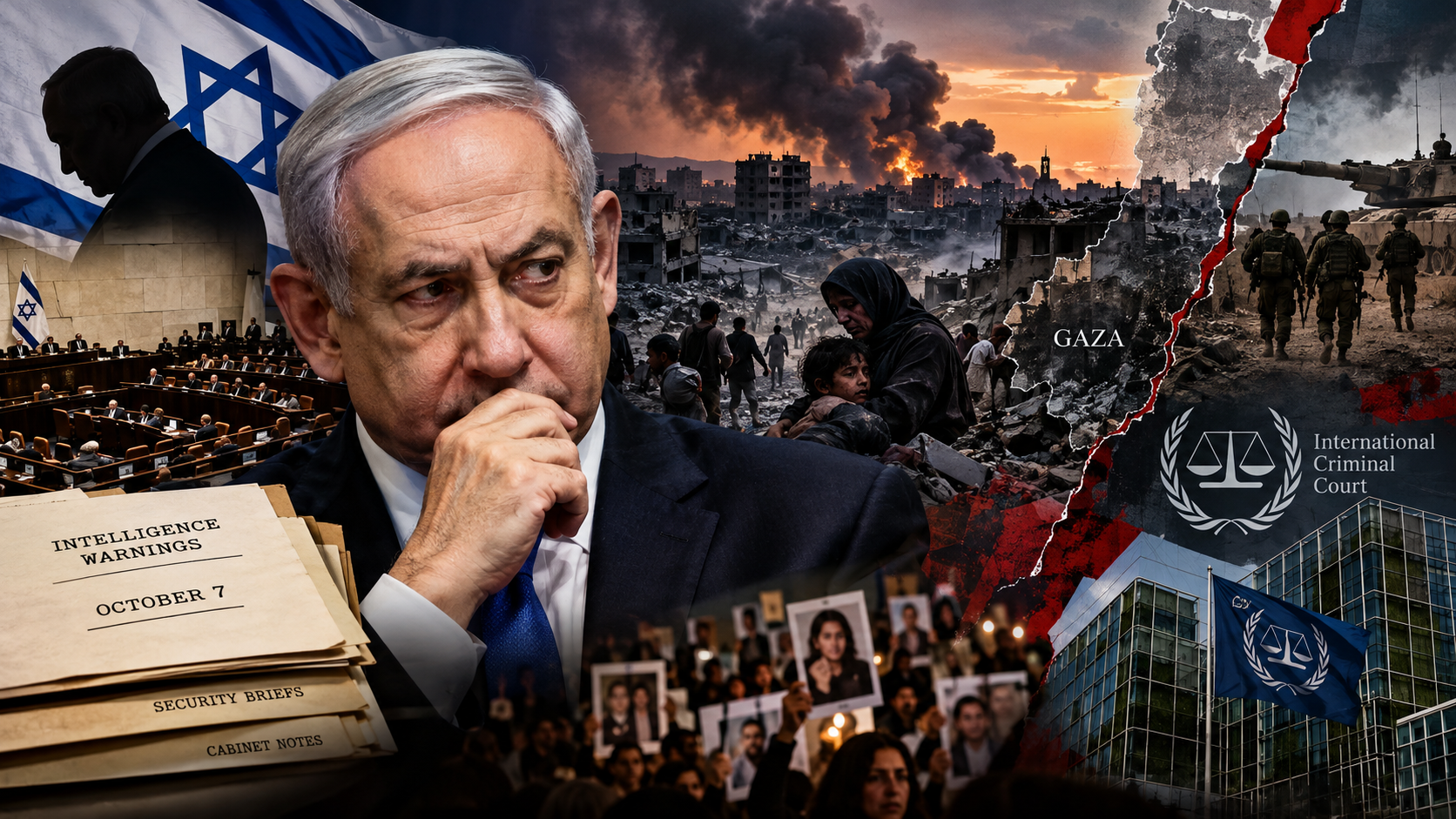
Three years after October 7, Israel’s election is asking whether Netanyahu was warned. It is not asking what the war has since cost, and what that silence says about how democracies hold themselves to account.
By Meer Yassir Ahmed
In the spring of 1974, Golda Meir resigned as Israel’s Prime Minister. The Agranat Commission, set up after the Yom Kippur War, had just reported. It held military intelligence chiefs responsible for the surprise of October 1973 and stopped short of blaming the political leadership. Meir was not formally indicted. She went all the same, because a public that had lost confidence would not accept a technical exoneration. Israelis have lived with that precedent for half a century: a national trauma, an inquiry, a verdict of sorts, and a prime minister who falls even when the report spares her.
Three years after October 7, 2023, Israel is again in the grip of the question that defined 1973. With elections weeks away, the matter dominating the campaign is whether Benjamin Netanyahu was warned.
- What is alleged
The allegation is specific. Haaretz reported that the UAE’s president, Sheikh Mohamed bin Zayed, telephoned Netanyahu about ten days before the attack and warned in a lengthy call that Yahya Sinwar was planning a major operation. The report alleged that Netanyahu failed to inform his security chiefs. The New York Times later published its own investigation, citing multiple officials, that matched the Haaretz account. The former Shin Bet chief and the former army chief have said they were not informed of any such warning.
Netanyahu denies it entirely. He has called the report a malicious libel timed for the election. His office says he never spoke to the Emirati leader in the period in question. Naftali Bennett, a former prime minister now running against him, says the report is true and that ignoring such warnings amounts to criminal negligence. Netanyahu’s opponents say they would set up a state commission of inquiry immediately if they win.
Two things should be said at once. The central allegation is contested, and it rests on anonymous sourcing, however well corroborated. And the political context is plain: an incumbent seeking re-election and rivals who stand to gain from the charge. Neither fact settles the matter, but both belong in any sober account.
- The critique from outside the debate
The article under discussion argues that “Did he know?” is the wrong question, or at least a profoundly incomplete one. Its case is that the campaign scapegoats one man for a failure of vigilance while absolving a wider society and political establishment of responsibility for what followed in Gaza. It points to what is absent from the campaign: whether the “Hannibal Directive” was invoked on October 7, how many hostages died in Israeli bombardment, why negotiators were targeted during ceasefire talks, why ceasefire proposals were rejected, the ICC arrest warrants against Netanyahu and former Defence Minister Yoav Gallant, and a Palestinian death toll the author puts at over 74,000. It concludes that Israeli society is psychologically unwilling to look at what it has done, and that replacing Netanyahu would leave the “machinery” intact.
This is an argument, not a finding, and it should be read as such. Some of its building blocks are documented. The ICC warrants exist. Casualty figures from Gaza’s health authorities are widely cited, though the sourcing is disputed by Israel and the breakdown between combatants and civilians remains contested. Questions about the Hannibal Directive and the hostages’ deaths have been raised by Israeli journalists and by sections of the Israeli press itself. But the leap from these to a sweeping verdict on an entire society, in language that characterises it as fascistic and genocidal, is a moral and legal judgement that remains the subject of live litigation and bitter dispute. A commentator may make that case. An analyst should note that it is a case, not a conclusion.
III. What the critique gets right, and where it overreaches:
It is right about one thing that deserves more attention than it receives. Electoral campaigns select their questions. Politicians ask the questions on which they can win, and an opposition seeking to unseat an incumbent will ask about his failures before the attack. The war’s conduct, the fate of the hostages, and the humanitarian catastrophe in Gaza are questions on which the opposition itself is divided, and on which many of its leaders supported the war. It is true that the campaign debate has a narrower aperture than the war itself.
But the critique overreaches in three ways.
First, it treats the focus on pre-attack failure as evidence of evasion. Yet the failure to prevent the deadliest day in Israel’s history is not a trivial question. Roughly twelve hundred people were killed and about 250 were taken hostage. Every democracy that has suffered a catastrophic surprise has first asked how it happened. Britain asked about Iraq’s weapons through the Chilcot inquiry. America asked about September 11 through the 9/11 Commission. India asked about Kargil through the Kargil Review Committee. A society’s need to establish how it was caught unawares is a legitimate civic impulse. It does not, by itself, signal denial.
Second, it assumes that the Israeli public is uniformly indifferent. In reality the debate within Israel is far noisier than the article allows. Families of hostages have protested against the government for months. Former security chiefs have publicly criticised its war aims. The Haaretz report itself, which triggered this storm, was published by an Israeli newspaper long regarded as the harshest critic of its own establishment. A society that produces such journalism is not wholly closed to scrutiny of itself.
Third, it brushes past the Israeli view of the war as a response to an existential attack. One need not endorse that view to recognise that it is held sincerely by a large majority of Israelis, and that any analysis of electoral politics which ignores it will mislead.
- The deeper pattern: accountability is always partial
A more useful way to read the debate is through the logic of Agranat. Commissions of inquiry, in democratic societies, tend to examine the decision-makers rather than the decisions’ moral foundations. They ask who knew what, and when. They rarely ask whether a policy, adopted by a whole political class for decades, was itself the problem. Israel’s long strategy of “managing” the Gaza conflict rather than resolving it was shared across governments, including those led by Netanyahu’s predecessors. The question of whether that strategy invited the disaster may never come up in a state commission, because the commission’s mandate would be written by the politicians it would judge.
That is not unique to Israel. It is the structural weakness of all accountability exercises conducted by those who must live with their findings.
- The Indian interest
Why should this matter in Delhi? Because India has more at stake in the Gulf and Israel than most observers acknowledge. The UAE, whose president is at the centre of this controversy, is among India’s closest partners: a trade partner, an investor, a home to millions of Indian workers and a participant in the corridors India hopes will connect it to Europe. Israel is a defence and technology partner. India’s position has been to condemn terrorism, call for humanitarian relief, and avoid taking sides in a way that would jeopardise either relationship.
That balance is harder to sustain when intelligence-sharing between the UAE and Israel becomes a campaign issue. If it emerges that the Gulf’s most trusted interlocutor warned Israel and was ignored, the lesson for every government that relies on quiet channels is sobering. Delhi should draw two conclusions. First, quiet diplomacy depends on trust that political systems can bear. A channel that is leaked into an election campaign is a channel that will be used more guardedly next time. Second, India’s own practice of reviewing intelligence failures, through bodies such as the Kargil Review Committee, is a model worth defending. Such reviews work best when they are insulated from the electoral cycle, and when their findings are tabled before the legislature and not buried.
- The verdict
The Israeli election will answer one question, probably, and leave another untouched. It will tell us whether voters believe Netanyahu was warned and failed to act, and whether that belief outweighs their view of his wartime leadership. It will not, in all likelihood, resolve the larger argument over the conduct of the war, which is now before international courts and will be settled, if at all, over years.
Two cautions follow. To those who insist that the campaign proves a society in denial, the right reply is that a campaign is a poor measure of a nation’s conscience. To those who insist that the pre-attack failure is the only reckoning needed, the right reply is that a country cannot fully understand October 7 without also understanding what followed from it.
Golda Meir resigned because the public would not accept a narrow answer to a broad question. That, in the end, is the real test of a democracy’s reckoning: not whether it removes one man, but whether it is willing to ask what it must change. The evidence so far suggests that Israel’s political class would prefer the first answer to the second. Whether its voters agree is what the coming weeks will reveal.
Inquiries, a veteran civil servant once told me, are like monsoon rains: everyone demands them, everyone is relieved when they arrive, and nobody much remembers what the drains looked like afterwards. The Agranat Commission fixed a general or two and spared a prime minister, who resigned anyway. India’s Kargil committee produced a thick report that is still more cited than implemented. The honest test of any reckoning is not the headline it earns but the habit it changes. By that standard, the questions Israel has not yet asked may matter more than the one it cannot stop asking.
The Question Israel Is Asking, and the One It Is Not – 2026
The Question Israel Is Asking, and the One It Is Not – 2026
The Question Israel Is Asking, and the One It Is Not – 2026
GO TO THE PAGE
Yassir Ahmed is an Indian journalist and analyst specialising in national security, foreign policy, intelligence networks, and geopolitical strategy, defence, and strategic affairs across Globe, examining the intersection of intelligence, diplomacy, and regional power.
About The Author