
Quiet Without Consent
Quiet Without Consent – 2026
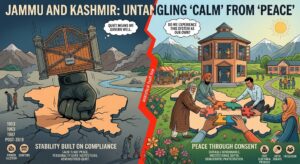
Jammu and Kashmir has had long stretches of calm. It has rarely had a peace that survives the withdrawal of coercion and until policy stops confusing the two, it will keep misdiagnosing the region it is trying to govern
Jammu and Kashmir has not lacked for quiet. Long stretches of it, in fact the 1960s had their quiet, the mid-2000s had theirs, and the years since 2021 have had one of the longest unbroken runs of low militant violence the Valley has seen in three decades. What the region has lacked, across nearly all of its modern political history, is a peace that can survive the withdrawal of coercion. That is not a semantic distinction. It is the analytical fault line that separates a government that has suppressed disorder from one that has been accepted as legitimate. In Kashmir, policy under every dispensation, Congress, PDP-BJP, Governor’s Rule, and now the reorganised Union Territory has treated these as interchangeable. They are not. And until they are separated, on paper as much as in practice, the Valley will keep being governed on the strength of the wrong diagnosis.
The case for this does not need to be argued from theory. It is written into the administrative record of how Jammu and Kashmir has actually been run since 1947: stability built around personalities rather than institutions; calm purchased through compliance rather than earned through legitimacy; and political order mistaken, again and again, for the mere statistical absence of visible disorder. The pattern shows up in the dismissal of Sheikh Abdullah in 1953, in the Bakshi decade that followed, in the Holy Relic crisis of 1963, in the rigged Assembly election of 1987, in the insurgency that grew out of it, and this is the part current policy would rather not examine too closely in the post-2019 constitutional restructuring and the security-heavy governance architecture that has accompanied it. The instruments have changed. The underlying design flaw has not.
- Security is not a substitute for political theory
The first mistake in how Kashmir has been governed is methodological: security policy is treated as if it were self-justifying, when in fact every security policy rests on an implicit theory of politics. Get the theory wrong, and the policy built on top of it will fail regardless of how well it is executed. In J&K, the working theory across six decades has effectively been this: reduce violence enough, and peace will follow as a residue. It does not work that way. A ceasefire is not a settlement. A quiet tourist season is not evidence of reconciliation. A fall in the number of infiltration attempts along the Line of Control is not, by itself, proof that a population has made its peace with the structures that govern it.
This is where the distinction Hannah Arendt drew between violence and power is worth borrowing, not because she wrote about Kashmir, but because she identified a confusion that almost every counter-insurgency state eventually makes: violence can destroy power, but it cannot manufacture it. Power, in the sense that matters for durable governance, exists when people act together and recognise the institutions governing them as, in some sense, their own. Violence can compel obedience. It cannot generate consent, and it certainly cannot generate belonging. A government that governs primarily through coercion may buy itself years of apparent stability. It is, nonetheless, living on borrowed time, because the coercive balance it depends on is never permanently fixed.
That is the analytical gap in most Kashmir commentary, including a good deal of what gets written from Srinagar itself. The conversation stays fixed on security metrics infiltration numbers, encounter counts, tourist footfall, this season’s calm compared to last season’s when the harder and more consequential question is distributional and political: does the population experience the system governing it as theirs, in any operative sense? If the answer is no, then whatever calm currently exists is provisional, and it will remain provisional regardless of how long it lasts.
- The original dependency: 1947 to 1953
The post-accession settlement in Jammu and Kashmir began with a dependency on personality that was structurally unsustainable from the outset. India’s position in the Valley was legally secured through the Instrument of Accession, but politically it rested almost entirely on Sheikh Abdullah’s cooperation and on the National Conference’s genuine, at the time considerable, popular standing. That was a real asset Abdullah commanded a loyalty New Delhi could not have manufactured through administrative fiat. But it also embedded a weakness that would recur in every subsequent decade: the Centre’s authority in Kashmir came to rest more on the management of an individual than on the construction of institutions durable enough to survive that individual’s departure, dissent, or disillusionment.
That is the operative lesson of the early 1950s, and it is one that later governments including, at points, my own generation of policymakers have relearned rather than internalised. New Delhi did not resolve the Kashmir question in this period by building an institutional relationship with the population. It managed a succession of political dependencies: first on Abdullah, then on Bakshi Ghulam Mohammad, then on a wider architecture of patronage, intelligence oversight, and tightly managed electoral politics. This was not institutional consolidation. It was political improvisation, functional in the short run for want of an alternative, but brittle the moment it was mistaken for structure which is precisely what happened.
Abdullah’s dismissal and arrest in August 1953 exposed that fragility in the starkest possible terms. Whatever the merits of the specific charges laid against him and the historical record on that remains genuinely contested the episode revealed that the governing arrangement in Kashmir had never been built to accommodate real political contestation from within. The moment Abdullah’s relationship with Delhi shifted, the entire arrangement had to be forcibly reset from the top. That reset may have been operationally effective. It was not institutionally transformative. The state had purchased compliance. It had not earned legitimacy. And it treated the two as fungible a habit of mind that governments in Srinagar and Delhi alike have found very difficult to shake since.
- The Bakshi decade: success that concealed the same flaw
The decade after 1953 is remembered, not wrongly, as a period of genuine development road-building, education expansion, administrative consolidation, and comparatively low visible unrest. That memory deserves its due. But the Bakshi years matter analytically precisely because they look like a policy success while reproducing the same structural defect in a new register.
Bakshi Ghulam Mohammad did not function as an institutional substitute for Sheikh Abdullah. He functioned as a different personality anchor. The governance architecture remained dependent on personal loyalty networks, patronage flows, and close central oversight rather than on institutions capable of standing independent of the man running them. When Bakshi resigned in 1963, the structure built around him did not have the institutional depth to absorb the transition smoothly. Stability dissolved with unexpected speed, because the foundations beneath it had never been allowed to become autonomous of the individuals who had built them.
There is an economic parallel here that is worth making explicit, because it is one policymakers in Srinagar keep re-encountering under different names: a fiscal or administrative structure that looks robust from the balance sheet and fragile the moment you examine who actually holds discretion over outcomes is not, in any durable sense, an institution. It is a personality wearing an institutional costume. Development spending, road contracts, and school openings can all be real and still not add up to political ownership, if the population experiences them as things done to them rather than decided with them.
The Holy Relic crisis of December 1963 supplied the proof. It was not simply an intelligence lapse, though it was certainly that too. It was a failure of political interpretation. The administration had spent a decade reading Kashmir through organisations, leaders, and patronage networks. The crisis revealed that beneath that surface, the Valley had been accumulating religious attachment, political resentment, and administrative distance in forms the system was neither built nor inclined to hear. That is the recurring cost of substituting management for legitimacy: the state hears noise. It stops hearing the political world underneath the noise.
- 1987 and the long collapse of institutional credibility
By the time the 1987 Assembly election arrived, this had become a chronic condition rather than a periodic crisis. The conventional shorthand holds that the rigged election triggered the insurgency. That is true, but it understates the mechanism. The rigging was catastrophic not because it stole one election, but because it confirmed what a great many Kashmiris had already come to believe: that formal political participation carried no reliable weight. The deeper injury was not the manipulation of a single result. It was that the political process had, over three decades, repeatedly signalled its own emptiness. Elections existed, but did not reliably translate into power. Representation existed, but did not reliably translate into outcomes. Grievance existed, but did not reliably translate into redress.
When institutions fail that consistently and for that long, people do not stop being political they never do. They search for alternative registers of political expression. In Kashmir, by the end of the 1980s, that search increasingly led to the gun. This was not inevitable in any deterministic sense, but it was structurally legible well before it happened. Where legal channels appear permanently sealed, extra-legal channels acquire a rational appeal they would not otherwise have. Where civic action seems consistently futile, militancy becomes politically thinkable, even for people who would, in a different institutional environment, never have considered it. Where the ballot has demonstrably lost meaning, the gun acquires a symbolic force disproportionate to what it can actually deliver.
The insurgency that began in 1989-90 should therefore be read as a legitimacy collapse with a security expression, not the reverse. Cross-border support mattered the training camps, the weapons pipelines, the ISI’s strategic interest in bleeding India through a low-cost proxy war were all real and consequential. But none of that infrastructure would have found the recruitment pool it did, at the scale it did, had the local political order been experienced as credible in the first place. External sponsorship explains capacity. It does not explain the willingness of thousands of young Kashmiris to walk into it. That willingness was manufactured domestically, over three decades, by the accumulated failure of institutional trust a point too many security assessments still treat as a footnote rather than as the causal core.
This is precisely where policy has habitually misread the problem, and continues to. Counter-insurgency can suppress a rebellion; the Indian state has, by any operational metric, done that with considerable competence. It cannot, by itself, produce the civic confidence that prevents the next one. A population that has not been given institutions it trusts will simply cycle through repertoires of dissent once one is exhausted: militancy gives way to street stone-pelting, stone-pelting gives way to hartal politics, hartal politics gives way to a more diffuse, faster-moving, harder-to-contain digital mobilisation. What remains structurally constant across every one of those forms is the same underlying grievance that politics does not deliver.
- What actually changed after 2019
The constitutional reorganisation of August 2019 produced a genuinely different administrative reality, and it is intellectually dishonest to pretend otherwise. It also created an opportunity, though whether that opportunity is being used well remains, six years on, a live and contested question rather than a settled one. The introduction of District Development Councils, the reinforced role of panchayats, the sustained push on infrastructure spending, and the tourism-led recovery strategy together represent a real shift from a purely reactive, security-first management style toward some degree of institution-building at the local level. That is not a negligible achievement. It is, in fact, the most serious attempt in several decades to build a governance layer in J&K that is not entirely hostage to one leader or one coalition’s survival.
But the operative question was never whether these institutions exist on paper. It is whether they function in the register that matters. A panchayat that cannot resolve a land dispute, allocate resources with any real discretion, or shape an administrative outcome is not a political institution in the strong sense of the term it is a procedural shell wearing institutional clothing, the same costume the Bakshi-era architecture wore sixty years earlier. A DDC that is directly elected but structurally unable to alter the broader logic of governance no capex approval authority, no say over the strategic direction of departmental spending, subordinate to a bureaucracy that answers upward rather than outward remains, whatever its democratic optics, limited in exactly the way that matters.
This is why the current period deserves to be judged with real caution rather than either triumphalism or reflexive cynicism. There has been meaningful capital investment; official data put industrial investment proposals in the tens of thousands of crores, even if actual on-ground investment has consistently lagged the announced figures by an order of magnitude. There has been a visible improvement in tourism and in the general security climate. But the deeper test the one policy keeps failing to set for itself is whether these gains are being converted into political ownership, or merely into improved statistics. If people see new roads, new hotels, and rising visitor counts, but continue to feel that the decisions that matter are still made somewhere else, then what the system is producing is compliance, dressed in the vocabulary of development. Not consent.
That distinction is not academic. Compliance is fragile because it depends on the continued application of leverage it has to be renewed, administratively and sometimes coercively, every single day. Consent is structurally stronger, because it produces its own maintenance: a population that has bought into a system defends it without being asked to. A state that has been accepted does not need to be constantly imposed. A state that is merely obeyed has to remain permanently vigilant, and permanent vigilance is, by definition, expensive fiscally, politically, and eventually electorally.
- Tourism as a political indicator, not just an economic one
The tourism economy in Jammu and Kashmir is not simply an economic story; it is one of the few genuinely reliable political indicators the Valley currently produces. The sustained growth in visitor arrivals the Valley crossed record footfall in successive recent seasons before the Pahalgam attack disrupted the 2025 season sharply signals that a meaningful cross-section of ordinary Kashmiris is making long-horizon bets on continued stability. Families are restoring houseboats that had sat derelict for a decade. Shikara operators, pony-wallahs, local guides, and homestay owners are sinking working capital into an assumption that visitors will keep arriving next season and the one after. That is, in its own quiet way, a genuine expression of civic confidence one of the few visible signals that a meaningful section of the population believes the present order might actually hold.
But the tourism numbers also expose the limits of treating aggregate success as proof of social consolidation. High arrival figures do not automatically mean the gains are widely distributed. A policy framework that celebrates the headline number without examining its district-wise and sector-wise distribution risks mistaking concentrated gain for social ownership. If revenue concentration is high, if local capital ownership in the hospitality sector is thin relative to outside investment, if the benefit is heavily front-loaded to a handful of well-connected destinations while districts like Kupwara, Bandipora, or large parts of the Pir Panchal see little of it, then tourism becomes another instance of the gap between the macro-statistic and lived legitimacy the same gap the region’s development data have shown repeatedly on other metrics, from GSDP growth that has slowed markedly in real terms since 2019 to an unemployment rate that has, at points, run into the high teens and remains among the highest of any state or Union Territory in the country.
The relevant question, therefore, is not simply how many tourists arrived, but who captured the surplus, in which districts, and under what terms of access to credit and land. Did local entrepreneurs retain ownership, or did the sharpest gains accrue to outside capital moving in to exploit a newly de-risked market? Did the upswing generate durable, formal employment, or largely seasonal and informal work that evaporates with the first security scare? Did the recovery reach beyond Srinagar, Pahalgam, and Gulmarg into the districts that have historically seen the least of J&K’s development spending? Where the honest answer to these questions is mixed and in most of the available data it is the correct conclusion is that the recovery is real but incomplete, and that a policy architecture built to celebrate the headline number rather than interrogate its distribution will keep mistaking growth for consolidation.
This is a distinction any economist working on J&K’s finances learns quickly and re-learns often: people do not experience the state through aggregate statistics. They experience it through whether credit is genuinely accessible, whether contracts are honoured without having to go through influence, whether property titles are secure, and whether the local administration responds to pressure applied through ordinary, legal channels rather than only through disruption. Growth that arrives without distribution manufactures new resentment even as the topline numbers improve. Growth that arrives with distribution is one of the few things capable of deepening consent rather than merely purchasing quiet.
- The unresolved question of representation
The persistent political problem in Jammu and Kashmir is not that people lack opinions about their own governance. It is that a very large number of them continue, with good historical reason, to doubt whether those opinions carry any operative weight. That is the deeper substance behind the continued demand for statehood restoration, and behind the low-grade but persistent frustration even within the region’s mainstream, pro-India political formations. These demands should not automatically be read as anti-state positions, though administrations under pressure often find it convenient to read them that way. They are, more often, signals that the current constitutional arrangement continues to be experienced as provisional a Union Territory that was explicitly promised as transitional, now entering its seventh year without a fixed timeline for restoration.
If that provisionality is allowed to harden into permanence, the gap between administration and legitimacy widens rather than closes, regardless of how competently the administration itself performs. Representation has to be more than ceremonial to do the work legitimacy requires of it. It has to be capable of altering outcomes. If elected bodies the Assembly, the DDCs, the municipal corporations cannot meaningfully influence the real distribution of administrative and fiscal power, they lose their capacity to generate the sense of ownership they exist to produce. And if opposition politics within J&K continues to be treated, reflexively, as a security concern rather than as an ordinary feature of a plural democracy, the state ends up confusing disagreement with disloyalty one of the most corrosive habits any government managing a conflict-affected region can develop, because it eventually forecloses the very channels through which grievance is supposed to be processed peacefully.
Arendt’s insistence on plurality as the basis of political life is useful here precisely because it resists the temptation to treat unanimity as the marker of success. Political life does not require agreement. It requires the ability to coexist inside a shared institutional world despite disagreement. Kashmir’s history is, in large part, the record of what happens when that shared world is narrowed repeatedly and from the top: communities grow more suspicious of one another and of the state; public language hardens; institutions bleed trust; the state responds to the resulting friction by tightening control further; and the tightening deepens the alienation that then appears, to the state, to justify still more control. It is a genuinely self-reinforcing cycle, and every generation of policymakers in Srinagar and Delhi since 1953 has, to one degree or another, been caught inside it.
Breaking that cycle will require more than the vocabulary of development, however well-funded. It requires real institutional room for disagreement to be expressed and processed without being treated as a security event. It requires local bodies whose decisions actually bind. It requires a political culture inside the bureaucracy as much as inside the political class that does not instinctively read dissent as the first stage of sedition. And it requires, more than anything else, consistency: a population cannot reasonably be asked to invest long-term trust in institutions whose meaning appears to shift with every change in the political season in Delhi.
- The Pandit question and the arithmetic of memory
No serious accounting of Jammu and Kashmir’s legitimacy deficit can set aside the Kashmiri Pandit exodus of 1990. It was, first and foremost, a humanitarian catastrophe for the community directly displaced. But it was also something more structurally consequential for the Valley as a whole: the forcible removal of a constituent community from Kashmir’s civic plurality. When a society loses part of itself to targeted violence and displacement, it does not simply become smaller in numerical terms. It becomes categorically less complete as a shared political world the loss registers not just in the census but in the texture of what “Kashmiri” is subsequently understood to mean.
That has a direct bearing on how any future settlement should be evaluated. A peace framework that does not seriously engage return, recognition, and the restoration of shared civic life will remain structurally incomplete, whatever else it achieves on the security or economic front. Symbolic gestures a memorial here, a scholarship scheme there are not a substitute for the harder, slower work of restoring the actual conditions under which return can be lived rather than merely announced. Isolated resettlement colonies, built mainly for administrative optics and largely absent the surrounding social fabric that would make them genuinely livable, have not, twenty-five years on, meaningfully answered this question. The underlying question how Kashmiri Pandits, Muslims, Sikhs, and other communities are to inhabit a shared political world together without fear on any side remains as unresolved today as it was in 1997, when the first tentative resettlement schemes were floated.
This is also the point at which justice becomes analytically inseparable from peace, however administratively inconvenient that linkage is. Reconciliation cannot be legislated into existence by simply declaring that the security situation has improved. Victims of militant violence, of custodial excess, of enforced disappearance, and of forced displacement on every side of this long conflict cannot be told, as they periodically are, that closure has effectively arrived because the annual security bulletin looks better than it did five years ago. That is not reconciliation. It is administrative amnesia dressed up as progress and populations, whatever the state’s own preferred timeline, tend not to forget on schedule.
- Where security logic reaches its limit
Security logic is indispensable in Jammu and Kashmir, and nothing in this argument should be read as suggesting otherwise. The point is narrower and, I would argue, more useful: security logic is necessary but structurally insufficient, and the persistent policy error has been to let it expand into domains it is simply not equipped to govern. Security can reduce casualties. It can disrupt operational networks. It can make the next attack materially harder to execute. It buys the political system breathing room. What it cannot do, on its own, is persuade a population that the system governing it has earned its loyalty.
That is precisely why security “wins” so often have such a short political half-life in Kashmir. They resolve the symptom faster than they touch the cause. A militant neutralised is not the same event as a political grievance addressed. A network disrupted is not the same as a rehabilitated relationship of public trust. A quiet street on a given evening is not the same as a citizen who has been genuinely convinced.
What Jammu and Kashmir needs, at this specific administrative juncture, is a policy architecture that treats the current security gains as an opening for institutional deepening rather than as proof that institutional deepening has become unnecessary. Concretely, that means strengthening the fiscal and decision-making authority of DDCs and panchayats rather than leaving them as electoral exercises with limited operative power; building a grievance-redressal system that responds within a defined and enforceable timeline rather than at bureaucratic discretion; increasing the transparency of development spending to the point where it can be independently audited by civil society rather than only by the government’s own institutions; protecting property and land rights with the same rigour applied to security enforcement; and treating political inclusion not as a reward handed out once order has been fully achieved, but as one of the principal instruments through which order becomes durable in the first place. That reordering of priorities treating legitimacy-building as a precondition for security rather than as its eventual dividend is the single most consequential policy shift Jammu and Kashmir’s governance still requires.
- What sustainable peace would actually look like
What, then, would a sustainable peace in Jammu and Kashmir actually look like, stated in terms specific enough to be checked against? Not the complete disappearance of conflict that is too absolute a standard for any genuinely plural society, and no democracy anywhere meets it. Sustainable peace would mean, more modestly and more concretely, that conflict, when it surfaces, is processed through institutions rather than around them. It would mean that a clear majority of the population regards political participation as worth the effort. It would mean that local government carries enough real authority to matter to household-level outcomes. It would mean that economic recovery is broad enough, across districts and income levels, to be genuinely felt rather than merely reported. It would mean that dissent is treated as a normal feature of democratic life rather than as a security indicator. And it would mean that the state no longer needs to lean overwhelmingly on coercive instruments simply to maintain ordinary order.
That is a demanding bar. It is, nonetheless, the correct one, because anything lower risks the exact error this argument has been tracing across seven decades: mistaking temporary quiet for durable settlement, and discovering the mistake only when the next crisis makes it visible.
The present moment in Jammu and Kashmir genuinely contains both promise and warning, and an honest column has to hold both at once. There is more infrastructure investment than in any comparable period since 1990. There is visible, if unevenly distributed, economic activity. There is a broader local-governance architecture than existed at any earlier point in the region’s post-accession history. There is, in parts of the economy at least, a restored sense that ordinary life can be planned beyond the horizon of the next security crisis. But there is also continuing constitutional ambiguity over statehood, unresolved historical grievance, uneven distribution of the recovery’s gains, and a persistent, well-founded sense across much of the Valley that the decisions that matter most are still being made somewhere else. That combination real gains alongside an unresolved legitimacy question is exactly what makes this period consequential rather than merely eventful. It is neither failure nor completion. It is, more accurately, a test whose result is not yet decided.
The test is whether the administrative and fiscal gains of the last several years can be converted into something closer to political ownership. If they can, Jammu and Kashmir may finally move toward a peace that is more than an extended armistice between crises. If they cannot if development spending, tourism growth, and improved security metrics continue to be treated as substitutes for representation rather than as a foundation for it the region will likely remain what it has so often been across the last seventy-eight years: quiet for a while, unsettled underneath, and exposed to the next breach the moment the coercive balance that has been holding it together shifts even slightly.
The Final Reflection
Jammu and Kashmir’s history teaches an uncomfortable but very specific lesson, and it is worth stating plainly rather than diplomatically: governance built on personalities fails whenever those personalities change. Stability built on compliance fails the moment coercion loosens even marginally. Development, however genuine, does not by itself settle a political question rooted in seventy years of contested legitimacy. And security, however well executed, cannot on its own build a peace that outlasts the security apparatus maintaining it.
That is, at bottom, the Arendtian core of the Kashmir problem, and it is one policy in Srinagar and Delhi keeps rediscovering at cost rather than absorbing in advance. Violence can silence a society for a season, sometimes for a decade. It cannot found one. Power, if it is to be durable in the sense that actually matters for a place like Jammu and Kashmir, has to arise from plural political action, from institutions the population recognises as genuinely its own, and from a shared political world in which disagreement does not automatically register as danger. The region’s future will not be secured by a more sophisticated security architecture alone, however necessary that architecture remains in the short run. It will be secured only if Jammu and Kashmir’s institutions begin producing the one thing coercion has never, in seven decades, managed to manufacture: consent with some depth to it, participation that carries real meaning, and a common political world sturdy enough to survive the next crisis without having to be rebuilt from the ground up each time.
Until that happens, the region will keep being misread as peaceful whenever it happens to be merely quiet. That misreading, on the evidence of the last seven decades, has already cost Jammu and Kashmir far more than its policymakers have been willing to admit.
Covering this Valley’s politics from a Srinagar newsroom for the better part of two decades teaches you to distrust a quiet season fairly quickly. I have sat through enough of them 2003-08, briefly again after 2010, and now this one to notice the same tell each time: the traders start talking about expansion loans before the politicians start talking about elections. Capital moves on quiet before institutions do. That gap, between what the market is willing to bet on and what the political system is willing to concede, is usually the most honest indicator running in the Valley at any given time. It is running again now. Whether this administration reads it correctly is, as things stand, still an open question.
GO TO FRONT PAGE
Quiet Without Consent – 2026
Quiet Without Consent – 2026
Quiet Without Consent – 2026
Quiet Without Consent – 2026
About The Author