
Constitutional Militarism: How Pakistan’s Army Learned to Rule Without Tanks in the Street
Constitutional Militarism: How Pakistan’s Army Learned to Rule Without Tanks in the Street – 2026
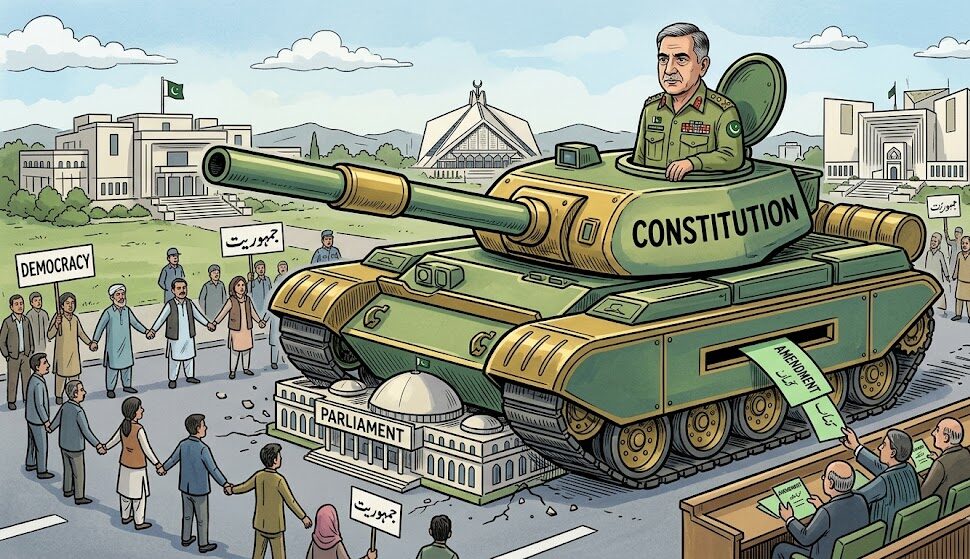
No tanks rolled through Islamabad. No general suspended the constitution. Instead, Pakistan’s parliament voted, amendment by amendment, to hand its army permanent, irreversible control and called it democracy.
In April 2022, Pakistan’s National Assembly did something it had never managed to do in the country’s seventy-five-year history. It removed a sitting prime minister through a vote of no confidence a parliamentary mechanism, conducted on the floor of the house, with members standing to be counted. Imran Khan lost the vote. He left office. No tanks rolled down Islamabad’s Constitution Avenue. No general appeared on state television to announce the suspension of the constitution. By every formal measure, Pakistan’s democracy had simply worked.
It was, in fact, the last gasp of what analysts call a hybrid regime a system in which civilian government exists, elections occur, and parliament sits, but where the military retains a decisive, if partially concealed, veto over who governs and how. Khan’s removal was managed. The numbers in parliament were assembled with the unmistakable assistance of an institution that does not vote but counts. And then, having proven its ability to engineer outcomes through ostensibly democratic means, that institution did something more consequential than removing a prime minister. It began rewriting the rules so that it would never again need to bother.
What has emerged in Pakistan since then is not a return to the martial law of Zia-ul-Haq or Pervez Musharraf periods when generals abrogated the constitution outright, dissolved parliament, and ruled by decree. It is something more durable and considerably harder to name, let alone resist. It is a system in which elections will be held, parliament will sit, judges will issue rulings, and the entire apparatus of constitutional democracy will continue to function on the surface while every lever that matters has been constitutionally, legislatively, and irreversibly transferred to military control.
Call it constitutional militarism. It is the most significant development in South Asian governance in a generation, and the world has barely begun to register what it means.
The Vocabulary Problem
For decades, the study of Pakistani politics relied on a familiar vocabulary: martial law, military coup, army rule, hybrid democracy. Each term described a recognizable phenomenon. Martial law meant the constitution was suspended and a general ruled directly, as Ayub Khan did in 1958, Zia-ul-Haq did in 1977, and Musharraf did in 1999. Hybrid democracy the term most commonly used to describe the Imran Khan years and the period preceding them described a system in which civilians held office but operated within boundaries set by the military, particularly on foreign policy, defense, and matters touching the army’s institutional interests.
What exists in Pakistan today fits neither category. Field Marshal Syed Asim Munir did not stage a coup. He did not need to. He became Chief of Army Staff in November 2022 through entirely conventional means, was elevated to the rank of Field Marshal in May 2025 only the second officer in Pakistan’s history to hold that rank and has since presided over the most thoroughgoing constitutional consolidation of military power since the country’s founding. The instrument of this consolidation has not been the tank or the decree. It has been the amendment.
This is the analytical distinction that matters, and that most international coverage of Pakistan has failed to capture. A coup is an event. Constitutional militarism is a structure. A coup can be reversed by another coup, by international pressure, or by the slow restoration of civilian institutions once the crisis that justified it passes. A structure embedded in constitutional amendments, ordinary legislation, and regulatory law does not expire. It requires another two-thirds parliamentary majority to undo precisely the kind of majority that a military-controlled parliament will never permit to assemble against itself.

The Architecture: What the 27th Amendment Actually Does
The instrument at the center of this transformation is Pakistan’s 27th Constitutional Amendment, passed by parliament in 2025. Its provisions, read individually, might appear as routine adjustments to military service rules. Read together, they constitute the legal scaffolding of a permanent military settlement.
The amendment extends the tenure of service chiefs most directly benefiting the Chief of Army Staff, now reconstituted in Munir’s case as Chief of Defence Forces, a position with authority over all three service branches that did not previously exist in this form. This is not a minor administrative adjustment. It is the creation of a singular military office, sitting above the army, navy, and air force chiefs, answerable to no fixed term and no meaningful civilian check.
Accompanying amendments to the Army Act extend a parallel principle into the realm of legal accountability. Under the revised framework, the Chief of Defence Forces enjoys a scope of immunity from accountability that the army chief and the chiefs of the other two services do not possess in equal measure. This is worth dwelling on, because it represents something genuinely new in the architecture of military power in Pakistan: not collective institutional immunity for the armed forces as a body, but personal, individualized legal insulation for the man who currently holds the top job.
The international parallel here is not accidental, and it deserves to be drawn explicitly. The same legal logic immunity constructed not for an office in the abstract but for the specific individual occupying it, often including provisions that extend protection to family members has appeared in other democracies under stress in recent years, including the United States, where legal theories advanced on behalf of a sitting president have sought similar insulation for both the officeholder and his relatives. Pakistan’s innovation has simply been to codify the principle into constitutional and statutory law rather than litigate it through courts. The effect is the same: the rule of law is replaced by the rule of a particular ruler, dressed in the vocabulary of law.
Husain Haqqani, the former Pakistani ambassador to Washington and one of the most incisive analysts of his country’s civil-military imbalance, observed in Pakistan: Between Mosque and Military that the Pakistani army’s genius has never been brute domination but rather its capacity to fuse itself with the instruments of the state so completely that the distinction between military interest and national interest disappears from public discourse. Haqqani’s analysis, written two decades ago, anticipated precisely this evolution: an army that no longer needs to seize the state because it has patiently arranged to become indistinguishable from it. The 27th Amendment is the most explicit legal confirmation of Haqqani’s thesis that Pakistan has produced in a generation.
Silencing the Field: Media Law as Counter-Insurgency
Constitutional militarism does not rest on amendments to the chain of command alone. It requires the systematic narrowing of the space in which that command structure can be criticized, examined, or challenged. Here, the relevant battlefield has been media regulation.
Amendments to the framework governing the Pakistan Electronic Media Regulatory Authority the body that licenses and disciplines broadcast media have expanded the grounds on which criticism of state institutions can be criminalized. The practical effect is that a television anchor, a newspaper columnist, or increasingly a private citizen posting on social media who criticizes the judiciary or, more pointedly, the armed forces, now operates under a legal framework broad enough to permit imprisonment for what would, in most democracies, constitute ordinary political commentary or satire.
This is not a uniquely Pakistani innovation, but it is being deployed with a uniquely Pakistani target in mind. Under discussion not yet passed into law, but advanced far enough in the legislative process to function as a deterrent in its current draft form is legislation that would permit the confiscation of property inside Pakistan belonging to citizens who, while resident abroad, are deemed to have criticized state institutions, with the armed forces functioning as the institution this provision is overwhelmingly understood to protect. The chilling effect of even a proposed law of this kind on Pakistan’s large diaspora a community whose remittances the country depends upon and whose political commentary on platforms beyond Islamabad’s reach has long been a source of institutional irritation is difficult to overstate. It transforms property ownership inside Pakistan into a hostage against the political speech of Pakistanis living in London, Toronto, or Houston.
Ayesha Siddiqa, the military sociologist whose study Military Inc.: Inside Pakistan’s Military Economy remains the definitive account of how deeply the Pakistani armed forces have embedded themselves in the country’s commercial and institutional life, has long argued that the Pakistani military’s dominance rests not on coercion alone but on the careful cultivation of a narrative architecture a national story in which the army is positioned as the only stable, competent, and patriotic institution in an otherwise dysfunctional state. Siddiqa’s framework helps explain why the media restrictions matter as much as the constitutional amendments. A military that controls the legal definition of permissible criticism controls the national narrative absolutely, regardless of what nominally elected officials say from the floor of parliament.
The Parliament That Carried Its Own Coffin
The most striking feature of constitutional militarism, and the one that distinguishes it most sharply from martial law, is the active participation of the civilian legislature in its own subordination. Zia-ul-Haq dissolved parliament. Musharraf suspended the constitution. Asim Munir has needed neither act, because Pakistan’s parliament the same body that removed Imran Khan through an ostensibly democratic vote has passed every piece of enabling legislation that constructed the current settlement, with the two-thirds majorities that constitutional amendments require.
This is the detail that should trouble anyone inclined to treat Pakistan’s continued electoral calendar as evidence of functioning democracy. The 27th Amendment did not arrive through ordinance or decree. It arrived through a vote, conducted by elected representatives, who chose for reasons ranging from coalition arithmetic to simple political survival to formalize the supremacy of an institution that does not require their permission to act but apparently prefers to have it anyway.
There is a structural logic to why Pakistan’s military prefers this method to outright seizure. A government that rules by decree invites international censure, economic sanction, and the perpetual question of legitimacy that dogged both Zia and Musharraf throughout their tenures. A government that rules through a parliament that has voluntarily ceded its own authority invites none of these consequences. It can point to election schedules, to sitting assemblies, to judicial proceedings, and declare itself a democracy in good standing even as every substantive decision affecting foreign policy, internal security, judicial appointments, and now its own legal accountability has been removed from genuine civilian deliberation.
What 2029 Will Look Like
Pakistan’s next general election is scheduled for 2029. It will, in all likelihood, take place on schedule. Polling stations will open. Ballots will be counted. International observers will issue reports describing the technical conduct of the vote with varying degrees of satisfaction. And the outcome, in its broad contours who governs, within what limits, answerable to whom will have been substantially predetermined by the architecture already in place.
This is the uncomfortable truth that ordinary political analysis of Pakistan persistently struggles to articulate, perhaps because doing so risks sounding cynical about the value of elections altogether. But the distinction is not between elections occurring and elections not occurring. It is between elections that determine power and elections that ratify a distribution of power already settled elsewhere. Pakistan’s 2029 vote will almost certainly belong to the second category. Any observer with even passing familiarity with the country’s institutional trajectory over the past three years the centralization of authority in a single Chief of Defence Forces position, the personalized legal immunity constructed for that office’s current occupant, the criminalization of institutional criticism, and a parliament that has demonstrated its willingness to formalize each of these steps can predict the shape of the outcome with a confidence usually reserved for far less complex political systems.
Why This Matters Beyond Pakistan’s Borders
The temptation, particularly for readers in India and across South Asia, is to treat Pakistan’s internal constitutional architecture as a matter of academic interest a curiosity in comparative government, relevant chiefly to specialists in civil-military relations. This temptation should be resisted.
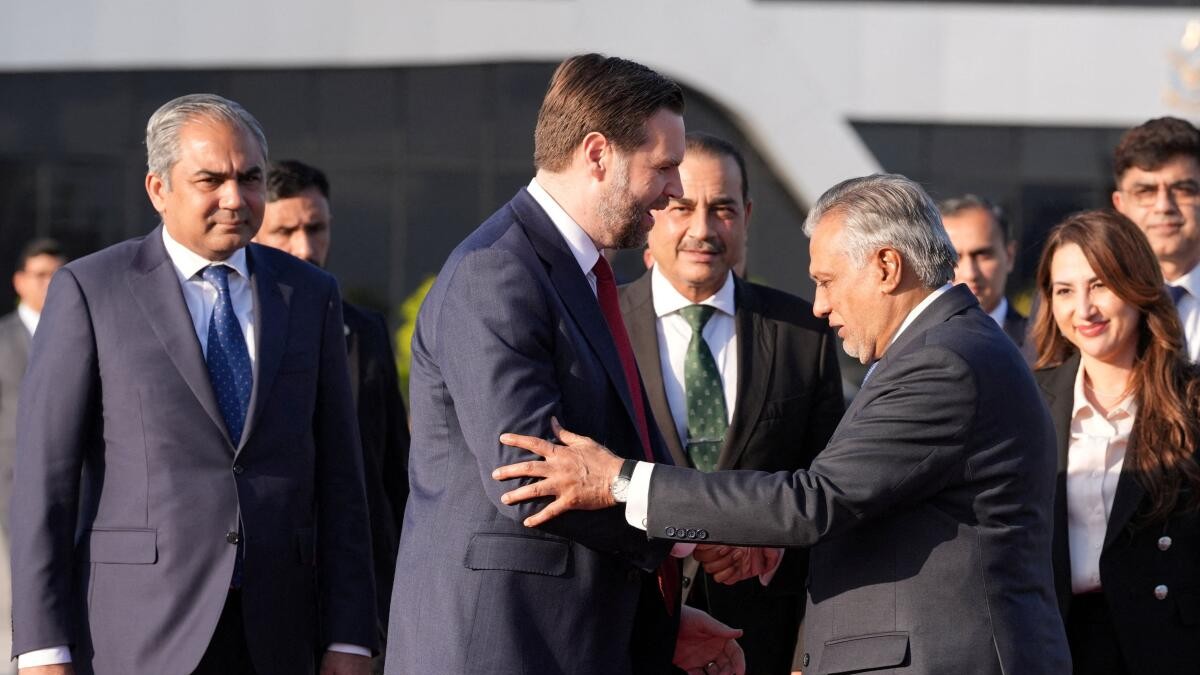
A Pakistani state in which foreign and security policy is constitutionally and irreversibly the preserve of a single military office, immune from the ordinary mechanisms of domestic accountability that even the most compromised hybrid regimes preserved in residual form, is a fundamentally different actor to negotiate with, deter, or anticipate than the hybrid system that preceded it. Field Marshal Munir’s emergence as Washington’s preferred interlocutor during the 2026 Iran crisis invited to the White House, credited publicly by President Trump for brokering ceasefire extensions, courted for cooperation on critical minerals and counterterrorism demonstrates that the international community, faced with a fait accompli of domestic consolidation, has chosen pragmatic engagement over principled scrutiny. Major capitals are negotiating with the structure as it now exists, not with the structure they might prefer it to be.
For India specifically, the implications are direct. A Pakistani military that answers to no domestic check beyond its own internal cohesion, and that has demonstrated through Operation Sindoor’s aftermath, through the continued operation of terror infrastructure on its soil despite years of targeted degradation, through the survival in protective custody of figures like Hafiz Saeed a persistent capacity to maintain proxy violence as state policy, is not rendered more predictable by international rehabilitation. It is rendered less accountable. The civilian fig leaf that once offered, at minimum, some diplomatic channel for de-escalation and some domestic constituency with an interest in regional stability, has been legislated into irrelevance.
The Five-Year-Old’s Verdict
There is a folk wisdom in Pakistan, repeated by analysts with the kind of weary precision that comes from having watched the cycle repeat across decades: ask any five-year-old on a Lahore street whether the next election will be free, and the child will tell you what every adult already knows. This is not cynicism. It is institutional literacy acquired by simple proximity to a system that has perfected the appearance of democratic process while hollowing out its substance.
What distinguishes the current moment from Pakistan’s previous cycles of military dominance is precisely that no one needs to whisper this knowledge in fear of a censor. It is openly understood, almost casually accepted, even as the legal and constitutional infrastructure that produces this universal expectation continues to be built in plain sight, ratified by a parliament whose members will themselves stand for re-election under rules they helped construct.
Constitutional militarism does not announce itself with a curfew or a suspended constitution. It announces itself in committee rooms, in amendment texts, in regulatory clauses governing broadcast licenses, in the quiet expansion of one man’s legal immunity relative to his nominal peers. It is, in this sense, a more sophisticated and more durable form of military rule than anything Zia or Musharraf attempted because it does not require the world, or Pakistan’s own citizens, to acknowledge that military rule is what it has become.
The tanks are not in the street. They have simply moved into the constitution.
Constitutional Militarism: How Pakistan’s Army Learned to Rule Without Tanks in the Street
Pakistan will hold an election in 2029. The polling stations will open. The ballots will be counted. International observers will file their reports. And the outcome who governs, within what limits, answerable to whom will already have been settled, years earlier, not by a ballot but by an amendment. That is the distinction this moment in Pakistan’s history demands the world finally learn to make: between elections that determine power, and elections that merely ratify a distribution of power decided elsewhere. Until that distinction is widely understood in Washington, in Brussels, in New Delhi Pakistan will keep being treated as a democracy in good standing, rehabilitated each time it proves useful, while the architecture quietly built into its own constitution ensures that usefulness is the only currency that has ever mattered. The tanks are not in the street. They have simply moved into the constitution. The next time the world looks for a coup to react to, it should already know none is coming because none is needed.
the writer is a senior editor and columnist based in Srinagar, Jammu and Kashmir. He writes on South Asian geopolitics, civil-military relations, and the institutional architecture of regional security.
GO TO HOME PAGE
Constitutional Militarism: How Pakistan’s Army Learned to Rule Without Tanks in the Street – 2026
Constitutional Militarism: How Pakistan’s Army Learned to Rule Without Tanks in the Street – 2026
About The Author