
The Flourishing Ruin
The Flourishing Ruin – 2026
Pakistan’s emergence as the indispensable mediator between Washington and Tehran in 2026 is not a triumph of diplomacy — it is the most complete expression yet of a seventy-nine-year structural condition: a state that has learned to profit from its own precariousness while seventy million of its citizens absorb the cost of governing by perpetual crisis.
By Meer Yassir Ahmed
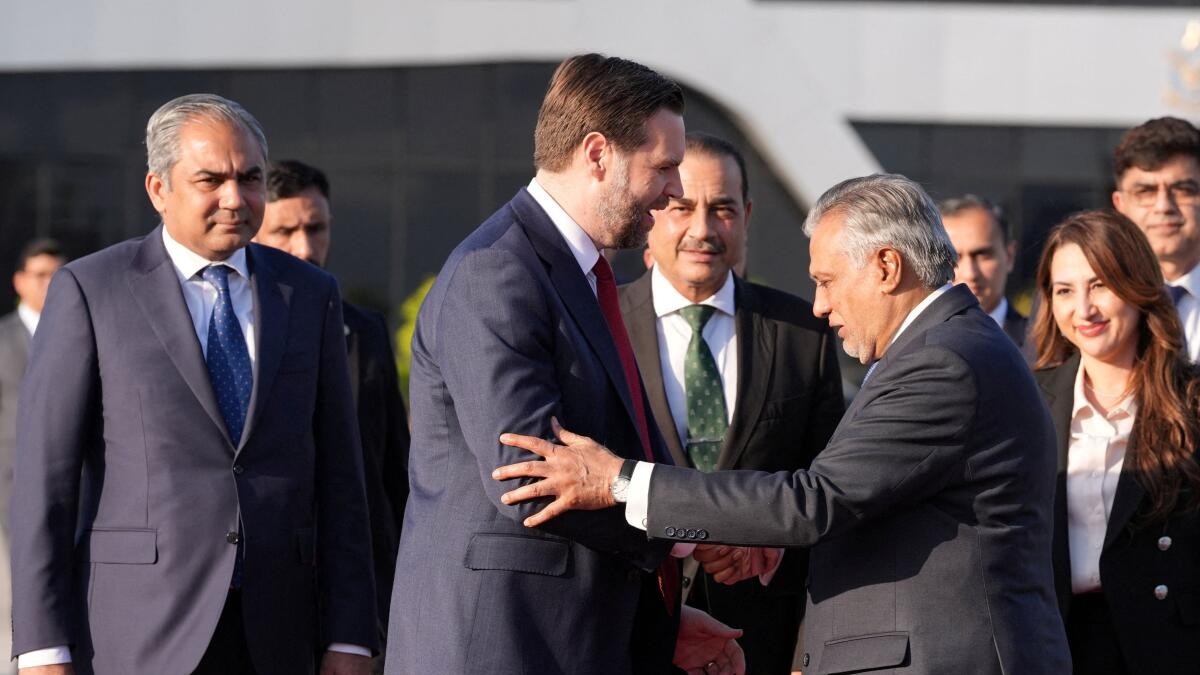
On April 11, 2026, Vice President JD Vance walked into Islamabad flanked by Pakistan’s Chief of Defence Forces Field Marshal Asim Munir and Foreign Minister Ishaq Dar, and the world briefly noticed a country it usually notices only when something has gone catastrophically wrong. The occasion was the first round of the Islamabad Talks — the direct US-Iran negotiations that Pakistan had brokered following the US-Israeli strikes that killed Iran’s Supreme Leader on February 28, destabilised the Gulf, and left the international community reaching, in familiar desperation, for the one state with working channels to both Washington and Tehran simultaneously. By June 12, 2026, Pakistan had shepherded the two adversaries to an agreed text. The Council on Foreign Relations called it “a remarkable role change.” Al Jazeera noted that “no other country enjoyed the same kind of trust from both parties.” A decade ago, a senior Pakistani analyst observed, these were exactly the kinds of talks “that pariah Pakistan would never have been allowed into.” The observation was intended as a compliment. It should be read as a diagnosis.
Pakistan was born in August 1947 without a functioning central bank, without a civilian bureaucratic apparatus of any scale, and with a refugee crisis — between fourteen and seventeen million people displaced across the new border — that would have tested the institutional capacity of a mature state. It inherited none. The administrative machinery of undivided India had been concentrated in Delhi; the new country’s capital, Karachi, was a port city reinvented overnight as a seat of government, and the state it housed was attempting to govern a geographically discontiguous territory — West Pakistan and East Pakistan separated by a thousand miles of Indian land — with the tools of a colonial revenue administration rather than a sovereign democratic one. The structural deficit was not a political failure; it was an architectural one, built into the blueprint before the first governor-general had been sworn in. Ayesha Jalal, in The State of Martial Rule, identified this founding asymmetry as the determining condition of everything that followed: a civilian political system too weak from birth to contain the military it had inherited, and a military too conscious of its own institutional coherence not to fill the vacuum the civilians could not hold.
It is here that the definitional correction this column requires becomes essential. The phrase “foreign policy success” is being used, in the coverage of the Islamabad Talks, as if it were interchangeable with “diplomatic relevance.” These are not the same thing, and the collapse of the distinction is doing significant political work. A foreign policy success advances the national interest of the state conducting it — it translates diplomatic activity into improvements in the welfare, security, and institutional health of the population it represents. Diplomatic relevance is something different and, in Pakistan’s case, something structurally older: it is the condition of being too dangerous to ignore and too fragile to stabilize without external management. I would call this the precarity premium — the strategic value a state extracts from its own instability, rented out to great powers who cannot afford the consequences of its collapse. Pakistan has been living off the precarity premium since 1979. It is not a foreign policy achievement. It is a country that has learned to monetize its own precariousness — and the monetization has, for seventy-nine years, substituted for the harder work of building a state that actually governs.
The template was established early. In 1951, four years after Partition, Prime Minister Liaquat Ali Khan — the country’s first and, by institutional reckoning, most consequential civilian head of government — was assassinated in Rawalpindi. No conviction was ever secured. The investigation was closed. The civilian political system never recovered the authority it had held even tentatively under his stewardship; the military and the bureaucracy filled the resulting space with a directness that made subsequent constitutional arrangements largely performative. By October 1958, General Ayub Khan had dissolved the cabinet, abrogated the constitution, and declared martial law — the first of four direct military takeovers that would punctuate the country’s political calendar like a recurring diagnosis. What followed Ayub’s coup was not aberration but pattern: a state that sought military adventurism abroad — the 1965 war with India, sold to the Pakistani public as a march toward glory, concluded in the stalemate of Tashkent — while its civilian institutions eroded at home. The 1971 war was the reckoning. East Pakistan’s secession as Bangladesh — after a military crackdown that the Hamoodur Rahman Commission itself described in terms that have never been fully made public — was not merely a territorial loss. It was the proof of concept for Jalal’s argument: a state organised around military power and geographic insecurity, rather than the civic legitimacy that alone can hold a plural society together, will eventually fracture along the lines the military was supposed to defend.
What 1971 broke in strategic terms, 1979 rebuilt — on different and more dangerous foundations. General Zia ul-Haq’s decision to position Pakistan as the frontline state in Washington’s proxy war against Soviet Afghanistan gave the country exactly the kind of great-power indispensability that the Islamabad Talks represent today: not earned through institutional strength but rented through geographic positioning and a willingness to absorb the costs that more stable states would decline. The ISI became, during this period, a state within the state — the institution through which American funding, Saudi finance, and Pakistani operational capacity flowed into the Afghan theatre, and through which the Islamist networks that would haunt the region for the next four decades were simultaneously armed and cultivated. The precarity premium, in its 1979 iteration, was paid to Pakistan in the form of American military and economic assistance; the cost was externalized to Afghan civilians, to the Pakistani tribal belt, and to the regional security architecture that collapsed when the Americans withdrew and left their intermediary to manage the wreckage. Pakistan had been indispensable. It had also, in the process, become ungovernable by the civilian institutions that indispensability was supposed to strengthen.
The nuclear tests of May 1998 deepened the premium by adding a new and irreversible dimension to Pakistan’s strategic unavoidability. A nuclear-armed state, whatever its domestic condition, cannot be allowed to fail in the conventional sense — its failure carries consequences that dwarf any calculation of humanitarian or institutional concern. September 11, 2001 reactivated the template in the form most familiar to Musharraf’s Pakistan: the frontline state again, the strategic partner again, thirty-three billion dollars in American assistance over the following two decades — and the Abbottabad revelation of May 2011, in which the world discovered that the world’s most wanted man had been living, for five years, eight hundred metres from the gates of the Pakistan Military Academy. The double game was not a secret. It was the precarity premium’s most efficient iteration: being simultaneously indispensable to the Americans and accommodating to the networks the Americans were hunting, collecting the strategic rents from both relationships for as long as the arithmetic held.
Pakistan has not learned to profit from its strength — it has learned to monetize its own precariousness, and the monetization has, for seventy-nine years, substituted for the harder work of building a state that actually governs.
Here is the inversion the Islamabad Talks demand: Pakistan is trusted by Washington and Tehran not because it is strong but precisely because it is weak. A stable, self-governing Pakistan with functioning civilian institutions and a military subordinate to elected authority would have less diplomatic utility, not more — because it would no longer need managing, and the management of Pakistan is, structurally, what creates its value to external powers. The country that has housed Iran’s Interests Section in its Washington embassy since 1979 — performing a consular function for a pariah state because no one else would — has turned decades of marginalisation into a niche service industry. That is not foreign policy success. That is a country that has become, in the language of international finance, too systemically important to allow to resolve.
Meanwhile, Pakistan’s Economic Survey 2025-26 records that the national poverty rate has climbed from 21.9 per cent in 2018-19 to 28.9 per cent in 2024-25 — nearly seventy million citizens now living below the poverty line, twenty-seven million additional people impoverished in six years. Rural poverty in Balochistan stands at 47 per cent. Government debt has reached 83.6 per cent of GDP. Debt servicing consumes, in some fiscal years, fully half the federal budget, leaving no fiscal space for the education, health, or infrastructure investment that alone converts economic stabilisation into human development. Pakistan has entered twenty-four IMF programmes since 1958 — its twenty-third, secured in 2023, arrived as Islamabad narrowly avoided sovereign default. The Atlantic Council’s assessment is unsparing: Pakistan has been “relegated from the richest economy in South Asia to the poorest over the last fifty years.” The country that brokered a peace deal between the United States and Iran has a nominal GDP per capita that ranks 160th in the world.
The domestic political condition is, if anything, more structurally revealing. Imran Khan has been imprisoned since August 2023, battling deteriorating health — significant vision loss in one eye — in Adiala Jail, Rawalpindi, where 103 PTI workers have been convicted in military courts that the International Covenant on Civil and Political Rights, to which Pakistan is a signatory, does not sanction. On May 20, 2025, the government promoted General Asim Munir — the army chief who has consolidated military influence over politics to a degree that analysts describe as qualitatively beyond historical precedent — to the rank of Field Marshal: only the second officer in Pakistani history to hold the rank, after Ayub Khan, whose legacy is precisely the civil-military asymmetry that has produced every crisis since. Human Rights Watch’s 2026 World Report documents that Pakistani authorities intensified their crackdown on critical voices throughout 2025, using legislation against media organisations, political opponents, and civil society with a breadth the report describes as systematic. The PTI announced a nationwide Long March for September 27, 2026 — demanding Khan’s release and the defence of constitutional order. The march is being met, as protests in Pakistan are invariably met, with the apparatus of a state that has never resolved the question of whose authority is sovereign.
What the Islamabad Talks represent, seen whole, is the precarity premium at its highest valuation to date — and its most instructive. A country in which the former prime minister is losing his eyesight in a military jail; in which seventy million people live below the poverty line; in which debt servicing has crowded out developmental spending for a generation; in which the civilian elected government serves at the discretion of a military that has just promoted its chief to Field Marshal — this country brokered peace between the world’s largest economy and a regional nuclear aspirant. The world called it remarkable. It is. But remarkable is not the same as healthy. A bridge can be the most important crossing in a city and still be on the verge of collapse. The diplomatic architects in Islamabad have mastered the art of being indispensable; what they have never managed — what the state’s founders never built the foundations for — is the art of governing themselves.
Ayub Khan gave himself the rank of Field Marshal in January 1965, the year he launched the military adventure that ended in the Tashkent stalemate. Asim Munir received the same rank in May 2025. Pakistan is a country with a talent for repeating its own history with impeccable attention to symbolic detail.
GO TO HOMEPAGE
The Flourishing Ruin – 2026
The Flourishing Ruin – 2026
The Flourishing Ruin – 2026
The Flourishing Ruin – 2026
Copyright © 2026 Yassir Ahmed Mir. All rights reserved.
No part of this article may be reproduced or distributed without written permission from the author. For permissions or syndication, contact yassirahmed001@gmail.com.
Disclaimer:
This article draws on verified public sources and research available at the time of writing. The views expressed are solely those of the author and do not represent any government or institution. While accuracy has been prioritized, some details may rely on incomplete or evolving information.
About The Author