

THE MADRASSA AT THE CROSSROADS
THE MADRASSA AT THE CROSSROADS – 2026
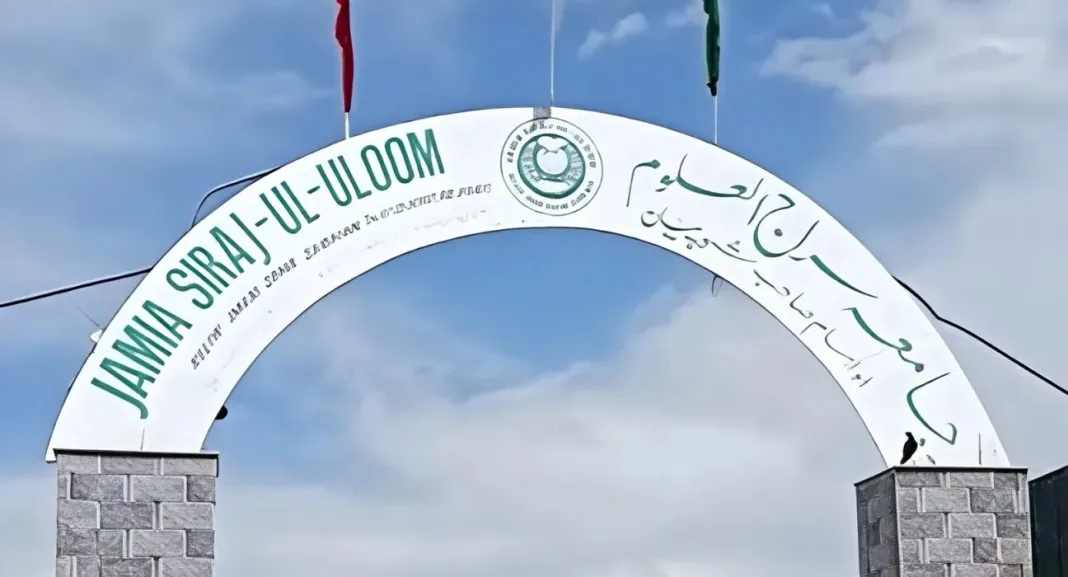
For Three Decades, Darul Uloom Jamia Siraj-ul-Uloom Presented Itself as a House of Learning. The State Has Now Declared It a House of Unlawful Activity. The Evidence Between Those Two Descriptions Is the Story.
“Every school is a statement of intent. The question is never what it teaches on paper. The question is what it produces in practice.” Alex Perry, The Good War (on institutional radicalisation in conflict zones)
SPECIAL REPORT
It began, as so many things in Kashmir begin, with land.
In 1994, in the village of Hillow in Imam Sahib, Shopian a district that would spend the next three decades acquiring a geography of grief a parcel of land changed hands. Not through the quiet formality of a registered deed or the transparent mechanics of a lawful sale. According to official records now forming the evidentiary spine of a government dossier, the land was alienated through coercion and duress, with suspected complicity of revenue officials who appear to have bypassed the prescribed legal procedures that exist, in a functioning state, precisely to prevent this.
On that land, they built a school.
On April 24, 2026 thirty-two years after that first irregular transaction Divisional Commissioner Kashmir Anshul Garg, acting on a dossier submitted by SSP Shopian, signed a two-page order. It invoked Section 8(1) of the Unlawful Activities (Prevention) Act, 1967. It declared Darul Uloom Jamia Siraj-ul-Uloom, Imam Sahib, Shopian, an unlawful entity.
It was, officials confirmed, the first time in Jammu and Kashmir’s history that a Darul Uloom had been banned and declared an unlawful entity by the administration.
The school that began on land taken by force had become, in the state’s formal legal assessment, something that could not be permitted to continue.
The Architecture of Evasion
What the dossier reveals is not a single act of wrongdoing but a sustained, multi-layered architecture of regulatory evasion built brick by brick across three decades, each layer designed to make the next layer harder to dismantle.
The institution operated without valid registration from the Jammu and Kashmir Board of School Education. It lacked mandatory clearance certificates. Yet it ran a Fazila College under affiliation with the University of Kashmir a university affiliation granted to an institution that had never resolved its most basic compliance obligations with the state’s own school education board.
When the Jammu and Kashmir Reorganisation Act restructured the regulatory landscape in 2019, the institution faced a legal requirement: seek re-registration under the new applicable provisions. It did not. According to the official order, the management was fully cognizant that re-registration would likely be denied, given its adverse background. Rather than comply with the law, it adopted a corporate structure registering simultaneously as “Siraj-ul-Uloom Educational Society” on the NGO Darpan Portal in 2018, and again as “Siraj-ul-Uloom Welfare Foundation” in 2025. The latter entity was additionally incorporated as a company under Registration No. U88900JK2025NPL017303 a corporate shell deployed, the official record alleges, to circumvent regulatory scrutiny and continue operations without requisite security clearance.
Two identities. One company. Zero security clearances.
The financial picture compounds the concern. Multiple bank accounts were maintained by the institute. Authorised signatories were changed without explanation. The continued inflow of funds through tuition fees and donations raised, in the official assessment, serious apprehensions regarding concealment of financial control and possible diversion. The legitimacy of donations and other receipts, the dossier states, remains questionable.
The Network Behind the Classroom
The order issued by the Divisional Commissioner carries a finding that no amount of institutional euphemism can soften: Darul Uloom Jamia Siraj-ul-Uloom had “sustained and covert linkages” with Jamaat-e-Islami the organisation that the Government of India banned in 2019 under the UAPA. Several individuals associated with the institute who held key positions administrative and academic were known affiliates of the proscribed outfit.
This was not incidental association. It was, according to the official assessment, de facto control a banned organisation exercising operational influence over an educational institution through the placement of its members in positions of institutional authority.
The consequence of that control is documented not in ideological assessments or intelligence abstractions but in police station records across multiple districts of south Kashmir. Seventeen individuals who passed through this institution subsequently joined terrorist ranks, their names and FIR numbers now forming a list that stretches across police stations from Shopian to Bijbehara, Zainapora to Tral, Kangan to Ganderbal.
Rayees Ahmad Teli of Kadgam. Munib ul Haq of Sugan, against whom eight separate FIRs were registered across multiple police stations under the UAPA and IPC. Tariq Ahmad Sheikh of Muloo Chitragam, named in six FIRs spanning 2010 to 2019. Shakir Ahmad Paul of Dangerpora, named in four separate cases including murder and kidnapping charges under UAPA. Zubair Ahmad Nengroo of Aloora, named in four FIRs including abduction.
Seventeen names. Seventeen trajectories that began in classrooms and ended in encounter reports, custody records, and FIRs under Sections 16, 18, 20, and 38 of the UAPA the legal vocabulary of terrorism in India’s most surveilled territory.
The school did not merely fail to prevent radicalisation. The official record suggests it created the conditions in which radicalisation became the destination.
Then and Now: What Three Decades Cost Shopian
In 1994, Shopian was already bleeding. The militancy that had erupted in 1989 had by then consumed thousands of lives across the valley, and south Kashmir’s villages had become both battlegrounds and graveyards. Into that landscape, a new institution arrived presenting itself as education, as learning, as the possibility of a different future for the children of a district that had seen too many of its young men choose the gun.
For the families who sent their sons there the farmers of Hillow, the labourers of Dangerpora, the small merchants of Kanelwan the school was not an ideology. It was a practical hope. Education, in the Kashmir of the 1990s, was the argument you made to a young man to keep him away from the mountains. The madrassa, for many parents, was that argument made concrete.
Thirty years later, those same families and the families of the seventeen names now in the official record carry a different knowledge. The institution that took their hope produced, in too many cases, an outcome they were never warned about, never consulted on, and never consented to.
The land was taken by coercion. The students’ futures were taken by ideology. The community’s trust was taken by both.
The Defence and the Reckoning
Not everyone accepts the official narrative without question. PDP president Mehbooba Mufti called the declaration a “flagrant injustice” to the underprivileged, alleging the institution was being targeted without solid evidence of anti-national activity. Mirwaiz Umar Farooq joined the condemnation, warning against what he characterised as the targeting of educational institutions. The institute’s chairman denied any link with illegal outfits.
These are legitimate voices in a democracy, and they must be heard. The UAPA’s Section 8(1) the provision invoked here has faced sustained criticism from constitutional lawyers who argue that it permits the executive to declare places unlawful on the basis of police dossiers without adequate judicial oversight. That structural concern is real and deserves the engagement of the courts.
But the seventeen names in the FIR list are also real. The dual NGO registrations are documented. The fraudulent land alienation is on record. The corporate incorporation designed to evade re-registration is a matter of official finding. These are not allegations assembled in haste. They are thirty years in the making.
A House of Learning, or a House of Unlawful Activity?
The answer, on current evidence, is that it was permitted to be both for three decades while the regulatory system that should have intervened looked the other way, the revenue officials who should have questioned the land transfer stayed silent, and seventeen young men from the villages of south Kashmir followed a path from classroom to conflict that no educational institution should ever have made possible.
The order of April 24, 2026 does not undo those thirty years.
But it names them.
And in Kashmir, where institutional silence has historically been the most effective protection available to those who exploit it, naming is where accountability begins.
Reporting based on the official order of Divisional Commissioner Kashmir dated April 24, 2026, SSP Shopian’s dossier as referenced in official records, police station FIR data, and verified regulatory filings. The Redlines has approached the institute’s management for detailed response. Statements received will be incorporated upon receipt.
THE MADRASSA AT THE CROSSROADS – 2026
THE MADRASSA AT THE CROSSROADS – 2026
THE MADRASSA AT THE CROSSROADS – 2026
THE MADRASSA AT THE CROSSROADS – 2026
THE MADRASSA AT THE CROSSROADS – 2026
#ShopianSeminary #UAPA #JamiatIslamiKashmir #DarulUloom #KashmirNews #RisingKashmir #UnlawfulEntity #Radicalisation #SouthKashmir #JammuKashmir #JKNews #MadrassaBan #TerrorFinancing #JKBOSE #CounterTerrorism #ImamSahib #Shopian #KashmirInvestigation #UAPAKashmir #JamaaTeIslamiKashmir #BreakingKashmir #InvestigativeJournalism
About The Author