

Fortress and the Mirage of Invincibility
Fortress and the Mirage of Invincibility – 2026
Israel’s tactical brilliance since October 7 is being mistaken for strategic permanence — and that confusion, not any external enemy, is the more dangerous adversary.
By Meer Yassir Ahmed yassirahmed001@gmail.com
When, not if, the current round of fighting subsides, Israel will be tempted to read its military record since October 7, 2023 as vindication. Hezbollah decapitated. Hamas alive but hardly kicking. The Houthis discovering that distance is not immunity. Iran’s aura, built over decades, punctured in days. It is a formidable record, by any reckoning. But a formidable record is not the same thing as a durable strategy, and Israel’s more serious enemy right now may not be Tehran, Beirut, or Gaza. It may be its own success.
This is not a new problem for Israel. It is, in fact, an old one wearing new fatigues.
There are two distinct dangers hiding inside this record, and it would be a mistake to conflate them, as much of the commentary around Israel’s wartime performance currently does. The first is external — the world’s growing habit of describing Israel as the regional powerhouse. The second, and the more consequential one, is internal — Israel’s own growing habit of believing it.
On the external count, the confusion is understandable but wrong. Israel is not, in any structural sense, a regional powerhouse. It remains what it has always been: a small country with negligible strategic depth, ringed by adversaries whose combined demographic and territorial weight dwarfs its own many times over. Tactical dominance on a battlefield does not translate into strategic dominance over a region. If anything, every humiliation Israel inflicts on Iran, Hezbollah and the wider rejectionist camp does two things simultaneously — it buys deterrence, and it manufactures resentment. Deterrence has a shelf life. Resentment, married to injured pride, does not. The target on Israel’s back is not shrinking. It is getting larger and more carefully studied.
It is the second danger, though, that ought to concern Israeli strategists more, because it is self-inflicted and therefore avoidable, and it is precisely the kind of danger a small state can least afford. Much of what Israel achieved after October 7 was genuinely earned — the intelligence work, the operational improvisation, the technological edge, the sheer adaptability of forces fighting simultaneously across conventional, urban and long-range theatres. But not everything that went right did so because of Israeli brilliance. Some of it went right because Hamas, for all its brutal ambition, did not coordinate with Hezbollah and Iran to strike at full strength, all at once, on October 7 itself. That is not a strategic achievement. It is a contingency Israel happened to benefit from. To mistake contingency for competence is the oldest trap in military history, and Israel has fallen into it before.
In March 2020, the Supreme Court of India held that a resolution… corroborated by the Rules of Procedure… — no, that reference belongs to another republic’s crisis. Israel’s precedent lies closer to home, in its own historiography: 1967 and 1973.
The Six Day War was one of the most spectacular victories of the modern military age. It was also, in retrospect, the moment Israeli strategic thinking began to calcify. Overwhelming victory against Arab armies hardened into assumption. Assumption hardened into doctrine. Doctrine hardened into what Israelis themselves now call conceptzia — the entrenched military mindset that convinced the establishment the Arabs simply could not threaten Israel on its own terms, and that qualitative edge, warning time and static defences would always be sufficient. Then came October 1973, and the fortress along the Suez, the Bar-Lev Line, revealed itself for what it was: politically reassuring, superficially formidable, and strategically brittle.

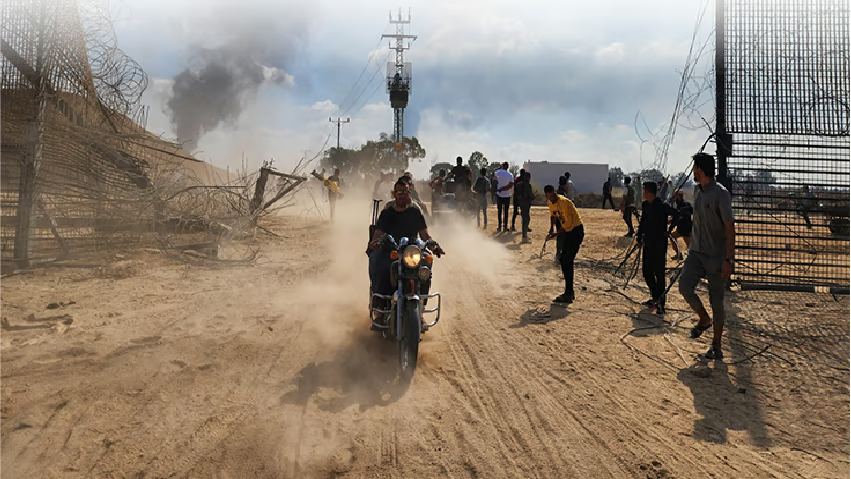
That is the lesson worth extracting today, not the box score of the current war. Israel’s real strength has never been its capacity to sit behind walls. It has been its capacity to move — to improvise, to surprise, to seize initiative before an enemy can dictate the terms of engagement. Walls, fences, sensors, and increasingly elaborate defensive architecture have their place. But they also encourage a strategic psychology in which a state permits its enemies to gather patiently at its perimeter, confident that technology and deterrence will hold the line. Enemies adapt to walls. They always have. Proxies, tunnels, drones, rockets and grey-zone tactics are precisely the toolkit an adversary builds when it cannot breach a fortress directly but can compress it slowly, from multiple directions, staying just below the threshold that would provoke a decisive response. The answer to that kind of pressure was never going to be a taller wall and one more tank parked beside it.
What Israel needs to recover, and what its current doctrine underweights, is maneuver — not as a battlefield tactic but as a strategic principle. A country with no depth on land has spent its energy trying to manufacture depth artificially, through layers of fortification. It would do better to look for the depth it actually possesses and has chronically underused: the sea.
Israel’s geography is conventionally discussed only as a liability — narrow, exposed, without room to trade space for time. But its maritime position tells a different story. Israel sits at the intersection of the eastern Mediterranean, the approaches to the Red Sea, and the arteries connecting Europe, Asia and the Indian Ocean. That is not incidental geography; it is unexploited strategic capital. As the naval threat environment shifts — missiles, drones, mines, submarines, hostile control of choke points — the sea offers Israel something land cannot: room to disperse, to persist, and to strike from directions an enemy has not fully priced in.
This requires more than a bigger navy of the conventional kind. It requires building a maritime force around the warfare that is arriving, not the warfare that is retiring — unmanned surface vessels, underwater drones, autonomous reconnaissance, mine and counter-mine systems, long-endurance platforms operating alongside submarines and missile ships, not instead of them. The arrival of the Dakar-class submarine is a welcome data point, but a submarine is not a doctrine. It only matters if it sits inside a wider architecture in which manned and unmanned systems work in concert across distance, not as isolated platforms bought to satisfy a procurement wish-list.
Israel does not need to choose between air power and sea power; that is a false binary the current euphoria makes tempting. Air power gives it reach. Sea power gives it persistence. Maneuver, recovered as doctrine rather than improvised as emergency response, gives both their depth. The three, together, are what fortress logic can never substitute for.
None of this is to diminish what Israel achieved militarily since October 7. The point is narrower and, in some ways, more uncomfortable: extraordinary tactical execution is not proof of strategic soundness, and battlefield success bought partly through enemy miscoordination should induce humility, not swagger. As Israel’s own domestic politics turn toward elections, the temptation to convert this record into electoral capital is real and understandable. But political back-patting is not strategy. It captures votes; it does not capture reality.
Every adversary Israel has fought in the past two years is now doing what militaries always do after a defeat — studying precisely what worked, what failed, and where the openings remain. Hezbollah will rebuild if it is permitted the time to. Hamas, if it survives in any form, will mutate rather than disappear. The Houthis are already recalibrating. Iran, weakened, is not therefore rendered passive; weakened powers historically become more inventive, not less. Warfare is an evolutionary process, and nothing is punished faster in it than complacency.
Sharon’s argument against the Bar-Lev Line was, at its core, an argument against comfort — against the seduction of a defence that looks solid on a map and feels solid in a press briefing. Israel’s current wartime record risks becoming its own Bar-Lev Line: an achievement so visible and so recent that it discourages the harder, less photogenic work of asking what assumptions made October 7 possible in the first place. The question Israel should be asking is not how it preserves the superiority it has just demonstrated. It is how it prevents that superiority from calcifying into the very mythology that made the last surprise possible — and the next one, should Israel let it, no less so.
Yassir Ahmed is an Indian journalist and analyst specialising in national security, defence, and strategic affairs across South Asia and West Asia, examining the intersection of intelligence, diplomacy, and regional power.)
GO TO HOME PAGEhttp://theredlines.world
Fortress and the Mirage of Invincibility – 2026
Fortress and the Mirage of Invincibility – 2026
Fortress and the Mirage of Invincibility – 2026
Fortress and the Mirage of Invincibility – 2026
About The Author