Why Washington Went to Mumbai: Oil, Capital and the New Geography of Indian Diplomacy.
Diplomats say that where a statesman chooses to land tells you what he has come to buy. When US Secretary of State Marco Rubio touched down in Mumbai on October 20, the first Secretary of State to visit India without a single scheduled meeting in Delhi, the itinerary spoke before he did. Mumbai for the money, Jamnagar for the oil, and the capital left to the commentators. Beneath the quarrel over protocol lies a more instructive story, about a world in which fuel prices decide elections, refineries have become instruments of foreign policy, and Indian corporate houses are no longer petitioners at the diplomatic table but participants in it.
In 1944, a group of Indian industrialists, among them J.R.D. Tata and G.D. Birla, published what became known as the Bombay Plan, a blueprint for the economy of an India not yet free. They did not wait for a government to tell them what the national interest was. They wrote it themselves. It was an early instance of a pattern that has marked India since: where the country’s capital is made, its policy is often made too.
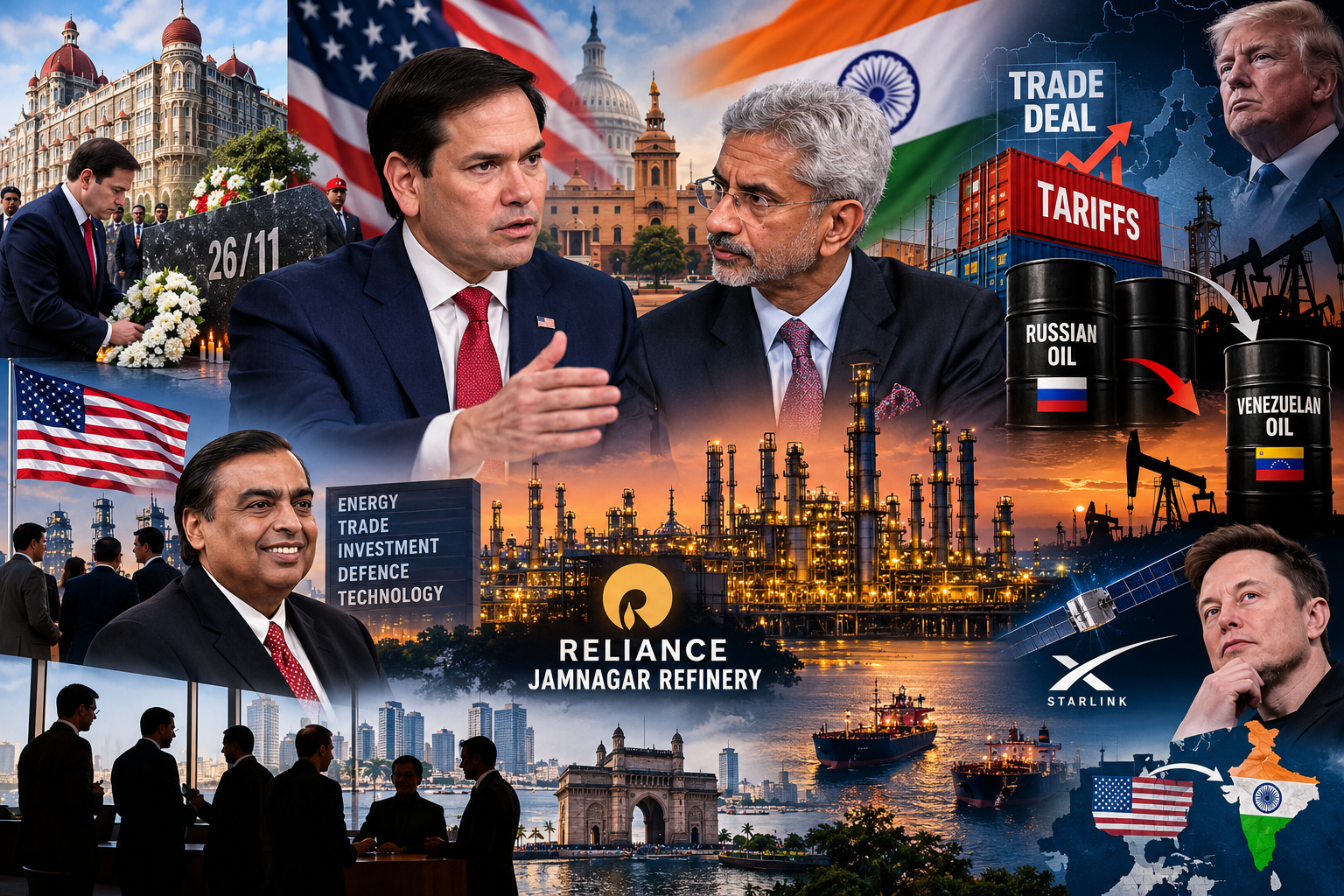
That memory is worth carrying into a week in which the United States Secretary of State has chosen to spend three days in India without once visiting its capital. Marco Rubio landed in Mumbai on October 20. He laid a wreath at the 26/11 memorial at the Taj Mahal Palace Hotel, met External Affairs Minister S. Jaishankar, and attended a reception marking the 250th anniversary of American independence. Today he is in Jamnagar, Gujarat, at the world’s largest single-site refinery. His trip, which runs from October 17 to 22, takes in Uzbekistan, Mumbai and Jamnagar. The capital is missing from the list.
Reading the itinerary
The omission became a political story before Rubio arrived. The State Department framed the trip around energy and investment. The US ambassador, Sergio Gor, said he hoped officials from Delhi would travel to Mumbai to meet the Secretary. The Leader of the Opposition, Rahul Gandhi, said Delhi’s officials had been “summoned”. The government declined to respond.
Both readings have something in them, and neither is complete. The opposition is right that protocol matters in diplomacy, and that a Secretary of State bypassing a capital sends a signal. The government is entitled to reply that a meeting is a meeting wherever it happens, and that Mumbai, India’s financial centre, is where much of the business Rubio came for is located. Keir Starmer chose Mumbai on his India visit last October, and no one called that a snub.
The deeper point is that the itinerary reveals what Washington is actually buying. Americans have always had a taste for official Delhi. This week they have gone where the capital is, in both senses of the word.
The oil question
Strip away the choreography and the central issue is energy. Diesel prices are rising in the United States as the midterm elections approach, and the elections fall on November 3. A government worried about pump prices will look for supply wherever it can find it.
India is the obvious place to look. It imports about 88 per cent of its crude, with Russia its largest supplier since 2022 and the United States fifth. The Graham sanctions legislation, signed last month, threatens tariffs of up to 500 per cent on the largest buyers of Russian energy. Washington has also been urging India to buy more Venezuelan oil. On October 16, days before the provisions were due to bite, Trump granted India an exemption. Rubio has acknowledged that trade negotiations were among the considerations behind Washington’s sanctions decisions, and he has defended the relief by saying other economies cannot be allowed to collapse over a single issue.
Look at what this implies. The exemption is not a favour from a patron to a client. It is a calculation by a government that cannot afford costlier fuel before an election. India, for its part, has no wish to lose cheap Russian crude, and has said so plainly. Each side holds a card, and each knows the other’s.
Why Jamnagar
This explains the choice of Jamnagar. Reliance describes it as the largest and most complex single-site refinery in the world, with a capacity of about 1.4 million barrels a day. It can process the heavy, high-sulphur crude that Venezuela produces. Reliance is also the biggest buyer of Venezuelan crude after the United States itself. Rubio has described India as a “refining superpower”, and the phrase is accurate. A refinery is only valuable if there is crude to feed it, and America’s new access to Venezuelan supply, following Maduro’s removal in January, needs a place to be turned into diesel.
There is a second thread. In March, President Trump announced a refinery at Brownsville, Texas, in partnership with Reliance, the first new American refinery in about fifty years. He called it a $300 billion deal. That number deserves a footnote. It reflects the stated value of the oil to be processed and the fuel to be produced over five years, not capital invested. Treat it as a measure of throughput, not of investment.
The visit also arrives with a sideshow. Elon Musk recently asked whether Mukesh Ambani is the “real boss of India”, in a dispute over Starlink’s licence. Reliance said it welcomed competition. The episode is a reminder that Indian corporate power is now a subject of conversation in Washington and Silicon Valley, and not merely in Mumbai.
The trade deal that is “99 per cent” done
The other thread is the trade agreement, which has been “close” for most of two years. Rubio says it is as close as it can be without signing. Commerce Minister Piyush Goyal says the first tranche is in its final stages, but that India will not sign until its exporters have an edge over rivals such as Bangladesh, Vietnam and Indonesia.
That condition is the heart of the matter. The United States imposed 50 per cent tariffs on Indian goods in August last year, and a February framework reduced them to 18 per cent before talks stalled. India’s aim is not merely lower tariffs. It is lower tariffs than its competitors face. Without that advantage, there is little point in signing.
The friction extends beyond tariffs. H-1B fees have risen, immigration rules have tightened, and eight Indian firms, including Infosys, TCS, Wipro and HCL, have been suspended from a labour certification scheme. Each of these costs Indian companies money and Indian professionals opportunity. Rubio has said the tariffs and visa curbs are not aimed at India. Indian negotiators will wait for the text.
The most interesting reading comes from the scholar C. Raja Mohan, who argues that the Jamnagar stop should not be judged only through the old debate over India-US relations. His point is that Rubio’s conversations with the Tata and Adani groups and with Mukesh Ambani reflect something new: Indian capital has become part of Indian foreign policy.
This strikes me as correct, and it is a long-overdue recognition. For decades, India’s external economic relations were conducted by officials. Business was a petitioner. Today a handful of Indian conglomerates operate at a scale that makes them interlocutors for foreign governments, whether in refining, ports, telecommunications or pharmaceuticals. Governments that wish to do business in India now have to do business with them.
The question Raja Mohan poses is the right one: how can Delhi turn the growing importance of Indian companies into a strategic asset for India-US ties? The answer is not obvious. A company’s interests and a country’s are not always the same. A refiner will buy the cheapest crude and sell to the highest bidder. A government must weigh the same transaction against sanctions, alliances and domestic politics. Where those interests diverge, a diplomatic channel that runs through boardrooms may become a liability.
Three cautions
I would offer three.
First, geo-economics cuts both ways. The same interdependence that gives India leverage with Washington also exposes it. A country that imports 88 per cent of its oil, and sells refined products into a tight global market, is both indispensable and vulnerable. A swing supplier is only as secure as the sanctions regime that permits it to swing.
Second, the exemption is temporary. It was granted as a pre-election measure by a government managing fuel prices. It can be withdrawn once the midterms are over and oil prices ease. India should treat it as breathing space and not as a settlement. The diversification Rubio praises is not a favour to Washington. It is the sensible hedge that every large importer should pursue.
Third, the Delhi question is not trivial. Foreign policy requires institutions, and institutions require an address. A Secretary of State who meets the foreign minister in Mumbai and the refinery owner in Jamnagar is saying something about where he believes decisions are made. Indian diplomacy should be careful not to confirm that impression by default.
Several things will tell us whether this visit was substance or theatre. The first is whether a trade agreement is signed before Prime Minister Modi travels to the United States in December for the G20. The second is whether the Russian oil exemption survives the American election. The third is what, if anything, comes out of Jamnagar: an expanded Venezuelan crude arrangement, a Texas refinery announcement, or simply a handshake.
Whatever happens, the visit has already clarified something. India’s diplomacy is no longer conducted only in the corridors of South Block. It runs through refineries, ports and stock exchanges, and the foreign ministries of the world have begun to notice. In 1944, the Bombay Plan’s authors imagined a country in which business and the state would shape the nation’s future together. Eighty years on, Washington seems to have noticed that this is what India has become. The task for Delhi is to ensure that the partnership remains on its own terms.
Eighty years ago the authors of the Bombay Plan assumed that business and the state would build the nation together. Rubio’s three days suggest the assumption has come true, with a twist: the partnership now has a foreign audience. Delhi’s task is not to resent that, but to make sure the guest list is its own.
Yassir Ahmed is a senior editor and defense analyst based in New Delhi. He writes on national security, foreign policy, intelligence networks, and geopolitical strategy across South Asia and West Asia, South Asian security, geopolitics, and institutional accountability.