
THE DOLLARS LAST WALL
THE DOLLARS LAST WALL – 2026
From Bretton Woods to the Strait of Hormuz: How Fifty Years of American Financial Architecture Met the One Weapon It Was Never Built to Withstand
In 1944, the world gave America its financial throne. In 1974, Henry Kissinger made it permanent by anchoring it to oil. In 2026, Iran found the one physical lever that no sanctions, no aircraft carrier, and no Treasury enforcement mechanism could neutralise and pulled it. This is the story beneath the war that everyone is watching. It is also the most consequential economic event since Richard Nixon walked into a television studio and changed the world without most people understanding what he had done.
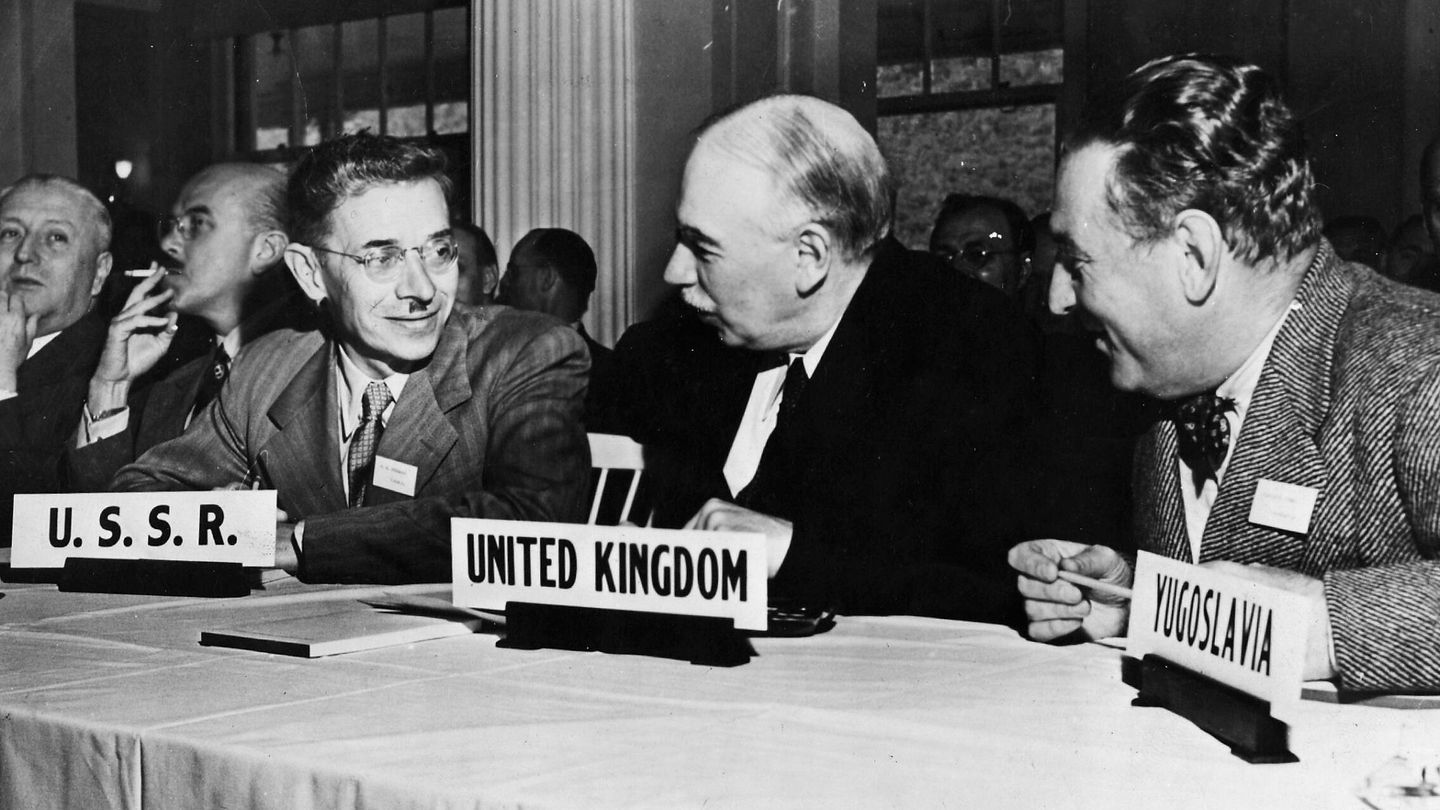
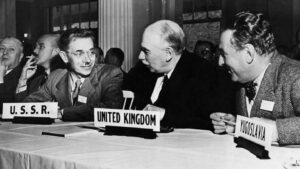
There is a photograph taken at Bretton Woods, New Hampshire, in July 1944, that has appeared in a thousand economics textbooks and been genuinely understood by almost none of the students who looked at it. Forty-four nations are represented in the frame. Their delegates are dressed in summer suits. They look like men who have just concluded a satisfactory transaction, which, in the most precise sense, is exactly what they were.
The transaction they concluded was this: the United States, which held approximately seventy percent of the world’s monetary gold reserves and whose industrial economy had been strengthened rather than devastated by the war, would serve as the anchor of the post-war international financial system. Every other currency would be pegged to the dollar. The dollar would be pegged to gold at thirty-five dollars per troy ounce. Any foreign government could present its dollar reserves to the US Treasury and receive gold in exchange. The system was called Bretton Woods, and it governed global finance for twenty-seven years.
What that photograph does not show, what no photograph from that conference could show, is what would eventually be required to sustain the privilege it conferred, and what would eventually happen when the physical infrastructure of that sustenance became vulnerable to a power with nothing left to lose.
The answer to both questions is now visible, in real time, through the narrow waterway that separates the Arabian Peninsula from Iran: The Strait of Hormuz, twenty-one miles wide at its narrowest point, through which approximately twenty percent of the world’s daily oil supply passes every single day.
THE ARCHITECTURE: WHAT KISSINGER ACTUALLY BUILT
To understand what Iran did in 2026, you must first understand what Henry Kissinger built in 1974 and why it was, in the judgment of anyone who studies the relationship between financial power and geopolitical dominance, the single most consequential diplomatic achievement of the twentieth century. More consequential than the opening of China. More consequential than détente with the Soviet Union. More consequential, in its long-term effects on the global distribution of power, than almost any military alliance or territorial settlement in the post-war period.
The background is necessary. By August 1971, the United States had spent approximately one hundred and forty-one billion dollars on the Vietnam War, a figure that had so severely eroded the gold reserves backing the dollar’s international convertibility that foreign governments, led by France’s Charles de Gaulle, had begun presenting their dollar holdings to the US Treasury and demanding gold in exchange. The arithmetic was irreversible: America had issued more dollar liabilities than it held gold to cover. On August 15, 1971, Nixon closed the gold window. The dollar would no longer be convertible to gold at any price. The Bretton Woods system was over.
The immediate international alarm was understandable and correct. If the dollar was not backed by gold, what was it backed by? Why would any country accumulate dollar reserves if those reserves could be inflated at the discretion of the American government? The exorbitant privilege that the French economist Valéry Giscard d’Estaing’s precise term for what reserve currency status actually provided appeared to have been revoked.
Kissinger’s genius was to recognise that oil could replace gold as the anchor of dollar demand, and that this replacement would be structurally superior to the gold standard in one critical respect: unlike gold, oil was consumed. Every barrel burned was a barrel that needed to be replaced, purchased, priced, and settled. If that settlement occurred exclusively in dollars, the demand for dollars would be not merely permanent but self-renewing, driven not by the finite stock of a metal in a vault but by the continuous productive activity of the entire global economy.
Between 1974 and 1975, Kissinger negotiated the arrangements that made this operational. The United States provided Saudi Arabia and, through Saudi Arabia, the entire OPEC membership with security guarantees, advanced weapons systems, and the explicit commitment of American military protection for the Gulf monarchies. In exchange, oil would be priced and sold exclusively in US dollars, and OPEC’s surplus petrodollar revenues would be recycled into US Treasury bonds, providing Washington with a reliable base of foreign creditors at favourable rates. By 1975, the system was complete. It had a name, the petrodollar, and a consequence that would shape every geopolitical calculation for the next fifty years.
The practical consequences are worth stating with specificity, because they are still not widely understood outside specialist financial circles. The United States, from 1975 onward, could run persistent trade deficits, consuming more than it produced, importing more than it exported, without the currency depreciation that would cripple any other economy on the same terms. This was because the world’s structural need for dollars to purchase oil created an artificial demand for US currency, which absorbed supply regardless of American economic performance. It could finance defence expenditure exceeding the combined military budgets of every other major power, because its debt was denominated in a currency it could issue. It could impose economic sanctions on adversaries by threatening SWIFT exclusion and dollar system cutoff tools whose effectiveness depended entirely on the dollar’s irreplaceable role in global commodity trade. The petrodollar was not merely a financial arrangement. It was, as Barry Eichengreen documents in Exorbitant Privilege: The Rise and Fall of the Dollar and the Future of the International Monetary System, the operational foundation of everything that the phrase “American hegemony” actually means in practice.
And it rested, from the beginning, on a geographic fact that Kissinger could manage diplomatically but could not alter physically: Gulf oil flowed through Gulf straits, and those straits were not American territory.
THE EROSION: FIFTY YEARS OF CRACKS IN THE FOUNDATION
The petrodollar system did not go unchallenged across its half-century of dominance. The challenges followed a pattern that is, in retrospect, painfully legible.
Saddam Hussein announced in 2000 that Iraq would accept Euros for its oil exports. He was removed from power in 2003 in a military intervention whose stated justification of weapons of mass destruction has been comprehensively discredited. Oil pricing reverted to dollars immediately following the invasion. Muammar Gaddafi proposed in 2009 a gold-backed African dinar that would serve as the medium for African oil sales, explicitly framing it as a mechanism for liberating African economies from dollar dependence. He was removed from power in 2011, and the proposal died with his government. The pattern was observed across the global South’s foreign policy establishment, and it was not interpreted as a coincidence.
The more significant structural challenge came not from a single leader’s announcement but from Russia’s experience following the invasion of Ukraine in 2022. The Western response to the freezing of approximately three hundred billion dollars in Russian central bank reserves held in dollar and Euro-denominated assets demonstrated to every finance ministry in the global South a fact that had previously been theoretical: dollar reserves were not unconditionally safe. They were safe as long as Washington considered you a legitimate member of the international financial community. The moment it is decided otherwise, your reserves could be immobilised at the push of a button, regardless of their legal status under international law.
The consequence was documented and rapid. India began purchasing Russian oil at discounted prices in non-dollar currencies. China’s Yuan-denominated oil futures contract on the Shanghai International Energy Exchange, launched in 2018 and initially dismissed as marginal, gained substantial volume as non-Western exporters sought dollar-independent payment options. The BRICS expansion of 2023-24, adding Saudi Arabia, Iran, the UAE, Egypt, Ethiopia, and Argentina, was explicitly framed by its architects as creating an alternative financial architecture for commodity trade. The phrase “de-dollarisation” entered the vocabulary of finance ministers in New Delhi, Brasília, Riyadh, and Jakarta simultaneously.
Eichen Green had argued, with structural logic that remains partially correct, that the dollar’s reserve status was likely to erode gradually rather than collapse dramatically, that the absence of a single credible alternative would protect American financial supremacy even as its relative dominance declined. The Yuan was not freely convertible. Chinese capital markets lacked the depth and institutional transparency that reserve managers required. The Euro lacked political unity. No alternative had the combination of scale, liquidity, and political reliability that the dollar’s reserve status required.
What Eichengreen’s framework did not anticipate, which no framework built on financial market analysis could anticipate, was the possibility that a physical chokepoint would be weaponised to enforce a competing currency condition. That is the variable that 2026 introduced.
THE STRIKE: WHAT IRAN ACTUALLY DID
Iran’s closure of the Strait of Hormuz in the context of the military confrontation with Israel and the United States was not, in purely military terms, unprecedented. The threat had been made before. What was unprecedented was the condition attached to partial passage.
Vessels transacting in Chinese Yuan could transit. Vessels transacting in US dollars could not.
This single condition, eleven words that restructured the global financial conversation overnight, transformed a military blockade into a direct structural attack on the petrodollar architecture. The distinction between a simple blockade and a currency-discriminatory passage condition is the difference between a temporary supply disruption and a systemic challenge, and it is worth being precise about why.
A simple blockade creates a temporary shortage. Every previous Iranian closure threat was understood in these terms: disruptive, expensive, dangerous, but ultimately resolvable through military pressure, diplomatic negotiation, or both, after which the existing system would be restored. A currency-discriminatory condition creates something qualitatively different: a real-world demonstration, conducted under wartime conditions and therefore with maximum international visibility and zero ambiguity about the stakes, that an alternative payment system could be enforced at the level of physical commodity access, not at the level of financial transaction processing, where the dollar system’s institutional defences (SWIFT control, correspondent banking, Treasury enforcement) remained largely intact.
Every oil-importing government watching the 2026 confrontation received identical information simultaneously: for a defined period, access to twenty percent of global oil supply was contingent on the ability to pay in Yuan rather than dollars. For countries that had been developing Yuan-denominated financial relationships and after the BRICS expansions of 2023-24, this included Saudi Arabia, the UAE, and much of Southeast Asia. The practical message was that the alternative payment infrastructure they had constructed as insurance had demonstrated its operational value under genuine stress conditions. The insurance policy had paid a claim. Its value was now proven.
Murray Rothbard, in A History of Money and Banking in the United States, identified the structural vulnerability that this moment exposed with a precision that reads, in 2026, like prophecy: any monetary system built on external demand for a fiat currency rather than on the currency’s domestic productive backing is vulnerable at the precise point where that external demand is coercively disrupted. The dollar’s external demand had been sustained for fifty years by the petrodollar arrangement. The petrodollar arrangement had been sustained by Gulf security architecture. Gulf security architecture had been sustained by American military presence in a region whose critical infrastructure, the strait, was not American territory and could not be made so.
Iran, in the specific context of a military confrontation in which it had already absorbed strikes on its nuclear facilities, lost senior military commanders, and been placed in a war it could not conventionally win, was operating with a cost-benefit calculus that no peacetime sanctions threat could reproduce. It had, in the language of game theory, nothing further to lose from using the one asset whose use it had previously been deterred from exercising. The deterrence had already failed. The strict condition was the consequence.
THE WORLD THAT NOW EXISTS
The most analytically important question is not whether the specific blockade holds or breaks. It is what the demonstration has permanently changed in the financial calculations of every treasury, central bank, and sovereign wealth fund on earth.
Consider the position of India, the case that deserves the most analytical attention and is receiving the least. India is simultaneously the world’s third-largest oil importer, a BRICS member, a Quad partner, a major US trading partner, and a country whose foreign policy under every government since 2014 has been explicitly built around strategic autonomy the principled refusal to be permanently aligned with any single power bloc. Before 2026, India’s energy payment system was predominantly dollar-denominated, not because Indian policymakers were naive about the petrodollar’s structural implications but because the dollar system offered the liquidity, the universality, and the institutional infrastructure that India’s import volumes, approximately five million barrels per day, required.
The strait condition changed the arithmetic in ways that New Delhi cannot publicly acknowledge and cannot privately ignore. India had already demonstrated its willingness to navigate outside dollar-denominated energy systems when it purchased Russian oil at steeply discounted prices following the 2022 Ukraine sanctions transactions settled through rupee-rouble arrangements and, in some cases, UAE dirham intermediaries. By early 2025, India was the largest single buyer of Russian crude, absorbing approximately two million barrels per day that Europe had stopped purchasing. This was not ideological alignment with Moscow. It was strategic opportunism of a kind that every serious Indian policymaker would recognize as entirely consistent with the doctrine of strategic autonomy, buying cheap energy while maintaining formal diplomatic neutrality.
The 2026 Strait condition added a new dimension to this existing calculation. India has active Yuan swap arrangements with China through the Reserve Bank of India’s bilateral currency frameworks. It has growing trade settlements in rupees with the Gulf states. It has, within the BRICS financial working groups, participated in the discussions around alternative settlement infrastructure, participating as an observer rather than an architect, preserving deniability while accumulating optionality.
What the Strait Condition demonstrated to India’s finance ministry, the National Security Council’s economic desk, the Reserve Bank’s foreign exchange management division, and the petroleum ministry’s strategic planning cell is that the optionality it had been carefully accumulating now had a proven operational use case. The alternative payment infrastructure was no longer theoretical. It had moved a measurable volume of oil under genuine wartime stress conditions.
India’s response will not be announced. It will be implemented gradually, through the quiet expansion of rupee and Yuan settlement proportions in energy import contracts, the acceleration of UPI-based international payment infrastructure that reduces dollar intermediation in smaller transactions, and the continued diversification of its foreign exchange reserves away from dollar-denominated assets, a diversification that the RBI’s published reserve composition data already shows has been underway since 2018. India is not abandoning the dollar system. It is engineering, with characteristic strategic patience, the conditions under which it would be less catastrophically exposed if the system’s structural vulnerability were exploited again.
That is what strategic autonomy actually looks like in the twenty-first century: not dramatic declarations of independence from American financial architecture, but the systematic, deniable, incremental construction of the capability to survive its disruption. The strict condition gave India’s policymakers the one thing that accelerates every institutional decision-making process in government: a real-world precedent they can cite internally without publicly citing it.
The same calculation is being made, simultaneously and with different numbers, in every finance ministry in every oil-importing country that has both the Yuan-denominated payment infrastructure to use it and the political motivation to consider doing so.
THE RECKONING
In July 1944, forty-four nations gathered at Bretton Woods and gave the United States its financial throne because America had the gold, the industrial capacity, and the military victory to justify it. In 1974, Henry Kissinger converted that throne into a permanent structural arrangement by anchoring dollar demand to oil, the one commodity that every economy on earth requires to function. For fifty years, that arrangement held because no power with both the will and the capability to challenge it physically had been willing to bear the cost of doing so.
Iran, in 2026, was already bearing costs that exceeded any normal strategic calculation. Having been sanctioned, isolated, struck militarily, and placed in a war it could not conventionally win against two nuclear-capable powers, it had arrived at the specific condition that deterrence theorists identify as the most dangerous in any strategic relationship: the condition of a state with nothing further to lose from using the capability it has been deterred from using.
The capability used was not a nuclear weapon. It was not a ballistic missile. It was a currency condition attached to a shipping lane. And it struck the petrodollar system at the one point in its fifty-year architecture that Kissinger’s diplomatic brilliance could manage but could not eliminate: the physical geography of the Gulf, which required oil to flow through a strait that was never, and could never be, American territory.
Kissinger built a system of extraordinary strategic elegance, a financial architecture so durable and so embedded in the infrastructure of global trade that it had survived oil shocks, financial crises, the collapse of the Soviet Union, and the rise of China without fundamental structural disruption. It rested, ultimately, on one assumption: that no power would pay the price required to weaponise the strait’s geography against the dollar’s currency requirement. For fifty years, that assumption held.
In 2026, it did not.
The system will survive. Reserve currencies die slowly, by erosion rather than explosion. But the erosion that was proceeding gradually through BRICS expansion, Yuan internationalisation, bilateral currency arrangements, and the post-Ukraine revision of sovereign reserve management has been accelerated by a demonstration whose implications no finance ministry on earth can now ignore in its long-term planning.
The dollar’s last wall was always the Strait of Hormuz. The wall has not fallen. But it has, for the first time in fifty years, been visibly cracked, and the world’s financial architects are now measuring the fracture. That is the story beneath the war that everyone is watching. It is the most important economic story of the twenty-first century. And most people are missing it entirely.
THE DOLLARS LAST WALL – 2026 https://yassirahmed.substack.com/p/the-dollars-last-wall
https://yassirahmed.substack.com/p/the-dollars-last-wall
https://yassirahmed.substack.com/p/the-dollars-last-wall
https://yassirahmed.substack.com/p/the-dollars-last-wall
https://yassirahmed.substack.com/p/the-dollars-last-wall
https://yassirahmed.substack.com/p/the-dollars-last-wall
About The Author