
The Ghost Trigger: India’s Shadow War and the Doctrine That Dare Not Speak Its Name.
The Ghost Trigger: India’s Shadow War and the Doctrine That Dare Not Speak Its Name
Thirty-two designated terrorists have been eliminated inside Pakistan in six years. No group claimed responsibility. The files say “unknown.” This is what accountability looks like when diplomacy has nothing left to offer.
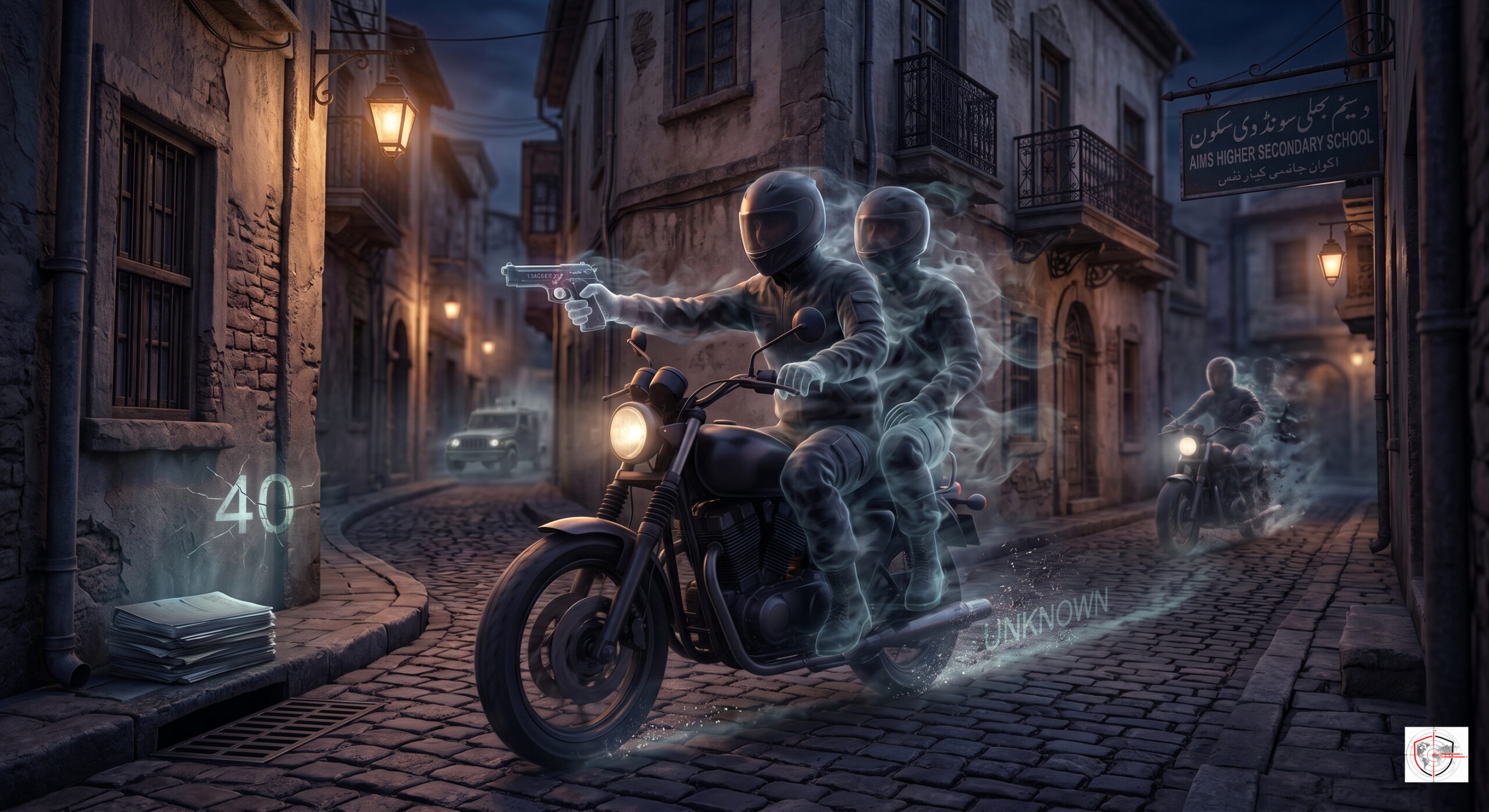
There are 40 families in Uttarakhand, Bihar, Madhya Pradesh, and Jharkhand that buried their sons on Feb. 15, 2019, the morning after the Pulwama car bomb tore through a CRPF convoy on the Jammu-Srinagar highway and turned the deadliest single terror attack on Indian security forces in a generation into a number that would be repeated in every press release, every diplomatic note, and every parliamentary condemnation that followed over the next six years: 40 jawans, gone in seconds, while the man who helped plan it, Arjumand Gulzar Dar, operational alias Hamza Burhan, cover name “Doctor,” resident of Muzaffarabad, principal of a private school, commander of a splinter cell, asset of Pakistan’s ISI, went on living, recruiting, radicalizing, and running logistics for cross-border terrorism from a rented building on a named road in the capital of Pakistan-occupied Kashmir, with state-provided bodyguards, for seven more years, until the morning of May 21, 2026, when two men on motorcycles arrived during the one window in his security routine when those bodyguards were occupied elsewhere, fired multiple rounds, and dissolved into the narrow streets of Muzaffarabad without leaving a trace that any Pakistani court will ever examine or any Pakistani police file will ever close, because the file, like every one of the 32 files opened across Pakistan since January 2020 when another Muzaffarabad school principal was shot three times in the head, says the same two words that have become the operational signature, the institutional silence, and the most honest sentence in South Asia’s most consequential undeclared war: unknown assailants.
The File That Always Says Unknown
At 1:40 p.m. on May 21, 2026, a young man stepped through the front gate of AIMS Higher Secondary School on the Western Bypass of Muzaffarabad. He was the school’s principal. He wore no uniform. He carried no weapon. He had, for reasons that would only become clear later, sent his two ISI-provided bodyguards inside to meet two unknown visitors who had requested a private audience, an arrangement so convenient that it was almost certainly not accidental. Three men on motorcycles were waiting.
Three shots, one to the head, one to the chest, one to the abdomen. By the time Pakistani police arrived, two of the three attackers had dissolved into the narrow streets of Muzaffarabad, leaving nothing behind but spent casings and the silence that follows professional work; one was subsequently apprehended by Pakistani authorities. The principal, whose real name was Arjumand Gulzar Dar, whose operational alias was Hamza Burhan, whose cover designation was “Doctor,” was still breathing when they reached him. He was airlifted to a military hospital. He survived on life support for several hours before dying of his injuries.
The Indian government, designating him a terrorist under the Unlawful Activities (Prevention) Act in 2022, had stated that Arjumand Gulzar Dar, alias Hamza Burhan, alias Doctor, was a resident of Kharbatpora, Ratnipora, Pulwama, and a key member of Al-Badr, a proscribed terror organisation. He was born in the same district that gave the world, on Feb. 14, 2019, one of the most devastating single acts of terrorism in South Asia’s modern history: the Pulwama car bomb that tore through a CRPF convoy and killed 40 Indian soldiers in the deadliest strike on Indian security forces since the 1993 Mumbai bombings. Hamza Burhan was considered one of the main planners of the Pulwama attack, a local man from the same district as the suicide bomber, who knew the terrain intimately and used that knowledge to provide explosives and logistical support to the attackers.
His father, Gulzar Ahmed Dar, told journalists after the killing: “He got what he deserved.” A sentence that contains, compressed into six words, an entire biography of grief, estrangement, and something too complicated to call justice and too real to call anything else. This is the story of that killing, that man, and the six-year covert campaign it belongs to. But it is also a story about something larger, deeper, and more consequential: what happens when a democratic state exhausts every institutional instrument and finally reaches for the only tool that has no paperwork.
“The motorcycle has no flag. The bullet has no court date. The file says unknown. And the state, having exhausted every word it was given, has learned to speak in a language that leaves no transcript — only a result, and a silence that both sides understand perfectly.”

What We Are Watching
Let us walk through it clearly, because the language surrounding covert action is designed professionally, institutionally, deliberately to prevent clarity. A covert operation, in the doctrinal framework used by every major intelligence service, is any activity whose sponsoring state must remain hidden. The CIA’s formal definition describes it as an activity conducted to influence foreign conditions where the role of the United States is not intended to be apparent or acknowledged. India’s Research and Analysis Wing, established in 1968 following the strategic humiliation of the 1962 Sino-Indian War, operates under no comparable public doctrine. Its mandate is understood, not written. Its operations are acknowledged, never.
What is happening in Pakistan is not a sequence of unrelated criminal murders. The taxonomy of the last six years, 32 individuals, each designated a terrorist by the Government of India, each eliminated by two gunmen on motorcycles inside Pakistan’s borders, across eight cities and multiple jurisdictions, with a uniform tactical signature and uniformly cold police files, describes not a criminal enterprise but a strategic program. The word for it in the academic literature is “targeted killing.” In Orwell’s plain English, it is an assassination. In the language of international law, it occupies a juridical space that no treaty has successfully defined, and no tribunal has yet adjudicated.
In “Terror and Consent” (2008), Philip Bobbitt argued that the emergence of what he called the “market state,” a sovereign entity defined more by its ability to protect opportunity than to enforce law, would produce exactly this kind of doctrine: the state choosing effectiveness over legality when legality has demonstrably failed to protect its citizens. We have arrived at that point. India is doing what Bobbitt predicted a state would eventually do. The question is not whether it is happening. It is what it means that it is.
“A nation that cannot deliver justice through its institutions does not stop wanting justice. It simply stops asking its institutions for it. That is not the death of the rule of law. It is the moment the rule of law is asked to answer for what it failed to prevent — and has no answer.”
The Boy from Pulwama
Hamza Burhan left for Pakistan in 2017, telling his family he was pursuing higher studies. He did not pursue them. He joined Al-Badr and quickly rose to the rank of commander. After distancing himself from Al-Badr’s formal structure around 2021, he established a splinter cell calling itself “Lone Wolf Warriors,” a name that reveals precisely the operational logic of the post-Pulwama jihadi ecosystem. With large organisational hierarchies increasingly exposed and targeted, smaller, deniable, structurally flat cells with no formal chain of command became the new architecture of cross-border violence. Hamza Burhan was both a practitioner and a promoter of that model.
And yet he lived openly enough in Muzaffarabad to run a school. Not in hiding. Not underground. In a rented building on a named road in the capital of Pakistan-Occupied Kashmir, with ISI-provided security. His funeral, attended by senior militant commanders and Pakistani intelligence officials, confirmed what his address already implied: he was not sheltering from Pakistan’s state. He was hosted by it.
His father’s words, “He got what he deserved,” are not a simple moral verdict from a grieving parent. They are the sound of a Kashmiri family broken along a fault line that has run through this region for 35 years: young men who leave, radicalise, and return to the valley not as sons but as instruments of a war that nobody who lives it chose. The Pulwama attack on Feb. 14, 2019, remains one of the deadliest attacks on Indian security forces in Jammu and Kashmir. A suicide bomber drove an explosives-laden vehicle into a convoy of CRPF personnel near Lethapora, killing 40 soldiers. The attack triggered nationwide outrage and intensified India’s focus on cross-border terrorism operating from Pakistan and Pakistani-Occupied Kashmir.
For the families of those 40 jawans, most of them young men from rural Uttarakhand, Bihar, Madhya Pradesh, and Jharkhand, earning a serviceman’s wage in a dangerous valley, the killing of Hamza Burhan is not a geopolitical event. It is something that courtrooms and diplomatic communiqués never delivered. Whether one calls it justice or vengeance depends almost entirely on which side of the Line of Control one was standing on when those 40 men were buried.
Thirty-Two Names: The Architecture of a Campaign. The media rarely prints the numbers. So let us print them.
| Year | Eliminations | Notable Targets |
| 2020 | 2–3 | Early-phase; Muzaffarabad principal (Jan.) |
| 2021 | 4–5 | Acceleration begins; Saeed attempts |
| 2022 | 6 | Zahoor Mistry, IC-814 hijacker, Karachi (March) |
| 2023 | 7+ | Shahid Latif (Pathankot); Abu Qasim (Dhangri); Panjwar (Khalistani); Nijjar, Canada (June) |
| 2024 | 4–5 | Continued mid-tier decapitation |
| 2025 | 3–4 | Strategic pause ahead of Operation Sindoor |
| 2026 | 2+ | Hamza Burhan (Pulwama), Masood Azhar’s brother (March) |
The tactical signature across all 32 cases is strikingly, almost uncannily, uniform. Two gunmen on motorcycles. Close-range fire targeting, predominantly, the head. Immediate dispersal. No forensic trace recovered. No group claims responsibility. Pakistani police register each case under “unknown suspects.” Files go cold within weeks.
Notable figures include Paramjit Singh Panjwar, chief of the Khalistan Commando Force, who was gunned down in Lahore, and Shahid Latif, a key handler in the Pathankot attack, who was shot inside a mosque in Sialkot. Historical precedents indicate that the exact actors and intelligence agencies driving these targeted street executions are unlikely ever to be formally identified or acknowledged.
The geographic distribution of these operations, simultaneously active in Lahore, Karachi, Rawalpindi, Sialkot, Peshawar, Nawabshah, Rawalakot, Muzaffarabad, and extending to Surrey, British Columbia, does not describe a single cell. It describes an intelligence network with penetration deep enough to locate, track, and reach targets across hundreds of kilometres of Pakistani territory, across multiple jurisdictions, over six consecutive years. A December 2024 Washington Post investigation concluded that an unnamed Asian intelligence service had been pursuing a methodical assassination program since at least 2021, authorised at the highest levels of its government, and operated through a sophisticated network of intermediaries in the Middle East, particularly Dubai, financed through hawala networks managed by Afghan and regional contractors.
India has neither confirmed nor denied this. The silence is itself part of the operational discipline. It is what David Ignatius, who has covered intelligence services longer and more carefully than almost any journalist alive, would recognise as the first principle of plausible deniability: the absence of acknowledgement is not the absence of agency. It is the proof of professionalism.
“Forty families buried their sons and were handed a dossier. Six years later, someone sent motorcycles. Neither act brought the dead back. Only one of them made the living uncomfortable in Bahawalpur. History will decide which matters more. The dead already know.”
The Historical Library: What States Do When Institutions Fail
Ten thousand years ago, when humans first organised themselves into cities with walls and guards and hierarchies, they also created the first intelligence services men sent beyond the walls to do what the walls could not. The motorcycle gunman in Muzaffarabad is the latest iteration of that ancient architecture. What India is executing is neither unprecedented nor, in the moral calculus of states that have exhausted legal alternatives, without historical legitimacy. The precedents are documented with precision.
In the 1970s, Israel launched Operation Wrath of God following the murder of 11 Israeli athletes at the Munich Olympics. For more than a decade, Mossad operatives hunted Palestinian militant leaders across Europe and the Middle East, including Paris, Rome, Cyprus, and Beirut. The method was varied: explosive devices in telephones, poisoned food, a bullet in a hotel corridor. No group claimed responsibility. The Israeli government maintained studied deniability. Daniel Byman, in “A High Price: The Triumphs and Failures of Israeli Counterterrorism” (Oxford University Press, 2011), documents this campaign in forensic detail and reaches a conclusion of controlled ambivalence: the operations degraded operational capacity, disrupted command continuity, and forced organisational restructuring across multiple generations of Palestinian militant leadership.
They did not break the strategic intent of any targeted organisation. But they imposed a recurring, measurable cost that diplomatic instruments had entirely failed to impose. India, it appears, has read that history carefully, though it would do well to read it completely. Subsequent investigations by journalists and intelligence agencies across multiple countries produced a far less flattering verdict on Operation Wrath of God than Mossad’s official narrative ever acknowledged: several of the individuals targeted and killed, it emerged, had no operational connection to the Munich attack whatsoever, and at least some of those eliminated were ordinary civilians, not militant commanders. The operation that Israel presented to the world as a model of precision deterrence was, in significant measure, a campaign that struck the wrong people with the same professional certainty it applied to the right ones.
In Russia, Alexander Litvinenko died in London in 2006 from polonium-210 poisoning, a radioactive isotope that required state-level access to obtain. The killers were never prosecuted. In the United States, the post-9/11 drone program eliminated targets across Yemen, Somalia, Afghanistan, and Pakistan, including Anwar al-Awlaki in 2011, an American citizen killed without trial, without indictment, without a court ever hearing evidence against him. The Obama administration called it “targeted killing.” Civil liberties scholars called it extrajudicial execution. Both agreed on one point: this was a doctrine, and doctrines, once institutionalised, do not retire themselves.
What makes India’s campaign distinctive is not the method, the motorcycle assassin is the world’s oldest instrument of political killing, but the scale, the consistency, the six-year operational continuity, and the fact that it is being executed inside the territory of a nuclear-armed state that has spent six decades cultivating the very networks now being systematically eliminated.
Christine Fair’s “Fighting to the End: The Pakistan Army’s Way of War” (Oxford University Press, 2014) provides the indispensable framework for understanding why those networks exist in the first place. Since Pakistan was founded in 1947, its army has dominated the state, locking the country in an enduring rivalry with India, with the primary aim of wresting Kashmir from it. It has sustained a proxy war in Kashmir since 1989 using Islamist militants, supporting non-Islamist insurgencies throughout India, and a nationwide Islamist terror campaign that has brought the two countries to the brink of war on several occasions. Fair’s central argument that this is not an aberrant policy but the expression of a coherent strategic culture built around civilizational parity-seeking explains why Hafiz Saeed survives, why Masood Azhar is protected in Bahawalpur, and why Hamza Burhan had ISI-provided bodyguards until the morning they could no longer help him.
Steve Coll’s “Directorate S: The CIA and America’s Secret Wars in Afghanistan and Pakistan” (Penguin Press, 2018) provides the companion document: a forensic account of ISI’s Directorate S, the covert action arm of Pakistan’s intelligence service that, over the years, supported various Islamist militants operating across Pakistan’s borders, either in Afghanistan or in India. The structural reality Coll documents, an intelligence service institutionally committed to militant proxies as foreign policy tools, is precisely the reality that diplomatic notes, FATF warnings, and UN Security Council resolutions have spent 30 years failing to dismantle.
When institutions fail completely and repeatedly, states historically reach beyond them. Bruce Riedel documented this logic in “Deadly Embrace: Pakistan, America, and the Future of the Global Jihad” (Brookings Institution Press, 2011), tracing how Pakistan’s cultivation of jihadi proxies across four decades created networks so structurally embedded in the state that even genuine dismantlement would require tearing the institution itself apart. The central paradox of India’s covert campaign follows directly from Riedel’s analysis: Hafiz Saeed breathes. Masood Azhar breathes. Their mid-tier commanders, the Hamza Burhans, the Shahid Latifs, the Abu Qasims, fall one by one, while the patron layer, shielded inside the ISI’s institutional architecture, remains, for now, beyond reach.
“When the state exhausts its words, it reaches for what needs none. When courts fail, institutions fail, and dossiers gather dust in diplomatic pouches, the silence that follows is not the silence of surrender, it is the silence of a decision already made, a trigger already pulled, a file already marked unknown by the only people who know exactly what happened.”
The Intelligence Infrastructure
The media will not tell you this part. So let us be precise about it. What the 32-operation pattern reveals is not merely intent but capability. To track a designated terrorist across multiple cover identities in a Pakistani city to know his alias, his address, his daily schedule, his bodyguard rotation, and the precise window during which those bodyguards would be occupied elsewhere requires intelligence penetration of a depth and duration that no improvised criminal network possesses.
The December 2024 Washington Post investigation described a network of Middle Eastern intermediaries, particularly Dubai-based operatives, who were used to finance and coordinate operations through hawala channels. Dubai’s position as the financial nervous system of both the Indian diaspora and Pakistani remittance corridors gives it a unique capacity as an operational hub: money moves without formal banking records, operatives travel without requiring Pakistani visas, and contractors can be paid without institutional fingerprints.
Husain Haqqani, former Pakistani ambassador to the United States and author of “Pakistan: Between Mosque and Military” (Carnegie Endowment for International Peace, 2005), argued with prophetic precision that a Pakistani state structurally incapable of prosecuting its own intelligence-cultivated militants would, eventually, produce a response from India that bypassed the prosecutorial framework entirely. That response is now operational, running, and accelerating. Haqqani’s warning that a state which outsources violence as foreign policy eventually loses control of the violence it has outsourced applies, with equal and opposite force, to the state now deploying the response.
The Ceiling: Pahalgam and the Limits of the Ghost Trigger
Here is what the 32 names cannot tell you. And it is the most important thing this column will say. In April 2025, 26 Hindu tourists were shot dead in a meadow in Pahalgam, the single deadliest civilian massacre in Kashmir in over two decades. The command layer of Pakistan’s Kashmir terror infrastructure had been systematically degraded through five years of targeted elimination. The Pahalgam attack happened anyway.
The insurgency did not end. It adapted. Smaller cells. No large cross-LoC networks requiring centralised logistics. No single command structure that can be decapitated in one operation. Lone Wolf Warriors, the very model that Hamza Burhan himself had promoted and institutionalised, is precisely the architecture that survives the ghost trigger, because it is designed to survive it. There is no headquarters to locate. There is no commander whose elimination dissolves the cell. The bullet arrives for the planner, and the plan continues without him.
This is what Israel discovered across 50 years of targeted killing operations. You can eliminate the operational architect. You cannot, by that method alone, eliminate the ideology, the financing, the political patronage, or the institutional state support that enables the next planner to emerge. Byman’s “A High Price” documents the bitter paradox: every generation of Palestinian militant leadership that Mossad eliminated was succeeded by a generation more decentralised, more adaptive, and in some ways more difficult to degrade. The method works on organisational structures.
It works less well on ideas, and it works not at all on state policy. This is a reality that neither Hollywood nor Bollywood prepares its audiences for. The covert operative in the cinema departs cleanly, the mission accomplished, the threat extinguished. In the empirical record, the mission rarely resolves cleanly: the enemy is degraded, not destroyed; the network disperses rather than collapses; the ideology the operation was designed to punish often recruits more effectively from the grief the operation leaves behind than it ever did from the ideology it promoted. Covert operations are tools of attrition, not instruments of resolution, and conflating the two as popular culture systematically does and as strategic planners occasionally permit themselves to is among the more consequential errors a democratic state can make when calibrating what its shadow war is actually achieving.
Operation Sindoor India’s May 2025 airstrikes on nine terror infrastructure sites across Pakistan and Pakistani-Occupied Kashmir, the most significant Indian military action across the international border since 1971, represented the moment when the covert campaign’s implicit ceiling became explicit. When motorcycles had not broken the strategic intent, aircraft were sent. The covert became overt. The shadow war cast an actual shadow. And still: Hafiz Saeed is alive. Masood Azhar is alive. His brother, Muhammad Tahir Anwar, was killed by unknown gunmen in March 2026. Azhar himself, in Bahawalpur, was not.
The Contrarian Argument
There are scholars, not apologists for terrorism, but serious researchers of conflict and democratic governance who argue that India is running directly into the trap that Pakistan built.
The argument, published with scholarly rigour in the East Asia Forum and developed further in work by researchers at the Carnegie Endowment and the International Crisis Group, runs as follows. Proxy assassination networks, once institutionalised inside a democratic state’s intelligence architecture, are extraordinarily difficult to contain, redirect, or retire. Pakistan’s own experience with the Tehrik-i-Taliban Pakistan is the definitive case study: a state that cultivated jihadist proxies for strategic ends across three decades, eventually watched those proxies turn inward, killing thousands of Pakistani soldiers and civilians in exactly the blowback that strategic analysts had warned about. The proxy is never fully controllable. The violence is never fully bound.
Building a covert kill architecture that operates through hawala financing, utilising compartmented cells of contracted gunmen, and establishing targeting pipelines that evade judicial oversight creates institutional precedents and actors that democratic governments are rarely able to fully dismantle when the original target set has been eliminated. The methods that eliminate Hamza Burhan in Muzaffarabad today can be applied to other categories of targets tomorrow. Daron Acemoglu and Simon Johnson, in “Power and Progress” (PublicAffairs, 2023), argue that technological and institutional capabilities developed for specific purposes almost always expand beyond their original mandate. Once the capability exists, the operators are trained and compensated and embedded. A covert kill program is precisely such a capability.
This is not a frivolous argument. It deserves a direct response. The direct response from India’s strategic community is equally unambiguous, and it runs through the specific, non-abstract history of institutional failure. After Pulwama. After Uri. After Pathankot. After the 2008 Mumbai attacks that killed 166 people, for which no Pakistani court has delivered accountability in 18 years. After every NIA chargesheet filed, every dossier delivered to Islamabad, every FATF grey-listing subsequently softened under Pakistani diplomatic pressure, every UN sanction designation subsequently diluted by Chinese veto. The question posed from New Delhi is not rhetorical: what tool remained? The chargesheet names the conspirators. Pakistan refuses to try them. International pressure has produced, in three decades, no accountability. When every institutional channel has been exhausted completely and repeatedly, what is the democratic state’s alternative? Perpetual victimhood administered through diplomatic notes? The honest answer is that both arguments are correct simultaneously, which is the most uncomfortable place for a democracy to stand.
The Price Nobody Accounts For
The negative implications of a sustained, unacknowledged covert assassination program, even one directed at individuals whose guilt is not in serious dispute, are neither hypothetical nor distant; they are structural, they are accumulating, and the historical record makes them entirely predictable. Chalmers Johnson, in “Blowback: The Costs and Consequences of American Empire” (Metropolitan Books, 2000), gave the intelligence world’s own internal term its definitive political meaning: blowback describes not merely the immediate tactical retaliation that follows a covert strike, but the long, slow return of violence against a population that never knew the operation was conducted in its name and therefore has no framework for understanding why the retaliation has come. Examples of unintended consequences from covert policies include retaliation attacks directed at civilians or military personnel, the erosion of international law, the destruction of political credibility, and the collapse of alliances.
Applied to India’s six-year campaign inside Pakistan, Johnson’s framework produces a sobering inventory: every elimination that goes unacknowledged is a provocation that cannot be politically managed, because a government that will not confirm the original act has no standing to negotiate the response; every contractor recruited into the operational network carries knowledge that can, under pressure or inducement, be redirected; every hawala channel established to finance a legitimate counter-terror operation becomes a permanent feature of the shadow economy that democratic institutions will never fully account for or retire.
Daron Acemoglu and Simon Johnson, in “Power and Progress” (PublicAffairs, 2023), argue that institutional capabilities developed for specific, bounded purposes almost always expand beyond their original mandate once the operators are trained, compensated, and embedded a principle that applies with specific force to covert kill programs, which historically demonstrate what security scholars call “mission creep” not as aberration but as operational law: the network built to reach Hamza Burhan in Muzaffarabad is structurally capable of reaching other categories of target in other cities, and the precedent for doing so has already been set. Philip Bobbitt, in “Terror and Consent” (Knopf, 2008), warned that a democratic state which abandons legal frameworks under strategic pressure even for defensible reasons does not simply suspend those frameworks for the duration; it teaches its own institutions that legality is conditional, which is a lesson that outlives the emergency that produced it and shapes every subsequent decision about what the state may do without acknowledgment.
The precautions that a democratic state running such a program must build into its architecture are not optional governance aesthetics; they are the structural difference between a bounded counter-terror instrument and a permanent, unaccountable apparatus: a defined target category with explicit legal authorization, even if classified; parliamentary oversight committees with genuine access to operational data rather than sanitized briefings; a sunset mechanism requiring active reauthorization at intervals no longer than two years; a legal doctrine however internally classified that distinguishes the designated terrorist from the political dissident, the journalist, the civil society activist who criticizes the state from abroad; and, critically, a public acknowledgment strategy for the moment when the program’s existence becomes unsustainable to deny, because that moment always arrives and the states that have prepared for it Israel, eventually; the United States, reluctantly survive the disclosure with their democratic legitimacy structurally intact, while the states that have not are left explaining, without framework or precedent, why the files said “unknown” while the intelligence said everything. India is not there yet.
But thirty-two names in six years is a trajectory, not a plateau, and the political architecture for managing what comes next the escalation, the exposure, the retaliation that strikes not the intelligence operative but the civilian who shares a country with the program they were never told about needs to be built now, in the deliberate calm before the next motorcycle, not improvised in the panicked hours after. A state that kills without a constitutional framework for doing so is not more secure for the killing; it is more brittle, because it has traded the rule of law, the only instrument that survives governments, prime ministers, and intelligence chiefs, for a tactical advantage that, as Israel’s five decades of targeted killing demonstrate, never produces the strategic settlement it is deployed to create.
The Nuclear Dimension
Let us say plainly what most commentary is careful to soften. Christine Fair explicitly argues that nuclear weapons have given Pakistan’s security establishment tremendous psychological confidence, and that this confidence is deployed operationally using militants as a strategic shield for Kashmir, enabling Pakistan to avoid direct conventional confrontation with India.
The nuclear umbrella, in Fair’s analysis, is not merely a deterrent against Indian military action. It is the enabling condition for Pakistani proxy warfare: a state can sustain asymmetric violence against its larger neighbour precisely because nuclear escalation makes conventional retaliation politically catastrophic for both sides.
India’s covert campaign is, in part, a response to the nuclear constraint itself. If conventional military action against Pakistani soil carries an escalation risk that rational actors must weigh seriously, then the covert campaign becomes the instrument that operates below that threshold: enough to impose a measurable, recurring cost on Pakistan’s terror infrastructure; not enough to trigger the nuclear calculus. This is a sophisticated doctrine. It is also, by definition, an indefinitely escalatable one.
Gideon Rachman, in “Easternization: Asia’s Rise and America’s Decline” (Other Press, 2017), warned that the defining risk in South Asia is not a single catastrophic confrontation but sustained, low-intensity conflict that normalises state behaviours, covert killing, proxy sponsorship, cross-border strikes that any external framework for regional stability would previously have classified as acts of war. We have normalised them. Both sides have. The question now is not whether this is a dangerous precedent. It is whether any institutional architecture, bilateral, regional, or international, is capable of managing the escalation before the covert campaign and the conventional threshold touches each other in a way that cannot be walked back.
The people who should be most concerned about this are not the intelligence analysts in Delhi or the generals in Rawalpindi. They are the seven million people of Kashmir, on both sides of the Line of Control, who live in the territory over which this shadow war is being fought, who were not consulted about its conduct, and who will bear the primary cost of any miscalculation.
When Institutions Fail, the State Pulls the Trigger: Thirty-two designated terrorists eliminated inside Pakistan in six years. No group claimed responsibility. The files say “unknown.” This is what accountability looks like when diplomacy has nothing left to offer.
The View From Srinagar
I want to say something about what this looks like from here. From the streets of Srinagar. From Pulwama, where the fields are beautiful, and the people have buried too many of their young men for reasons manufactured in Bahawalpur and Rawalpindi.
The families of the 40 CRPF jawans killed on Feb. 14, 2019, were never going to see a Pakistani court convict Masood Azhar. They were never going to see an Interpol red notice produce an extradition. They were never going to see a dossier delivered to the United Nations produce accountability. The machinery of international justice, when one of its members is a nuclear-armed state with a permanent friend on the Security Council and a strategic usefulness to Washington and Beijing alike, does not produce accountability. It produces communiqués.
For those families and for the families of those killed in Uri, in Pathankot, in Dhangri, in Pahalgam, the ghost trigger is delivering something that courtrooms did not. Whether one calls that justice depends on whether one believes justice requires a formal verdict or merely requires that the guilty eventually face consequences. Hannah Arendt, in “Eichmann in Jerusalem” (1963), argued that justice requires a public record that accountability without visibility is not accountability but merely revenge conducted in the dark. The ghost trigger produces no public record. The FIRs say “unknown.” The files go cold.
The families of the 40 jawans may not care about Arendt. They may be right not to. But the society that permits a state to kill without record is accepting a different kind of governance, one where accountability flows only in one direction, and the state that claims to protect you also claims the right to act on your behalf in ways it will never acknowledge. For the people of Srinagar, already living under decades of security structures that claim protection and deliver control, the ghost trigger raises a question with no comfortable answer: when the state acts in the shadows to avenge the dead, does it serve justice, or does it simply extend the long history of violence in which ordinary people are the permanent collateral?
Sainath spent two decades documenting how Indian institutions fail the ordinary citizen, how the distance between the state’s rhetoric of protection and the reality of people’s lives is the central political fact of the subcontinent. The families of the 40 jawans are ordinary citizens. The state has now acted for them, in their name, by a method they were not told about, against men they will never see in court. That is not a clean outcome. It is the only one available. And it is worth being honest about the price of it.
“Somewhere in Muzaffarabad, a file sits in a police station drawer. It lists the cause of death. It lists the time. It lists the location. In the column reserved for suspects, it says: unknown. Somewhere in the same city, the men who know know. Somewhere in New Delhi, the men who ordered know. And somewhere in Pulwama, in a village that gave the world a car bomb and a chargesheet no court ever acted on, a father whose son never came home from that convoy on Feb. 14, 2019, does not know the operational details, and does not need to. He knows the result. That, in the end, is all any of them were ever asking for.
The Only Honest Conclusion
Thirty-two names. Six years. Two gunmen on motorcycles, every time. Muzaffarabad, Sialkot, Karachi, Lahore, Rawalpindi, Peshawar, Rawalakot, Nawabshah, Surrey. Pakistani police, every time: unknown suspects. Files, every time: cold.
The fatal shooting of Hamza Burhan in Muzaffarabad is not an isolated incident. Over the past few years, a successive wave of high-profile India-wanted operatives residing in Pakistan have met identical ends at the hands of “unknown gunmen.” Historical precedents indicate that the exact actors driving these clinical street executions are unlikely ever to be formally identified or acknowledged.
This is not gang violence. This is not settling criminal scores between rival factions. This is a covert campaign of state deterrence, conducted with professional precision, sustained over six consecutive years across multiple cities and jurisdictions, targeting a specific, legally defined category of individuals, those designated by India for attacks on Indian soil while leaving no formal fingerprint. It is not random. It is not a coincidence. It is a doctrine.
Jamal Khashoggi, who understood from devastating personal experience what it costs to name plainly the covert violence that states conduct in the shadows, wrote that journalism’s essential obligation is to say precisely what official language exists to obscure. The thing to be named here is this: India has built and is running a covert assassination program inside the territory of a sovereign state. That program is eliminating people who are unambiguously complicit in mass murder. That program is also operating outside any judicial framework, any democratic oversight mechanism, any international legal architecture. Those three facts coexist. They cannot be separately true. They are simultaneously true.
Whether one judges the program as justified depends almost entirely on one’s answer to a prior question: what is a democratic state owed when every peaceful instrument has failed completely? If the answer is “nothing further, it must continue to absorb the cost of those failures,” then the ghost trigger is indefensible. If the answer is “eventually, the state reaches for what no other instrument can achieve,” then the ghost trigger is the logical expression of three decades of exhausted alternatives.
The ghost trigger is not stopping. It shows no sign of stopping. Hamza Burhan’s father said his son got what he deserved. The ISI officials who attended his funeral had provided him with bodyguards that a better-resourced and better-informed operation rendered irrelevant. Someone knew exactly where he was, exactly when he was alone, exactly how to disappear from a Pakistani city without a trace. Thirty-two times. Someone has known everything.
The files say “unknown.”
Both things are true. And the distance between those two truths is where South Asia’s most dangerous and least acknowledged war is being fought one motorcycle at a time, one name at a time, with no verdict ever issued and no tribunal ever convened. Because when the state has nothing left to lose, it stops pretending…….
Kharbatpora: Where the Story Began and Ended, He Got What He Deserved
Justice, or the Only Thing Left That Resembled It
There is a village in Pulwama called Kharbatpora. It is not famous. It will not appear on any tourist map of Kashmir. It is the kind of place that only enters the news when something catastrophic has already happened, and even then, it appears for a day, perhaps two, before the news cycle moves on and the village is left to absorb, alone and without ceremony, whatever the catastrophe has deposited in its soil.
Arjumand Gulzar Dar was born there. He left at 18, telling his family he was going to study medicine. He came back to the region as a designated terrorist, a militant commander, a school principal, and a man whose own father, Gulzar Ahmed Dar, who still lives in Pulwama, who still wakes up in the same district where 40 CRPF jawans were buried in a single afternoon, told journalists, after the killing, he got what he deserved.
Six words. The entire moral weight of 35 years of Kashmir’s conflict, compressed into one sentence by a father who watched his son leave for Pakistan and understood, before any intelligence agency filed a report, exactly what the destination meant.
The 40 families from Uttarakhand, Bihar, Madhya Pradesh, and Jharkhand that buried their sons on Feb. 15, 2019, were handed a chargesheet. They were handed a dossier. They were handed diplomatic notes and FATF warnings and UN Security Council resolutions, and they considered the silence of institutions that had, for three decades, processed their grief into procedure and returned nothing. What they were never handed was a verdict. What they were never given was a courtroom that produced one.
Six years later, someone sent motorcycles.
Whether one calls what followed justice depends on a prior question that this column has tried to ask honestly and without resolution: what is a democratic state owed when every peaceful instrument has failed, and failed not once but 26 times across 26 years of attacks and dossiers and silence from Bahawalpur? The question has no clean answer. It has only consequences — for the 32 men who are dead, for the institutions that produced the silence that made those deaths feel like the only available response, for the civilians on both sides of every border involved who will absorb the blowback of a war they were never asked about and never asked for.
The ghost trigger is not stopping. It shows no sign of stopping. And every time it fires and the Pakistani police open another file and write the same two words in the same column — every time the file says unknown while the intelligence says everything — South Asia moves one motorcycle further from the institutional framework that could, eventually, make the motorcycles unnecessary.
That framework does not exist yet. Building it is the only work that matters.
The files say unknown. Both sides know that isn’t true. That shared knowledge — unspoken, unacknowledged, permanent — is the only treaty this war has ever had.
GO TO HOME PAGEhttp://theredlines.world
The Ghost Trigger: India’s Shadow War and the Doctrine That Dare Not Speak Its Name – 2026
About The Author