
Caliphate by Proxy
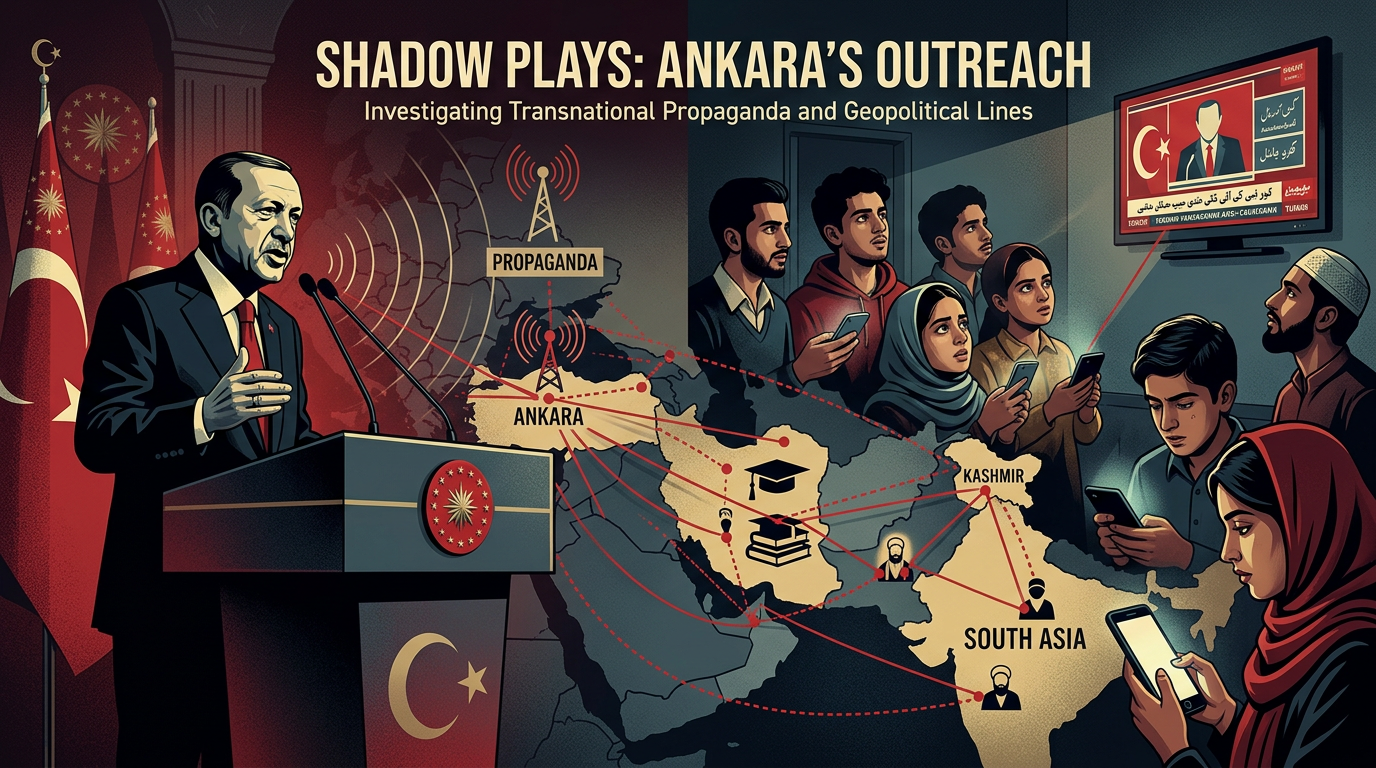
Caliphate by Proxy – 2026
Turkey’s outreach to Indian Muslims is not humanitarian solidarity but a calculated instrument of Erdogan’s revivalist ambitions, in which Kashmir functions less as a cause than as a credential.
The instinct, on first encountering Ankara’s noisy interventions on Kashmir, is to file them under the familiar cabinet of diplomatic theatre: a leader postures at the UN General Assembly, a hashtag trends, Islamabad applauds, and the world moves on. That instinct is comfortable, and comfortably wrong. What a close reading of Turkey’s institutional footprint in India reveals is not a passing rhetorical alliance with Pakistan but a patient, multi-decade project of ideological insertion, one that treats Kashmir, Indian Muslims, and South Asia’s wider Islamic constituency as raw material for a much larger ambition: the resurrection of the Caliphate, with President Recep Tayyip Erdogan cast, quite literally, as Caliph.
The record on this is not speculative; it is documented, if underexamined. In his address to the 74th session of the UN General Assembly in September 2019, Erdogan called Kashmir “besieged,” described eight million Kashmiris as trapped in an “open-air prison,” and drew an explicit analogy to Palestine. Co-hosting a sideline event on “Combating Hate Speech” with Pakistan, he went further still, invoking Hindu-Muslim tensions over beef consumption and declaring Turkey’s resolve to “defend the rights of Muslims living in Jammu and Kashmir.” The hashtag #OurVoiceErdogan generated roughly 300,000 tweets within hours, a volume that no ordinary diplomatic statement produces organically. The question that Indian strategic commentary too often skips is not whether Erdogan said these things he plainly did but why a leader with no historical stake in Kashmir would invest this much rhetorical capital in a dispute thousands of kilometres from Ankara.
The answer lies not in Kashmir but in Erdogan’s domestic and pan-Islamic calendar. Turkey’s ruling establishment has, for over a decade, nursed an ambition to revive the institution of the Caliphate by 2023, the centenary of the Turkish republic’s founding, with Erdogan positioned as the spiritual, moral, and political head of Muslims worldwide. A 2018 headline in the pro-government daily Yeni Safak put the ambition in plain print: “Erdogan: Turkey is the only country that can lead the Muslim world.” Kashmir, Palestine, Xinjiang, and Myanmar are not causes Erdogan champions out of universalist conviction; they are credentialing devices, each atrocity narrative a rung on the ladder toward pan-Islamic legitimacy that Riyadh’s clergy and Cairo’s establishment have long monopolised. This is realpolitik dressed as piety, and the distinction matters enormously for how India should read it.
That ambition finds intellectual scaffolding in GASAM, the South Asia Strategic Research Centre, a Turkish think tank founded by Ali Sahin, reportedly a Pakistani-origin Islamist who now serves as a deputy minister in the Turkish government. GASAM’s stated purpose is unremarkable on paper: conferences, papers, outreach to South Asian Muslim leaders. Its assessed operational logic, however, is considerably less benign. According to the analysis, GASAM’s strategy involves raising political awareness among Indian Muslims to encourage a bid for political power built on Islamic religious and cultural identity; propagating a narrative that Indian Muslims are besieged by Hindu nationalism; eroding faith in India’s secular constitutional order; and cultivating a shared political-religious identity across South Asian Muslims that could, in time, mirror the radicalisation trajectory already visible in Kashmir.
“A narrative does not need an army to conquer a mind; it needs only patience, funding, and an audience already primed to feel besieged.”
None of this would matter much if it were confined to seminar rooms in Ankara. It is not. The paper traces a network of touchpoints across India: Kerala, Hyderabad, Bangalore, and Aligarh, each cultivated with a different instrument but with a common objective: normalising Turkish religious and political authority among segments of the Indian Muslim population. In Kerala, prominent business families, selected madrasas, NGOs, and politicians reportedly constitute the core of Turkish engagement, with around 80 students said to have travelled to Turkey on state scholarships in a single year to study religion. Members of the Indian Union Muslim League are described as being in direct or indirect contact with Turkish entities. In Hyderabad, the effort reportedly extends to plans for a dedicated foundation. Aligarh Muslim University, notably, conferred an honorary doctorate on Erdogan himself. Turkey’s government has reportedly channelled some 460 million dollars to Islamist foundations globally, a sum whose downstream allocation to Indian religious organisations, while not itemised, is not implausible given the pattern established elsewhere.
The obvious objection here is that religious and educational exchange between Muslim-majority countries and India’s Muslim community is neither new nor inherently sinister; Gulf scholarships, madrasa linkages, and pilgrimage networks have existed for generations without producing insurrection. That objection deserves to be taken seriously rather than dismissed, and it is precisely where the analytical distinction must be sharpened. The concern is not that Indian Muslims study abroad or engage with global Islamic discourse; the concern is the asymmetry between the scale of investment, the selectivity of the intermediaries chosen, and the narrow ideological register in which that investment operates. When the conduits are consistently controversial clerics Sheikh Salman Nadwi, who once offered to raise an army of 500,000 Indian Muslims for jihad before retracting the statement, or Zakir Naik, wanted in India for inspiring the 2016 Dhaka ISIS attack and reportedly hosted warmly by Turkish Islamist circles including TUGWA, an organisation run by Erdogan’s own son Bilal the pattern stops looking like cultural diplomacy and starts looking like targeted radicalisation infrastructure.
The historical antecedent for this kind of mobilisation is not obscure; it is India’s own Khilafat Movement of 1919, when Mahatma Gandhi allied the freedom struggle with a campaign to restore the Ottoman Caliphate, hoping to unite Hindus and Muslims against British rule. The alliance backfired in ways that still echo. When Kemal Ataturk abolished the Caliphate in the 1920s, the movement collapsed, but not before, according to several historical accounts, it had sharpened communal fault lines and pushed a segment of Muslim politics toward the separatist trajectory that culminated in Partition. The Ali Brothers, prominent Khilafat leaders from Punjab, drifted from that movement directly into the politics that produced Pakistan. What should unsettle observers today is the geographic overlap: the regions showing the most enthusiastic uptake of Erdogan’s contemporary Islamist narrative Lucknow, Hyderabad, Calcutta, Kerala are largely the same regions that were most active a century ago in the Khilafat agitation. History, in this reading, is not repeating; it is being deliberately reactivated.
If the domestic outreach machinery constitutes one arm of Turkey’s strategy, its media arm is the second and arguably more consequential. TRT World, Turkey’s state broadcaster, maintains an outsized and highly professional focus on Kashmir, with video content the paper describes as comparable in production quality to that of the best international broadcasters. A casual search reveals dozens of videos with titles engineered for maximum emotional resonance: “Is Kashmir becoming Palestine?”, “13,000 boys detained in Kashmir,” “You can watch this video, but millions of Kashmiris cannot.” One widely viewed video on the Kashmir conflict alleges RSS massacres in 1947 with casualty figures ranging implausibly from 20,000 to 100,000, a claim presented without the kind of source rigour that would be demanded of comparable historical assertions elsewhere.
What makes this propaganda architecture effective is not fabrication alone but selective omission. The videos foreground alleged human rights violations pellet-gun injuries, detentions, and night raids while systematically excluding the fact that much of the street mobilisation they document has been organised and financed by Pakistan’s deep state through separatist intermediaries. The paper cites a 2016 sting operation by India Today in which separatist leader Nayeem Khan allegedly acknowledged that the ISI funnelled roughly 450 crore rupees into Kashmir to engineer civil unrest following Burhan Wani’s death. TRT World’s silence on this financing trail is not an editorial oversight; it is a structural feature of narrative-building that requires villains to be simple and grievances to appear organic rather than manufactured.
This is where the false binary that dominates Indian public discourse on Kashmir needs dismantling. One camp treats every account of security-force excess as manufactured propaganda designed to malign India; another treats every such account as self-evidently true regardless of provenance. Both postures are analytically lazy, and both let a more dangerous actor off the hook. Genuine grievances in Kashmir over accountability, over civilian casualties, over the asymmetric burden borne by ordinary residents deserve serious documentation and redress; they do not deserve to be laundered through a foreign state broadcaster with an explicit ideological agenda that has nothing to do with Kashmiri welfare and everything to do with Ankara’s claim to Islamic leadership. Treating TRT World’s output as either wholly false or wholly credible misses the more precise diagnosis: it is selectively true, curated for strategic effect, and weaponised toward an objective that predates and outlasts any specific news cycle in the Valley.
The separatist leadership’s embrace of Erdogan supplies further texture to this picture. Mirwaiz Umar Farooq reportedly hailed Erdogan’s 2018 re-election by calling him “an ardent supporter of Kashmir’s right to self-determination,” while Jamaat-e-Islami Kashmir described Turkey as “the hope of Ummah.” Greater Kashmir, a prominent separatist-leaning publication, characterised Erdogan’s victory as “a win for all oppressed people in the world.” When Delhi banned Jamaat-e-Islami, an organisation the paper describes as functioning as the intellectual and religious arm of Hizbul Mujahideen, Turkish state media reportedly criticised the move sharply. These are not coincidental affinities; they are the visible surface of an ideological alignment between Ankara’s Caliphate project and Kashmir’s separatist ecosystem, mediated substantially through Jamaat-e-Islami’s transnational networks.
The pull-quote earns repetition here because it compresses the entire mechanism: a narrative does not need an army to conquer a mind; it needs only patience, funding, and an audience already primed to feel besieged.
Kashmir, over the past decade, has supplied exactly that audience, shaped by Pan-Islamist currents flowing from the Arab Spring, ISIS’s Caliphate messaging, Gulf-funded Wahhabi proselytisation, and the accumulated alienation produced by decades of underperforming local governance. The paper notes something genuinely counterintuitive here: even Kashmir’s secular intellectuals have increasingly come to view the conflict through the prism of Palestine and Gaza, while religiously inclined constituencies read it through the frame of global jihad. Turkey’s messaging apparatus is constructed precisely to capture both audiences simultaneously: the humanitarian-rights framing for the secular-liberal segment, and the Ummah-solidarity framing for the devout a bifurcated appeal that most single-issue propaganda struggles to achieve.
The security implications extend well beyond narrative warfare, though narrative warfare alone would be consequential enough. Turkey’s documented linkages with transnational terror networks are neither new nor contested at the level of intelligence assessment. Turkish intelligence has reportedly funnelled resources to Al-Shabaab; the Maarif Foundation, state-funded and Erdogan-controlled, has pressured African governments into ceding school control following the 2016 coup, with allegations of radical curricula; Dutch intelligence has flagged Turkey as a springboard for foreign fighters transiting to Syria; and Turkey’s former counter-terrorism chief, Ahmet Yayla, has publicly stated he resigned rather than permit ISIS jihadis unimpeded passage through his jurisdiction, alleging that a company with ties to Erdogan’s relatives imported ISIS-linked oil for resale as Turkish crude. US officials have accused Turkey-backed militias in Syria of releasing ISIS detainees during the 2019 offensive, a charge the then US Defence Secretary characterised as possibly constituting war crimes, and which French President Macron separately linked to a resurgence of Islamic State capability.
The relevance of this pattern to India is not abstract. Analysts cited in the paper flag a genuine risk pathway: as American disengagement from Afghanistan proceeds and the Islamic State–Khorasan Province consolidates in the Af-Pak theatre, released or displaced ISIS-linked fighters could migrate toward a region abutting Kashmir, a region where, the paper notes, Kerala nationals have already been documented joining ISKP. Layer onto this the post-Article 370 incentive for Pakistan to reassert relevance in Kashmir through renewed foreign-fighter infiltration, and the strategic picture becomes considerably less comfortable than the “Erdogan is just posturing” school of Indian commentary tends to assume. Both Burhan Wani and Zakir Musa, the paper points out, had articulated explicit aspirations toward an Islamic Caliphate in Kashmir before their deaths, evidence that the ideological ground for exactly the kind of transnational jihadist framing Turkey promotes was already fertile before Ankara’s more recent activism intensified it.
There is also a domestic political dimension that deserves more scrutiny than it currently receives. The paper notes that the overseas unit of a major Indian opposition party announced, in November 2019, a decision to open an office in Turkey a development that, whatever its stated intent, sits awkwardly against the backdrop of Erdogan’s anti-India positioning alongside Pakistan. The concern here is not partisan; it is structural. Any foreign outreach office maintained by an Indian political entity in a country actively running an ideological outreach programme aimed at Indian Muslims creates, at minimum, a channel that could be repurposed whether for intelligence gathering, informal financial transfers, or simply legitimising Ankara’s claim to represent Indian Muslim interests. Institutions created for one purpose often become available for another; that is a lesson in political economy as much as in security studies.
What ties all these threads together the UN speeches, the GASAM strategy documents, the TRT World propaganda machine, the cleric networks, the scholarship pipelines, the honorary doctorates, the separatist endorsements is not a single coordinated conspiracy in the cinematic sense, but something more mundane and therefore more durable: an institutional ecosystem in which multiple actors, each pursuing overlapping but distinct incentives, converge on a common outcome. Erdogan wants Caliphate legitimacy; GASAM wants intellectual relevance and funding; separatist leadership wants international validation; Jamaat-e-Islami wants ideological reinforcement; and ordinary students and clerics caught in the scholarship and conference circuit often want nothing more sinister than education, community, and belonging. The tragedy of such ecosystems is that they do not require every participant to share the most radical objective; they require only enough participants to sustain the machinery while the architects at the top harvest the strategic dividend.
The historical analogy worth invoking here briefly, because it should not be overworked, is less to any single caliph of the classical Islamic period than to the pattern Eric Hobsbawm identified in his writing on invented traditions: political movements frequently manufacture continuity with a selectively remembered past to legitimise contemporary ambition. Erdogan’s Caliphate project performs exactly this manoeuvre, reaching back past Ataturk’s secular republic to an imagined Ottoman universalism, using genuine historical touchpoints the 1857 exodus of clerics, the 1919 Khilafat Movement as connective tissue for a thoroughly modern geopolitical project. The past being invoked is real; the continuity being claimed is manufactured.
None of this warrants panics, and it certainly does not warrant treating India’s own Muslim citizens as a security problem rather than as citizens navigating the same alienation, economic anxiety, and identity politics that shape every community’s engagement with global narratives. That framing would hand Ankara exactly the polarisation dividend it seeks, since GASAM’s own assessed strategy explicitly banks on Indian Muslims feeling persecuted enough by domestic majoritarian currents to seek transnational solidarity instead of domestic redress. Triple Talaq legislation, the Ayodhya verdict, and the CAA-NRC-NPR sequence have already supplied exactly the raw material TRT World needs; the paper cites headlines like “Ayodhya Verdict is a Blow to India’s Muslims and its Secular Constitution” as evidence of how efficiently domestic Indian legal and political developments are repackaged for external ideological use. Every additional grievance India’s own institutions generate through poor governance, discriminatory enforcement, or communal insensitivity becomes, in effect, free content for a foreign propaganda operation.
The policy response this demands is neither purely securitised nor purely accommodative; it has to be both, in careful sequence and proportion. On the security side, financial flows tied to religious foundations, scholarship programmes, and NGO funding deserve the same scrutiny already applied to other cross-border financial channels, not because religious exchange is inherently suspect but because the specific pattern documented here selective clerical intermediaries, opaque foundation funding, coordinated media amplification matches known radicalisation architecture rather than ordinary cultural diplomacy. Monitoring should be professionally calibrated, not indiscriminately applied to every madrasa or scholarship recipient, since overreach here would itself validate the persecution narrative Turkey is trying to build.
On the narrative side, India’s counter needs to be substantially more sophisticated than reactive denial. The most effective rebuttal to a Caliphate-nostalgia narrative is not louder nationalism but a credible, well-resourced articulation of India’s own centuries-old Islamic intellectual traditions: the Sufi orders, the syncretic mysticism, the constitutional protections that have allowed Indian Islam to develop independently of both Wahhabi puritanism and Ottoman revivalism. That case exists; it is simply undercapitalised relative to the professional media apparatus Ankara has built. And on the governance side, the uncomfortable truth is that no external counter-narrative campaign compensates for domestic failures in employment, education, and equal treatment; those failures remain the primary raw material any external actor exploits and closing that gap is the only durable defence against ideological penetration of this kind.
Erdogan calls himself the voice of the oppressed; the historical record suggests he is, more precisely, the voice of the ambitious, borrowing other people’s oppression to finance his own coronation.
GO TO HOMEPAGEhttp://theredlines.world
Caliphate by Proxy – 2026
Caliphate by Proxy – 2026
Caliphate by Proxy – 2026
Caliphate by Proxy – 2026
About The Author