
The Gap That Widened
The Gap That Widened – 2026
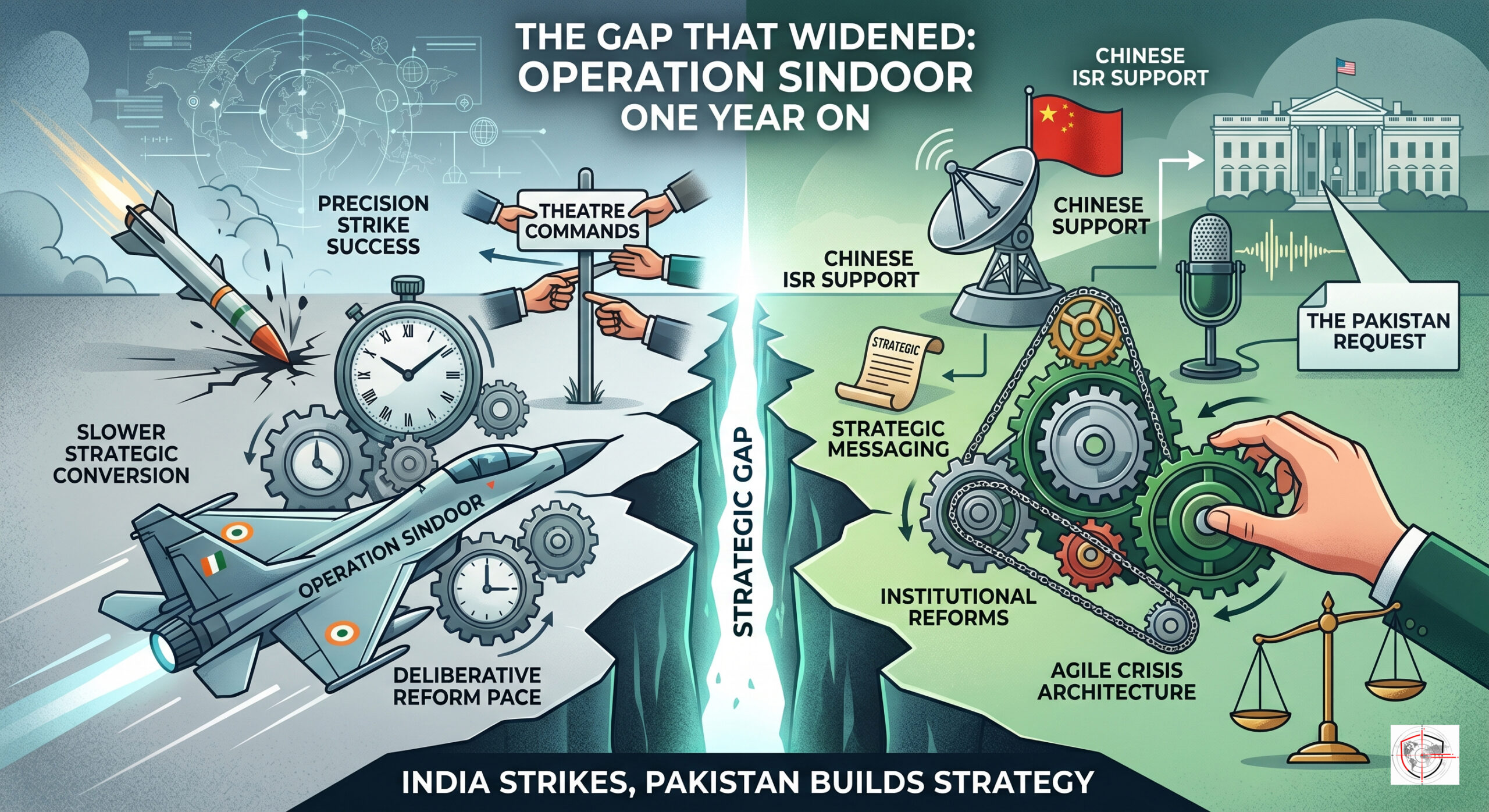
Operation Sindoor proved India can strike. One year on, it has not proven it can convert a strike into strategy.
Operation Sindoor proved India can strike. One year on, it has not proven it can convert a strike into a strategy.
By Meer Yassir Ahmed
There is a particular kind of strategic miscalculation that only becomes visible in retrospect. You execute the military operation cleanly. The jets return. The targets are confirmed. The ceasefire comes within days. And then, slowly, over weeks and months, you watch the political landscape settle into a shape that the military operation was meant to prevent, and you realise that the strike and the outcome were separate events, moving on separate tracks, toward separate conclusions.
That is the honest reckoning on the first anniversary of Operation Sindoor.
On May 7, 2025, Indian Air Force jets struck nine targets across Pakistan and Pakistan-occupied Kashmir with precision and competence. Within ninety-six hours, a ceasefire was in place. By most visible measurements, India had demonstrated what it needed to demonstrate. Pakistan’s Army chief was received at the White House within weeks. Months later, he promoted himself to field marshal. By the spring of 2026, that field marshal had become the principal foreign mediator for the United States in its war with Iran, with three separate Trump reversals on Iran publicly attributed to Pakistani requests in roughly six weeks.
India observed all of this from outside the channel.
The most honest test of any military operation is a single question: has the adversary’s strategic behaviour changed? One year after Sindoor, Pakistan’s support for cross-border terrorism continues as state policy. Its nuclear posture is unchanged. What has changed is the architecture surrounding that behaviour, and it has shifted entirely in Pakistan’s favour.
What twelve months built
Graham Allison, in his foundational study, The Essence of Decision, demonstrated that institutional structure determines outcome as much as military capability. The way a state organises its decision-making during a crisis, which channels operate, which coordination layers function, and how quickly information moves from intelligence to command is not background noise. It is the variable that separates states that convert military advantages into political outcomes from states that watch those advantages dissipate in the hours that matter most.
Pakistan read that lesson from Sindoor with a clarity and speed that demands acknowledgment.
Three institutional reforms, executed within twelve months, have rebuilt the architecture in which the next crisis will be fought. The 27th constitutional amendment, passed in November 2025, abolished the post of Chairman of the Joint Chiefs of Staff Committee and established a unified Chief of Defence Forces, consolidating multiple coordination layers into a single decision channel. The Army Rocket Force Command now unifies long-range strike assets, ballistic missiles, cruise missiles, and armed drone swarms under one authority, enabling coordinated multi-domain strikes within hours of crisis onset. The Defence Forces Headquarters institutionalised the narrative and messaging apparatus that defeated Indian communications during the attribution window of May 2025.
That attribution window is where the political war was lost. During the hours and days when perceptions of the crisis were being formed in Washington, Islamabad enabled over sixty engagements with American policymakers and media. India managed four. By the time Indian messaging reached the rooms that mattered, the conclusions were already hardening. Pakistan’s new institutional architecture is designed specifically to widen that gap in the next crisis to arrive in Washington’s information environment faster, with greater volume, and with clearer strategic framing than the adversary can contest.
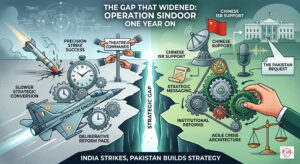
Pakistan spent the year building what May 2025 exposed as decisive: agile crisis architecture at the intersection of military command and political narrative. India spent the same year continuing the conversation about doing the same.
The reform that did not happen
The debate over the theatre commands has run for over two decades in India. Every successive review has produced the same analytical conclusion. Every political environment has prevented its execution. The structural authorisation chain that stretched India’s decision cycle from April 22 to May 7 during Sindoor intelligence validation, diplomatic preparation, inter-service planning, and external messaging, all proceeding through separate channels with no mechanisms for convergence, remains intact. The architecture that processed Sindoor in 2025 is the architecture that will process the next crisis, with the additional disadvantage that the adversary’s architecture has been rebuilt while ours has been preserved.
India’s long-range strike assets remain distributed across three services. A unified strike command for crisis-time coordination remains a proposal. A standing external engagement infrastructure for narrative management during crises remains absent.
The deeper problem is pace calibration. India’s reform timeline is calibrated to a peacetime political economy each reform debated on its own merits, weighed against ministerial equities, balanced against service interests, timed to electoral and budgetary cycles. Pakistan’s reforms were calibrated to a specific operational shortfall identified in real time. The Pakistani military identified what failed in May 2025, designed institutions to close the gap, and executed those institutions within the timeline available to a military establishment with constitutional entrenchment and single-channel command.
Two systems are processing the same strategic shock. One through deliberation. One through institutional consolidation.
The channel that now operates on the public record
Bruce Riedel, whose Deadly Embrace: Pakistan, America, and the Future of the Global Jihad remains the most operationally specific account of how Pakistan has managed American patronage through successive crises, documented the essential Pakistani strategic skill: the ability to position itself as indispensable to American objectives at precisely the moment when American pressure peaks. The skill has not diminished. It has found a new and more specific expression.
The “at Pakistan’s request” formulation has now stabilised as the rhetorical structure through which President Trump announces de-escalation in the US-Iran war. It was used three times in six weeks during spring 2026. In early April, Trump backed away from threats to destroy Iranian energy infrastructure, citing Field Marshal Munir and Prime Minister Sharif by name. On April 21, he extended the ceasefire with Iran hours before its expiry, again citing the same names. On May 5, he suspended Project Freedom, the active US naval operation to escort commercial shipping through the Strait of Hormuz, at Pakistani request, announcing it via Truth Social before his own Defence Secretary, Secretary of State, and Joint Chiefs chairman were informed.
Each reversal overrode the public position of senior American cabinet officers who had defended the contrary course hours earlier. The institutional system absorbed each contradiction in silence. The channel continued to deliver.
This is not a rhetorical cover for the decisions Trump was making independently. The channel operates through the alignment of Pakistani strategic preferences converging with Trump’s disposition toward face-saving exit at the moment of crisis, with the announcement structure available. The empirical record from Iran establishes both conditions. In any future India-Pakistan crisis, Munir’s task is to ensure the Pakistani request is on record at the moment Trump’s disposition turns toward exit. That moment, on the Iran record, arrives within days of crisis onset, well before Indian military effects have matured into political leverage.
General Munir commanded Pakistani forces during Sindoor. He is now a field marshal received at the White House, the principal foreign interlocutor for an American president on a regional war. The trajectory was built deliberately. Munir has a relationship with Trump. India has a relationship with the State Department.
The Iran confirmation
The US-Iran war has run the same structural logic at greater scale. America achieved rapid air superiority and struck thousands of targets. The strategic outcome remains inconclusive. A materially superior power produced operational dominance and strategic stalemate because Iran structured its forces to outlast its adversary’s political timeline rather than to defeat its military capability.
The pattern mirrors Sindoor precisely: tactical dominance by the stronger power, political outcomes shaped by the faster one.
One further detail from the Iran conflict sharpens the planning environment for any future India-Pakistan crisis. Iran’s strikes on American bases were enabled by a Chinese reconnaissance satellite acquired in 2024. China converted a weaker ally into a more precise one through intelligence, surveillance, and reconnaissance support, while keeping its own forces outside the conflict entirely. Pakistan will receive equivalent support in any future conflict with India in greater volume, with deeper integration, and with a People’s Liberation Army that has spent a decade building the specific architecture for standoff support to a treaty-adjacent partner. The Indian planner calculating Pakistani capabilities in isolation is calculating against a system that will arrive with Chinese augmentation.
The verdict at one year
The anniversary of Sindoor is not a celebration. It is a deadline.
The institutional conditions that produced the strategic shortfall in May 2025 remain intact. The conditions that allowed Pakistan to extract political benefit from a military exchange with India remain intact. The diplomatic gap between New Delhi and Washington’s decision-making core has not closed; it has widened and been demonstrated three times on the public record of a separate war.
The window in which Pakistani strategic patience holds is shorter than the window in which India’s institutional reform has been deliberating. The architecture Pakistan built this year is the architecture of a crisis it intends to initiate at a moment of its choosing, against an adversary whose decision cycle, narrative infrastructure, and diplomatic position have been allowed to deteriorate relative to May 2025.
Operation Sindoor demonstrated that India can strike with precision. The year since has demonstrated that precision without the institutional architecture to convert it into a political outcome is a capability that ends at the border, and the adversary has spent twelve months engineering exactly that limitation.
The first year after Sindoor was the year to close the gap. It was instead the year the gap widened. The second year, approached at the same pace, produces the same result on a worse field.
Go To Homepagehttp://theredlines.world
The Gap That Widened – 2026
The Gap That Widened – 2026
The Gap That Widened – 2026
The Gap That Widened – 2026
The Gap That Widened – 2026
The Gap That Widened – 2026
The Gap That Widened – 2026
The Gap That Widened – 2026
The Gap That Widened – 2026
The Gap That Widened – 2026
Operation Sindoor proved India can strike. One year on, it has not proven it can convert a strike into strategy.
Operation Sindoor proved India can strike. One year on, it has not proven it can convert a strike into strategy.
Operation Sindoor proved India can strike. One year on, it has not proven it can convert a strike into strategy.
About The Author